
Mantua
1740-1745 (made), 1875-1900 (altered)
| Artist/Maker | |
| Place of origin |
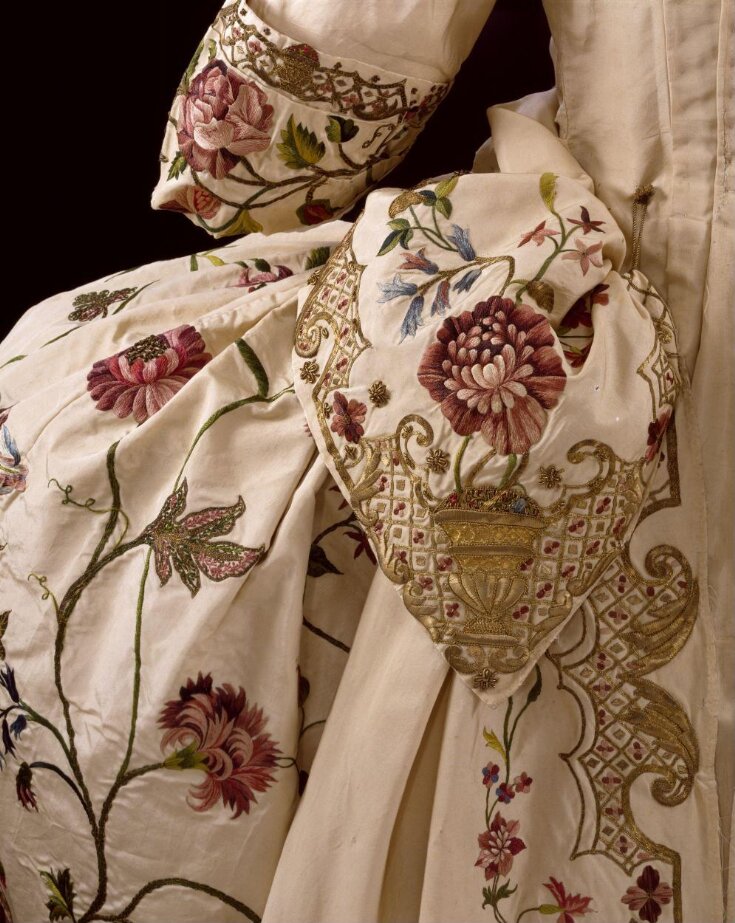
This ensemble of mantua and petticoat exemplifies court dress, the most formal of English 18th century clothing. Court dress was an exclusive and very ornate style of clothing worn by the aristocracy, the only people usually invited to attend at Court.
The embroidered skirt is open-fronted, and would have had extensive folds and pleats to flow into a long train at the back. The embroidered petticoat would have been visible at the front. It would have fastened at the back and been worn over large square hoops.
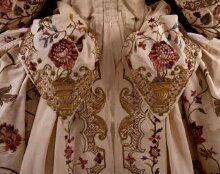
Leafy scrolls and vases, quintesssential Rococo motifs, are featured with a profusion of realistically rendered flowers. This ensemble recalls a garment worn by the Duchess of Queensbury in 1740: 'her cloathes were embroidered upon white satin; Vine leaves, Convulvus and Rosebuds shaded after Nature ...'. The mantua has been extensively altered, probably for fancy dress in the late 19th century.
The embroidered skirt is open-fronted, and would have had extensive folds and pleats to flow into a long train at the back. The embroidered petticoat would have been visible at the front. It would have fastened at the back and been worn over large square hoops.
Leafy scrolls and vases, quintesssential Rococo motifs, are featured with a profusion of realistically rendered flowers. This ensemble recalls a garment worn by the Duchess of Queensbury in 1740: 'her cloathes were embroidered upon white satin; Vine leaves, Convulvus and Rosebuds shaded after Nature ...'. The mantua has been extensively altered, probably for fancy dress in the late 19th century.
Object details
| Categories | |
| Object type | |
| Parts | This object consists of 5 parts.
|
| Materials and techniques | Embroidered silk with coloured silk and metal threads |
| Brief description | Court mantua composed of a gown and petticoat of embroidered silk with coloured silk and metal threads, England, 1740-1745 |
| Physical description | Court mantua composed of a gown and petticoat made of embroidered cream coloured silk with a design of large flowers sprouting from urns set in a border of swags and trellises. The ensemble has been extensively altered for fancy dress in the late 19th century. Silk hand sewn with 2 ply 'S' spun silk thread and embroidered with coloured silk and silver gilt threads, frisé, bullion and purl. |
| Dimensions |
|
| Style | |
| Production type | Unique |
| Credit line | Given by Miss Katharine Boyle |
| Object history | Historical significance: The size of the elements in the embroidery design indicates the early 1740s. The pleated cuff on the mantua is slightly old fashioned; the style of the late 1730s rather than the winged version seen in the 1740s. Displayed in the Costume Court, Gallery 40, 1962 to 1979 |
| Historical context | This ensemble represents court dress, the most formal of English 18th century dress. It would have been worn by a woman of aristocratic birth for attendance at court. |
| Subjects depicted | |
| Summary | This ensemble of mantua and petticoat exemplifies court dress, the most formal of English 18th century clothing. Court dress was an exclusive and very ornate style of clothing worn by the aristocracy, the only people usually invited to attend at Court. The embroidered skirt is open-fronted, and would have had extensive folds and pleats to flow into a long train at the back. The embroidered petticoat would have been visible at the front. It would have fastened at the back and been worn over large square hoops. Leafy scrolls and vases, quintesssential Rococo motifs, are featured with a profusion of realistically rendered flowers. This ensemble recalls a garment worn by the Duchess of Queensbury in 1740: 'her cloathes were embroidered upon white satin; Vine leaves, Convulvus and Rosebuds shaded after Nature ...'. The mantua has been extensively altered, probably for fancy dress in the late 19th century. |
| Bibliographic references |
|
| Collection | |
| Accession number | T.179 to C-1959 |
About this object record
Explore the Collections contains over a million catalogue records, and over half a million images. It is a working database that includes information compiled over the life of the museum. Some of our records may contain offensive and discriminatory language, or reflect outdated ideas, practice and analysis. We are committed to addressing these issues, and to review and update our records accordingly.
You can write to us to suggest improvements to the record.
Suggest feedback
You can write to us to suggest improvements to the record.
Suggest feedback
| Record created | December 10, 2002 |
| Record URL |
Download as: JSONIIIF Manifest
