Please complete the form to email this item.

Tuileries

  • Object:

    Evening dress and petticoat

  • Place of origin:

    Paris, France (made)

  • Date:

    1957 (made)

  • Artist/Maker:

    Castillo, Antonio, born 1908 - died 1984 (designer)
    Lanvin (designed for)

  • Materials and Techniques:

    Machine-sewn net on a boned foundation, net stiffened with nylon crin, sturdy grosgrain, satin ribbon trimming, stiffened net and gauze and silk taffeta

  • Credit Line:

    Given by Stella, Lady Ednam

  • Museum number:

    T.52&A-1974

  • Gallery location:

    Fashion, room 40, case CA12, shelf FIG4

  • Image in copyright

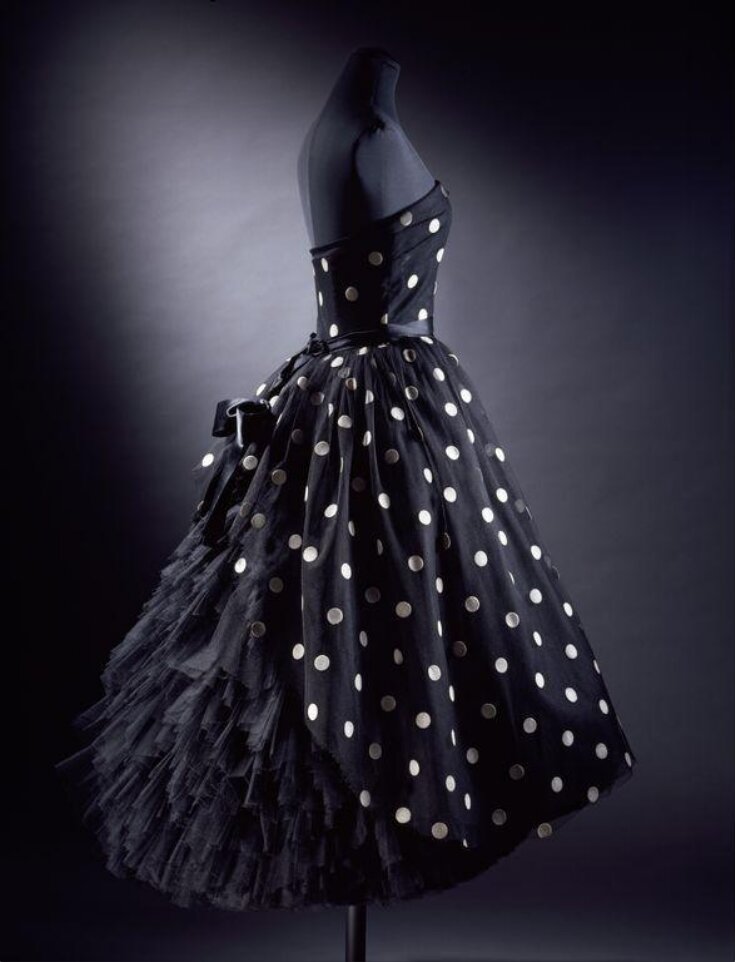
This evening dress and petticoat of black net with white polka dots was designed around 1957 by Lanvin-Castillo in Paris.

Physical description

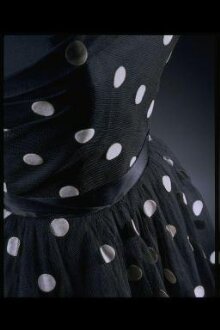
Short evening dress of black net with white felt spots, and petticoat of black silk taffeta and layers of stiffened net and gauze.
[Petticoat] Straight-lined waist petticoat of black silk taffeta and layers of stiffened net and gauze at the back.
[Evening dress] Black evening dress of net with white felt spots. The bodice is strapless with a corset-like boned foundation, and attached to a voluminous petticoat of layer upon layer of net stiffened with deep bands of nylon crin. The gathered black net frills give a bustle effect at the back. The overskirt is apron-like and is divided and cut away at the back. There is a waist-stay of sturdy grosgrain that fastened with substantial hooks and eyes to hold the petticoat in place. It has a black satin ribbon trimming around the waist and a side zip fastening.

Place of Origin

Paris, France (made)

Date

1957 (made)

Artist/maker

Castillo, Antonio, born 1908 - died 1984 (designer)
Lanvin (designed for)

Materials and Techniques

Machine-sewn net on a boned foundation, net stiffened with nylon crin, sturdy grosgrain, satin ribbon trimming, stiffened net and gauze and silk taffeta

Dimensions

Circumference: 74 cm Bust, Circumference: 60 cm Waist, Circumference: 59 cm Petticoat waist, Circumference: 220 cm Hem
[Petticoat] Length: 80 cm waist to hem
[Evening dress] Length: 97 cm neck to hem

Object history note

The evening dress was designed by Lanvin-Castillo,1957. It was worn and given by Stella, Lady Ednam. When displayed in the Cecil Beaton exhibition this dress was mistaken for a Balmain design and catalogued accordingly (38)

Historical context note

The Spanish-born designer Antonio del Castillo joined the long-established house of Lanvin in 1950, and from that date it became known as Lanvin-Castillo. Castillo was known for his evening gowns with tightly fitting bodices perched above spreading skirts. It reverted to the original name of Lanvin when Castillo left in the early 1960s to establish his own house.

"Other old established houses were rejuvenated by taking on new chief designers, such as Lanvin, which unusually was renamed Lanvin Castillo following the appointment of Antonio Canovas del Castillo in 1950. This very grand, luxurious establishment, arranged over six floors, had 600 employees and a mainly private clientele, and was described by Time magazine as the place where Parisiennes would go 'if they wanted to be sure they would not be mistaken for Americans'.” From Wilcox, C., 'Dior's Golden Age' in Wilcox, C., ed., The Golden Age of Couture: Paris and London 1947-57 (V&A Publications, London), p.46

Descriptive line

Evening dress of net and petticoat of silk taffeta and net, 'Tuileries', designed by Antonio Castillo for Lanvin, Paris, 1957.

Bibliographic References (Citation, Note/Abstract, NAL no)

Vogue (French), April 1957, p.107.
Photograph by Henry Clarke
Vickers, H., 'Cecil Beaton' in Wilcox, C., ed., The Golden Age of Couture: Paris and London 1947-57 (V&A Publications, London), p.166
Her [Ana Inez Astor] sister Stella ('Baby') Ednam gave part of the outfit in which she was married to Viscount Ednam (the present Earl of Dudley) in 1946 (T.46-1974). Balmain wrote in his autobiography, My Years and Seasons, that 'this was the first society marriage for which I designed the bride and bridesmaid's dresses'. She also gave another Balmain, a 1950 crimson velvet evening gown trimmed with sable,(T.48-1974) and a 1957 Lanvin Castillo polka-dot dress (T.52-1974).
Wilcox, C., 'Dior's Golden Age' in Wilcox, C., ed., The Golden Age of Couture: Paris and London 1947-57 (V&A Publications, London), pl.2.16
The Vogue image of the dress, 1957
Mendes, Valerie. Black In Fashion. London: V&A Publications, 1999.

Exhibition History

Black in Fashion (Victoria and Albert Museum 01/01/1999-31/12/1999)
The Little Black Dress (Victoria and Albert Museum 01/01/1983-31/12/1984)
The Golden Age of Couture. Paris and London 1947 - 1957 (Victoria and Albert Museum 22/09/2007-06/01/2008)
Fashion: an anthology by Cecil Beaton (Victoria and Albert Museum 01/01/1972-31/12/1972)

Labels and date

[Case panel]

Cocktail and Early Evening

Daywear was followed by formal afternoon dresses (robes après-midi habillées), cocktail dresses (robes de cocktail), semi-evening (robes demi-soir) and short evening dresses (robes du soir courtes). These distinctions became simpler as the decade progressed and social codes began to break down.

Cocktail dresses first appeared in the 1920s and gained a new popularity after the war. They were worn at early evening or ‘6 to 8’ gatherings, where guests usually stood and mingled. The gowns could include complex bustles and skirt details, which would be crushed if sat on.

In his book the Little Dictionary of Fashion (1954) Christian Dior described cocktail dresses as ‘elaborate and dressy afternoon frocks’, preferably in black taffeta, satin, chiffon and wool. These confections became the personification of the ‘little black dress’ and were often accessorised with gloves and small hats.

[Object label]
‘Tuileries’ cocktail dress (robe de cocktail)
Lanvin Castillo (Antonio del Castillo (1908–84))
Paris
1957

Several grand houses were rejuvenated by taking on new designers, though few changed their name. Lanvin had been established by Jeanne Lanvin in 1909 and became Lanvin-Castillo when the Spanish designer Antonio del Castillo was appointed as chief designer in 1950. This dress pays homage to flamenco. In a fashion feature in French Vogue it was accessorised with a lace mantilla.

Stiffened net and gauze, crêpe de Chine, silk and taffeta with felt polka dots

Given by Lady Stella Ednam
V&A: T.52&A-1974 [22/09/2007-06/01/2008]
EVENING DRESS, taffeta, spotted net and net
French, Paris, Lanvin-Castillo about 1958

The 1950s vogue for the puff-ball silhouette led to the development of underpinnings which almost rival those of the mid-19th century. Street clothes were held out by the '50s equivalent of crinolines - petticoats with channels containing plastic hoops or paper nylon or starched underskirts. However, couture clothes such as this extravagant, strapless evening dress had their own specially built petticoats.

In this playful Lanvin-Castillo design attention is focused on the back which forms an almost bustle-like protrusion. The petticoat falls straight at the front but behind has many layers of net and stiffening. The dress fastens over this and the top layer of net with large felt spots is curved up at the back to reveal the innumerable frills beneath. A double satin ribbon forms a sash and its plaited end with bow nestles in the black frills.

Worn and given by Stella, Lady Ednam.
The Cecil Beaton Collection
T.52&A-1974 [1983-84]

Production Note

Made for spring/summer 1957

Materials

Satin; Felt; Net; Grosgrain; Crepe de chine; Crin

Techniques

Machine sewing; Gathering

Subjects depicted

Dots

Categories

Fashion; Evening wear; Women's clothes

Production Type

Haute couture
[Evening dress] Haute couture

Collection code

T&F

Qr_O71739
Ajax-loader