
William Wytlesey's ring
Ring
ca. 1362-1374 (made)
ca. 1362-1374 (made)
| Artist/Maker | |
| Place of origin |
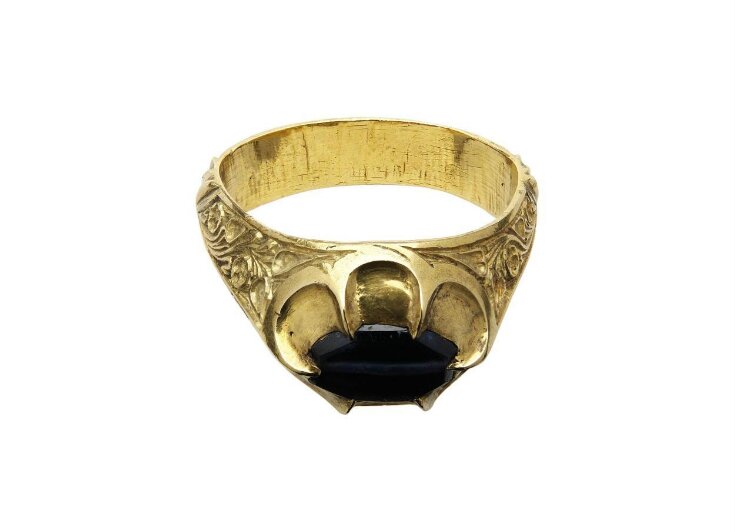
The name inscribed inside the hoop tells us that this ring belonged to William Wytlesey who was consecrated Bishop of Rochester in 1362. He was transferred to the See of Worcester in 1364, and was Archbishop of Canterbury between 1368 and his death in 1374. The ring is said to have been found in his tomb but may also have been preserved in the cathedral treasury. Bishops were given a 'pontifical' ring and a crozier as part of their investiture, symbolizing their spiritual and temporal powers but would also have owned personal rings. The ring and crozier played important symbolical roles - the crozier was based on the shape of a shepherd's crook and symbolised the bishop's role as a leader to his Christian flock. The ring could be understood as a sign of faith and commitment but in continental Europe, particularly in the Holy Roman Empire, it was used to show the spiritual marriage of the bishop and the Church. From the 10th century, the investiture ceremony, in which the bishop was consecrated, used the words 'Receive the ring, the sign of faith, so that, adorned with pure faith, you may preserve without harm, your bride, namely the holy church of God.'
It is still customary for a bishop to receive a ring at their consecration which is then worn as a symbol of office. St Isidore of Seville (died 636) explained that 'the ring is given to the Bishop at his consecration, as a mark of the Episcopal dignity, or as a seal of things hidden'. Around 1294, the Pontifical compiled by William Durandus for the diocese of Mende, France stated that 'the Ring being of gold and round, signifies perfection; being jewelled, the splendour of the Gifts of the Spirit, which Christ has received without measure.' The bishop's ring performed some of the same functions as a wedding ring. The twelfth century commentator Honorius of Autun stated that 'The bishop consequently bears a ring, that he may perceive himself as the bridegroom of the Church, and if it will have been necessary, lay down his life for her, like Christ.'
Bishops frequently chose sapphires for their official rings and of the 20 found in the graves of English medieval bishops, twelve are sapphires. Sapphires were believed to be particularly suited to bishops because of their heavenly colour. They were thought to expel envy, comfort the heart, detect fraud and witchcraft and obtain esteem from the wearer's lord. The hole drilled through the sapphire was believed to increased its power or 'virtue' but may also show that the sapphire was reused from an earlier piece of jewellery.
Although this ring may have been William Wytlesey's consecration ring, he is likely to have owned and worn a number of other jewels.
It is still customary for a bishop to receive a ring at their consecration which is then worn as a symbol of office. St Isidore of Seville (died 636) explained that 'the ring is given to the Bishop at his consecration, as a mark of the Episcopal dignity, or as a seal of things hidden'. Around 1294, the Pontifical compiled by William Durandus for the diocese of Mende, France stated that 'the Ring being of gold and round, signifies perfection; being jewelled, the splendour of the Gifts of the Spirit, which Christ has received without measure.' The bishop's ring performed some of the same functions as a wedding ring. The twelfth century commentator Honorius of Autun stated that 'The bishop consequently bears a ring, that he may perceive himself as the bridegroom of the Church, and if it will have been necessary, lay down his life for her, like Christ.'
Bishops frequently chose sapphires for their official rings and of the 20 found in the graves of English medieval bishops, twelve are sapphires. Sapphires were believed to be particularly suited to bishops because of their heavenly colour. They were thought to expel envy, comfort the heart, detect fraud and witchcraft and obtain esteem from the wearer's lord. The hole drilled through the sapphire was believed to increased its power or 'virtue' but may also show that the sapphire was reused from an earlier piece of jewellery.
Although this ring may have been William Wytlesey's consecration ring, he is likely to have owned and worn a number of other jewels.
Object details
| Categories | |
| Object type | |
| Title | William Wytlesey's ring (popular title) |
| Materials and techniques | Gold, chased, engraved; sapphire, drilled |
| Brief description | A gold ring set with a drilled octagonal sapphire, inscribed inside the hoop in black letter wllms wytlesey, England, 1362-1374 |
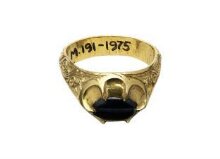
| Physical description | Ring: gold, sapphire. A gold ring with a six-cusped setting holding a drilled octagonal sapphire. The hoop is stirrup shaped, and the shoulders of the ring are chased with floral sprays, formerly enamelled. Inscribed inside the hoop in black letter wllms wytlesey [William Wytlesey]. |
| Dimensions |
|
| Style | |
| Marks and inscriptions | wllms wytlesey (Inscribed inside the hoop, in black letter)
|
| Credit line | Given by Dame Joan Evans |
| Object history | This ring was formerly part of the collection of Dame Joan Evans (1893-1977), art historian and collector. Early on she collected gems and jewels which resulted in the 1921 book, English Jewellery from the 5th Century BC to 1800. She published widely on jewellery, French medieval art and architecture. Evans was elected the first woman president of the Society of Antiquaries in 1959 (through 1964). She was a trustee of the British Museum (1963-67). In her personal life, she donated time and money to many charitable historic causes, nearly all of them anonymously. Her will left collections to the Ashmolean Museum, Oxford, and the Birmingham City Art Gallery. She gave her gem and jewellery collection to the Victoria and Albert Museum through a series of gifts, beginning in 1960. Her association with the museum went back to her childhood and she developed personal friendships with the museum curators and Directors. In 1975, two years before her death aged 84, Joan Evans made over her remaining jewels to the museum, choosing to remain anonymous during her lifetime. As she wrote jokingly to curator Charles Oman, her village was ‘divided into those who think it must have been me and those who say it cannot have been because I am so shabby.’ |
| Subject depicted | |
| Association | |
| Summary | The name inscribed inside the hoop tells us that this ring belonged to William Wytlesey who was consecrated Bishop of Rochester in 1362. He was transferred to the See of Worcester in 1364, and was Archbishop of Canterbury between 1368 and his death in 1374. The ring is said to have been found in his tomb but may also have been preserved in the cathedral treasury. Bishops were given a 'pontifical' ring and a crozier as part of their investiture, symbolizing their spiritual and temporal powers but would also have owned personal rings. The ring and crozier played important symbolical roles - the crozier was based on the shape of a shepherd's crook and symbolised the bishop's role as a leader to his Christian flock. The ring could be understood as a sign of faith and commitment but in continental Europe, particularly in the Holy Roman Empire, it was used to show the spiritual marriage of the bishop and the Church. From the 10th century, the investiture ceremony, in which the bishop was consecrated, used the words 'Receive the ring, the sign of faith, so that, adorned with pure faith, you may preserve without harm, your bride, namely the holy church of God.' It is still customary for a bishop to receive a ring at their consecration which is then worn as a symbol of office. St Isidore of Seville (died 636) explained that 'the ring is given to the Bishop at his consecration, as a mark of the Episcopal dignity, or as a seal of things hidden'. Around 1294, the Pontifical compiled by William Durandus for the diocese of Mende, France stated that 'the Ring being of gold and round, signifies perfection; being jewelled, the splendour of the Gifts of the Spirit, which Christ has received without measure.' The bishop's ring performed some of the same functions as a wedding ring. The twelfth century commentator Honorius of Autun stated that 'The bishop consequently bears a ring, that he may perceive himself as the bridegroom of the Church, and if it will have been necessary, lay down his life for her, like Christ.' Bishops frequently chose sapphires for their official rings and of the 20 found in the graves of English medieval bishops, twelve are sapphires. Sapphires were believed to be particularly suited to bishops because of their heavenly colour. They were thought to expel envy, comfort the heart, detect fraud and witchcraft and obtain esteem from the wearer's lord. The hole drilled through the sapphire was believed to increased its power or 'virtue' but may also show that the sapphire was reused from an earlier piece of jewellery. Although this ring may have been William Wytlesey's consecration ring, he is likely to have owned and worn a number of other jewels. |
| Bibliographic references |
|
| Collection | |
| Accession number | M.191-1975 |
About this object record
Explore the Collections contains over a million catalogue records, and over half a million images. It is a working database that includes information compiled over the life of the museum. Some of our records may contain offensive and discriminatory language, or reflect outdated ideas, practice and analysis. We are committed to addressing these issues, and to review and update our records accordingly.
You can write to us to suggest improvements to the record.
Suggest feedback
You can write to us to suggest improvements to the record.
Suggest feedback
| Record created | December 9, 2002 |
| Record URL |
Download as: JSONIIIF Manifest
