
Madhavchandra Giri (the Mahant)
Painting
ca. 1880 (made)
ca. 1880 (made)
| Artist/Maker | |
| Place of origin |
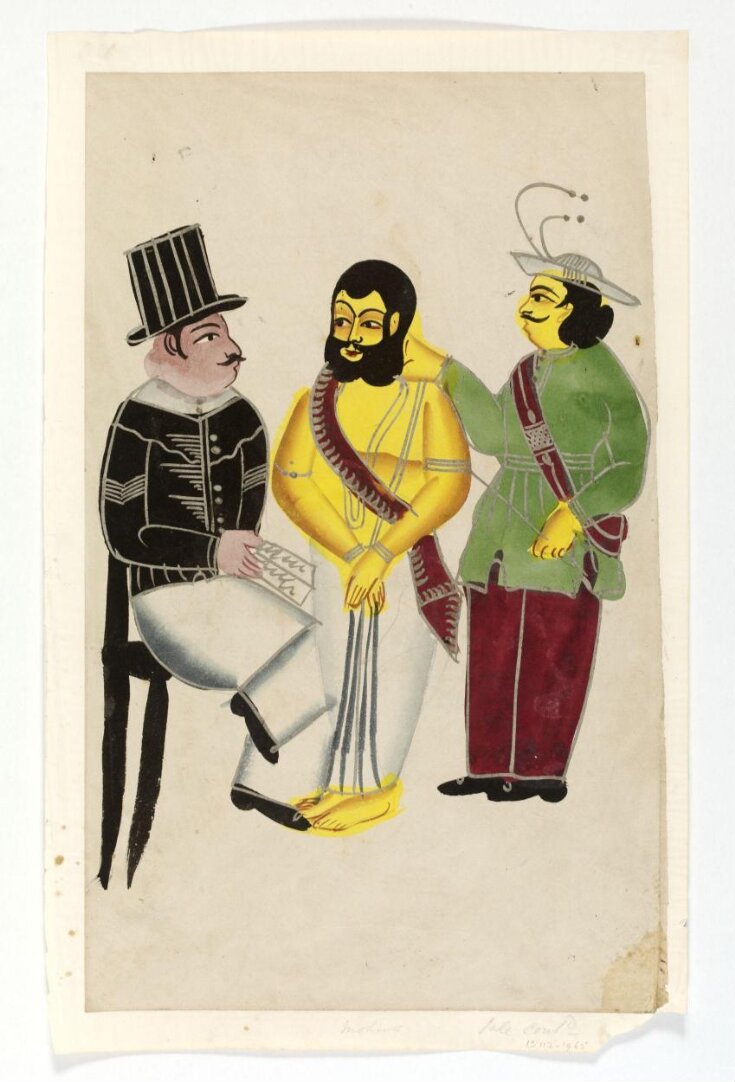
Painting, in watercolour and tin alloy on paper, an episode of the Tarakeshwar affair, the Mahant arriving in jail after his conviction, dressed only in a pleated dhoti and a shawl, he is roped to a jailer while standing before a fair-skinned jail superintendent. The Official sits in a black chair holding the Mahant's 'warrant of commitment' or conviction charges. His hairstyle, black coat with cut-away sides, white trousers and black shoes suggest the superintendent has a British or Anglo-Indian origin.
Object details
| Categories | |
| Object type | |
| Title | Madhavchandra Giri (the Mahant) (series title) |
| Materials and techniques | Painted in watercolour and tin alloy on paper |
| Brief description | Painting, Tarakeswar affair, Mahant arrives in jail, watercolour and tin alloy on paper, Kalighat, Kolkata, ca. 1880 |
| Physical description | Painting, in watercolour and tin alloy on paper, an episode of the Tarakeshwar affair, the Mahant arriving in jail after his conviction, dressed only in a pleated dhoti and a shawl, he is roped to a jailer while standing before a fair-skinned jail superintendent. The Official sits in a black chair holding the Mahant's 'warrant of commitment' or conviction charges. His hairstyle, black coat with cut-away sides, white trousers and black shoes suggest the superintendent has a British or Anglo-Indian origin. |
| Dimensions |
|
| Content description | The Mahant arriving in jail after his conviction. |
| Style | |
| Object history | The Tarakeshwar murder case of 1873 was a public scandal in Calcutta based on an affair between Elokeshi the young attractive wife of Nabinchandra Banerji and the mahant or chief priest of the Shiva temple at Tarakeshwar. Upon discovery of the affair, on 27 May 1873 her jealous husband Nabinchandra Banerji cut Elokeshi's throat with a fish knife. In the trial that followed Nabin was sentenced to life imprisonment and the Mahant was fined and imprisoned for 3 years. Different variations of this affair favouring the various characters occur in several Bengali plays and Kalighat images between 1875-80. See Archer p12. Purchased from Mrs K. Gregory. Historical significance: Calcutta was recognised as the Capital of British India from 1833-1912. By the 1830s, artists had arrived from rural villages in Bengal and began to produce paintings that reflected local history, mythology, customs and conflicts of a colonised society. As a popular art form, these artists are recognised for their use of brilliant colour, simplified images and swift brushstrokes that became the hallmark of Kalighat painting in the 19th and early 20th century. |
| Subjects depicted | |
| Bibliographic references |
|
| Collection | |
| Accession number | IS.112-1965 |
About this object record
Explore the Collections contains over a million catalogue records, and over half a million images. It is a working database that includes information compiled over the life of the museum. Some of our records may contain offensive and discriminatory language, or reflect outdated ideas, practice and analysis. We are committed to addressing these issues, and to review and update our records accordingly.
You can write to us to suggest improvements to the record.
Suggest feedback
You can write to us to suggest improvements to the record.
Suggest feedback
| Record created | December 4, 2002 |
| Record URL |
Download as: JSONIIIF Manifest
