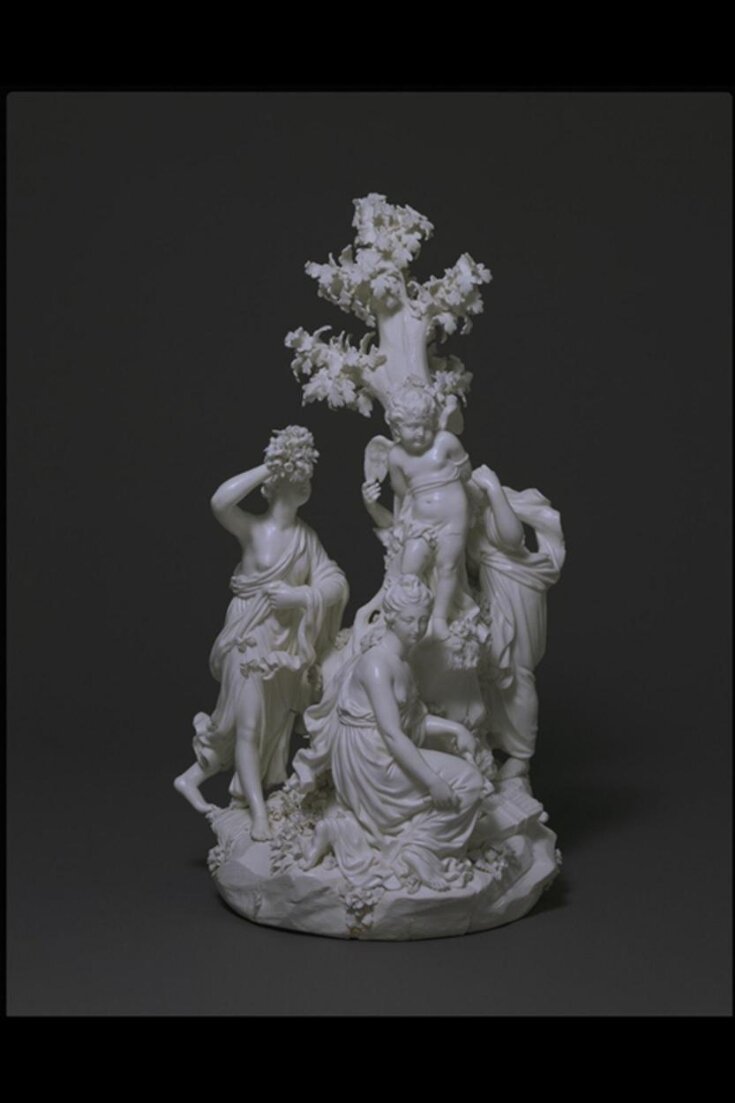
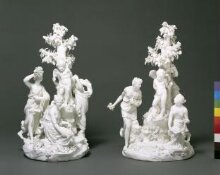
The Three Graces distressing Cupid
Figure Group
late 18th century (made)
late 18th century (made)
| Artist/Maker | |
| Place of origin |
The composition for this figure group was taken from a print. This was common practice with many of the more ambitious British porcelain figure models. Here the print was Etiam Amor Criminibus Plectitur ('Even Cupid is not alien to crime'). This engraving of 1777 by William Wynne Ryland reproduced a design by the painter Angelica Kauffmann. Ryland's engravings are listed in an inventory of prints owned by the Derby porcelain factory in 1791.
The Derby factory made two versions of this subject. The first was issued around 1782 and is a very skilful adaptation of a two-dimensional drawing to a three-dimensional figure. This second version is a much less skilful reworking of the subject. Derby's unglazed porcelain figure groups were advertised in 1773 as being 'particularly suited for the Embellishment of Desserts'.
The Derby factory made two versions of this subject. The first was issued around 1782 and is a very skilful adaptation of a two-dimensional drawing to a three-dimensional figure. This second version is a much less skilful reworking of the subject. Derby's unglazed porcelain figure groups were advertised in 1773 as being 'particularly suited for the Embellishment of Desserts'.
Object details
| Category | |
| Object type | |
| Parts | This object consists of 2 parts.
|
| Title | The Three Graces distressing Cupid (generic title) |
| Materials and techniques | Biscuit soft-paste porcelain, press-moulded, with smear-glaze and 'patch marks' |
| Dimensions |
|
| Credit line | Given by Mrs James, in memory of her son, George Brooksbank-James FRCS |
| Subjects depicted | |
| Summary | The composition for this figure group was taken from a print. This was common practice with many of the more ambitious British porcelain figure models. Here the print was Etiam Amor Criminibus Plectitur ('Even Cupid is not alien to crime'). This engraving of 1777 by William Wynne Ryland reproduced a design by the painter Angelica Kauffmann. Ryland's engravings are listed in an inventory of prints owned by the Derby porcelain factory in 1791. The Derby factory made two versions of this subject. The first was issued around 1782 and is a very skilful adaptation of a two-dimensional drawing to a three-dimensional figure. This second version is a much less skilful reworking of the subject. Derby's unglazed porcelain figure groups were advertised in 1773 as being 'particularly suited for the Embellishment of Desserts'. |
| Bibliographic references |
|
| Collection | |
| Accession number | C.59:1, 2-1924 |
About this object record
Explore the Collections contains over a million catalogue records, and over half a million images. It is a working database that includes information compiled over the life of the museum. Some of our records may contain offensive and discriminatory language, or reflect outdated ideas, practice and analysis. We are committed to addressing these issues, and to review and update our records accordingly.
You can write to us to suggest improvements to the record.
Suggest feedback
You can write to us to suggest improvements to the record.
Suggest feedback
| Record created | December 2, 2002 |
| Record URL |
Download as: JSONIIIF Manifest
