Wardrobe
1939 (made)
| Artist/Maker | |
| Place of origin |
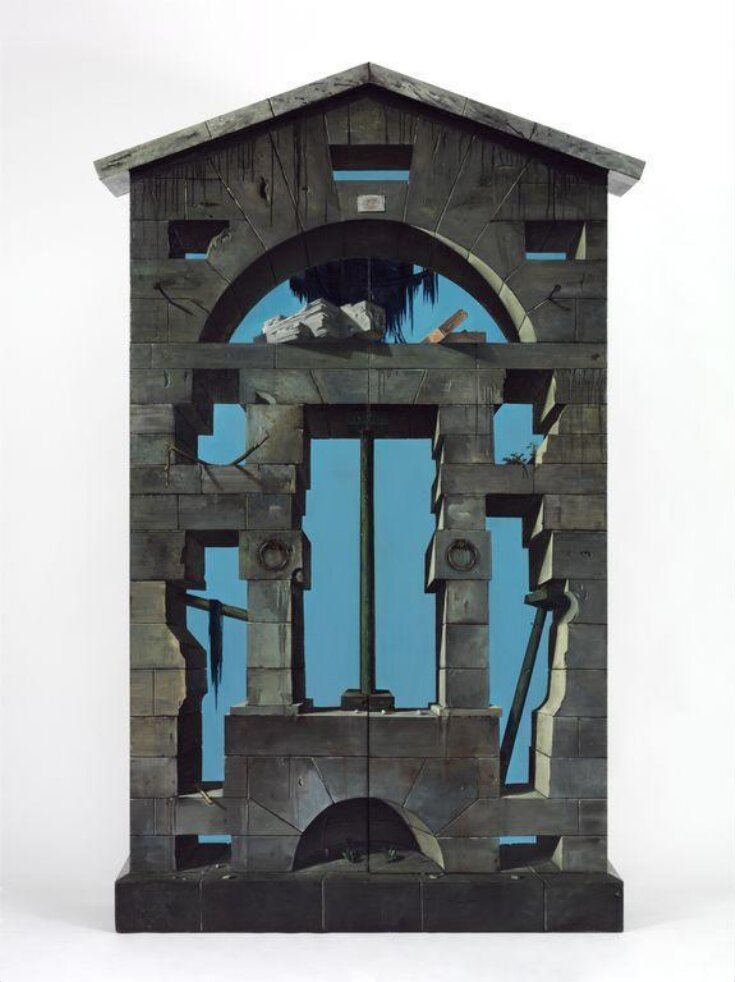
This wardrobe was shown at an exhibition of Surrealist art at the new Galerie Drouin in Paris in 1939. It was probably made for the exhibition. Although simple in form, it is monumental in scale. Its impact is heightened by the illusionism of the painting. The fantastical scene has a surreal and ominous nature and reflects Berman's interest in architecture as well as decay and destruction. Eugène Berman (1899-1972) worked principally as a painter, printmaker and stage designer, especially for ballet and opera. Furniture was not a major part of his work, and he did not attempt to engage with the functional complexities of furniture design itself. Instead, it was a means through which he could extend the illusionism of his painting into three dimensions.
Object details
| Categories | |
| Object type | |
| Parts | This object consists of 7 parts.
|
| Materials and techniques | Painted canvas on pine carcase |
| Brief description | Unique handpainted wardrobe by Eugene Berman, painted in trompe-l'œil effect, 1939 |
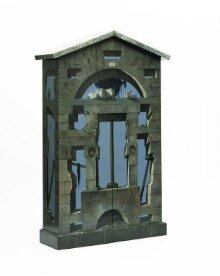
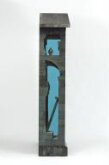
| Physical description | Berman’s simple wooden wardrobe is rectangular in shape with a peaked roof or pediment at the top. The roof overhangs the wardrobe slightly. The wardrobe is painted in oils on canvas to look like a stone archway. The painting wraps around the wardrobe forming a continuous image; the side panels, the front, and the roof are all painted. The back of the wardrobe is not painted. There are two identical circular metal door knocker style handles, one on each door. Two-thirds of the wardrobe opens, excluding the roof part. The two hinged doors are not identical but follow the motifs of the painting, and open outwards to reveal two cupboards. On one side there is a tiered-system of shelves and on the other a rail to hand larger garments. Above is a moon shaped (tympanum-like) shelf which can also be used for storage. The inside of the doors are painted blue; the inside of the cupboard is painted black. The wardrobe is simple in craftsmanship and design and although functional it is clear that the painting was meant to be the focus of the wardrobe. |
| Dimensions | H: 251cm, W: 147cm, D: 50cm (from 'Western Furniture', 1996, p.210) |
| Content description | Berman’s focus on architectural detail and his use of tromp l’oeil (a technique used in painting to create an illusion of space) is to give the illusion that the viewer is peering through a stone archway. The space between the arches is painted blue perhaps alluding to a blue sky. The stone work is predominantly grey and appears weathered and aged with cracks forming and plants growing from in between the stone work. An ominous black shape looms between the arch in the centre of the painting. On the panel on the left side of the wardrobe a single cracked vase rests on the stone work. The decaying and dilapidated nature of the scene is emphasised by wooden supports that appear to hold the stone work in place. The theatrical nature of the painting is evident in much of Berman’s work, particularly his set designs. In the centre of the wardrobe, above the archway, there is a keystone where Berman has painted his initials and the year. This is a signature that is common to many of Berman’s paintings and drawings. |
| Styles | |
| Production type | Unique |
| Marks and inscriptions | EB / 1939 (Signed on canvas in keystone on front of wardrobe (similar to signature on Berman paintings and drawings)) |
| Gallery label |
|
| Object history | Berman was born in St. Petersburg, Russia in 1889. He received training with an architect who worked in the Palladian tradition before going to study in Paris. “From the 1920s he was closely identified with a group of Parisian artists, mainly former fellow students, dubbed the ‘Neo-Romantic’ painters.” (Wilk, p. 230) “The architectural form and and subject matter of this cabinet relates directly to Berman’s training as well as to his intense study of buildings through travel and drawing, and his collecting of architectural books and prints. Berman clearly designed this cabinet specially for its decoration. Berman’s imagery suggests decay, destruction and the passing of time and may well have been related to when it was painted – on the eve of World War II. (Wilk, p. 230.) Calloway describes how Berman became fascinated with the forms of “decayed statuary” and goes on to suggest that the cabinet is “one of the greatest achievments of the Neo-Romantic impulse”. (Calloway, p. 115.) The wardrobe was most likely created for the exhibition at Galerie Drouin in 1939. “The gallery was the first commercial venture of a giant of the post-war American art world, Leo Castelli, and his partner, the designer Rene Drouin.” (Wood, p. 41) “However, the exhibition was soon overshadowed by the war and quickly forgotten. The Galerie Drouin exhibition marked the height of a symbiotic relationship between fashion and surrealism. The event revealed a little-studied world of Surrealist artists designing objects, and emphasised the importance that personal relationships played in the creation of a wider surrealist aesthetic. The social scene of Paris itself promoted the swift transmission of ideas.” (Wood, p. 42) “Tromp l’oeil in particular occupied an increasingly important role in Berman’s ouvre” (Callowayp. 116.) |
| Production | Reason For Production: Exhibition |
| Summary | This wardrobe was shown at an exhibition of Surrealist art at the new Galerie Drouin in Paris in 1939. It was probably made for the exhibition. Although simple in form, it is monumental in scale. Its impact is heightened by the illusionism of the painting. The fantastical scene has a surreal and ominous nature and reflects Berman's interest in architecture as well as decay and destruction. Eugène Berman (1899-1972) worked principally as a painter, printmaker and stage designer, especially for ballet and opera. Furniture was not a major part of his work, and he did not attempt to engage with the functional complexities of furniture design itself. Instead, it was a means through which he could extend the illusionism of his painting into three dimensions. |
| Bibliographic references |
|
| Collection | |
| Accession number | W.27:1 to 7-1987 |
About this object record
Explore the Collections contains over a million catalogue records, and over half a million images. It is a working database that includes information compiled over the life of the museum. Some of our records may contain offensive and discriminatory language, or reflect outdated ideas, practice and analysis. We are committed to addressing these issues, and to review and update our records accordingly.
You can write to us to suggest improvements to the record.
Suggest feedback
You can write to us to suggest improvements to the record.
Suggest feedback
| Record created | November 29, 2002 |
| Record URL |
Download as: JSON
