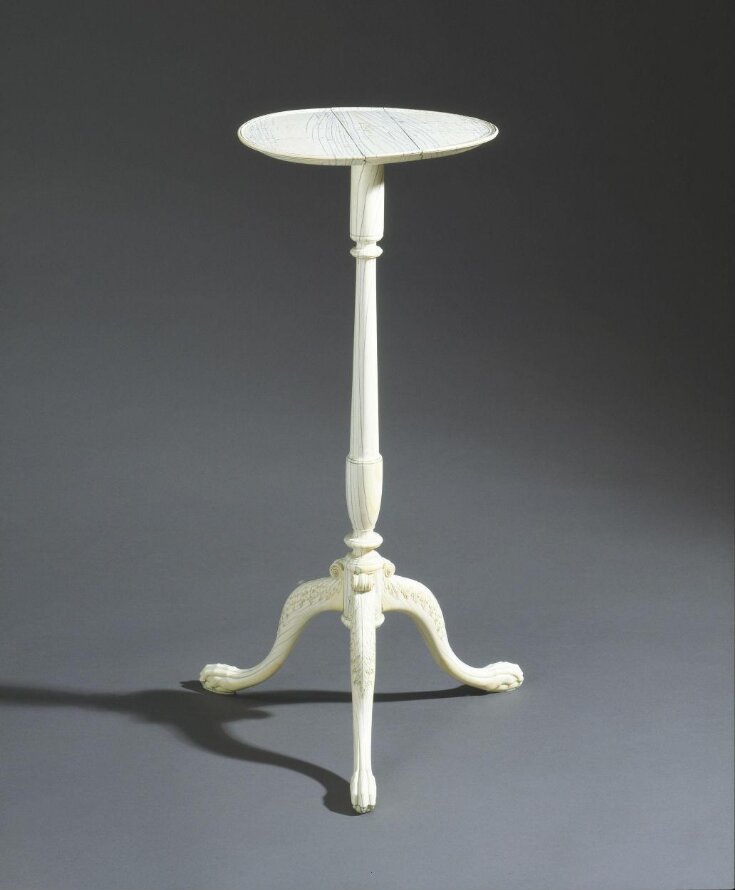
Candlestand
ca. 1790 (made)
| Artist/Maker | |
| Place of origin |
The word teapoy comes from the Hindi 'tin' 'pai', meaning 'three leg' or tripod. In British India tripod tables and small pillar tables in general were known as teapoys. Furniture makers copied the teapoy's form directly from the European candlestand. People used teapoys mainly as stands for candles and candle shades, although illustrations show that they were sometimes also used as a hookah stand. In Britain, the term teapoy was mistakenly linked with tea. The British began to use it to describe a small pillar table incorporating a caddy or chest fitted for the storage and consumption of tea.
Object details
| Categories | |
| Object type | |
| Materials and techniques | Solid ivory, turned, carved and partly gilded |
| Brief description | Candlestand or 'teapoy' (tripod table), solid ivory, turned, carved and partly gilded. |
| Physical description | Candlestand, solid ivory, turned, carved and partly gilded. Has a small table on a pillar stand with three legs, each with a clawed foot. |
| Dimensions |
|
| Credit line | Given by the 5th Earl Amherst of Arracan |
| Object history | In British India tripod tables - and small pillar tables in general - were known as 'teapoys' from the Hindi 'tin' 'pai', literally 'three leg' or tripod. |
| Subject depicted | |
| Summary | The word teapoy comes from the Hindi 'tin' 'pai', meaning 'three leg' or tripod. In British India tripod tables and small pillar tables in general were known as teapoys. Furniture makers copied the teapoy's form directly from the European candlestand. People used teapoys mainly as stands for candles and candle shades, although illustrations show that they were sometimes also used as a hookah stand. In Britain, the term teapoy was mistakenly linked with tea. The British began to use it to describe a small pillar table incorporating a caddy or chest fitted for the storage and consumption of tea. |
| Bibliographic reference | Luxury goods from India : the art of the Indian cabinet maker / Amin Jaffer. London: V&A Publications, 2002 Number: 1851773819
pp.86-87, ill. |
| Collection | |
| Accession number | IS.12-1991 |
About this object record
Explore the Collections contains over a million catalogue records, and over half a million images. It is a working database that includes information compiled over the life of the museum. Some of our records may contain offensive and discriminatory language, or reflect outdated ideas, practice and analysis. We are committed to addressing these issues, and to review and update our records accordingly.
You can write to us to suggest improvements to the record.
Suggest feedback
You can write to us to suggest improvements to the record.
Suggest feedback
| Record created | November 29, 2002 |
| Record URL |
Download as: JSONIIIF Manifest
