
Rosemunde
Print
1934 (printed)
1934 (printed)
| Artist/Maker | |
| Place of origin |
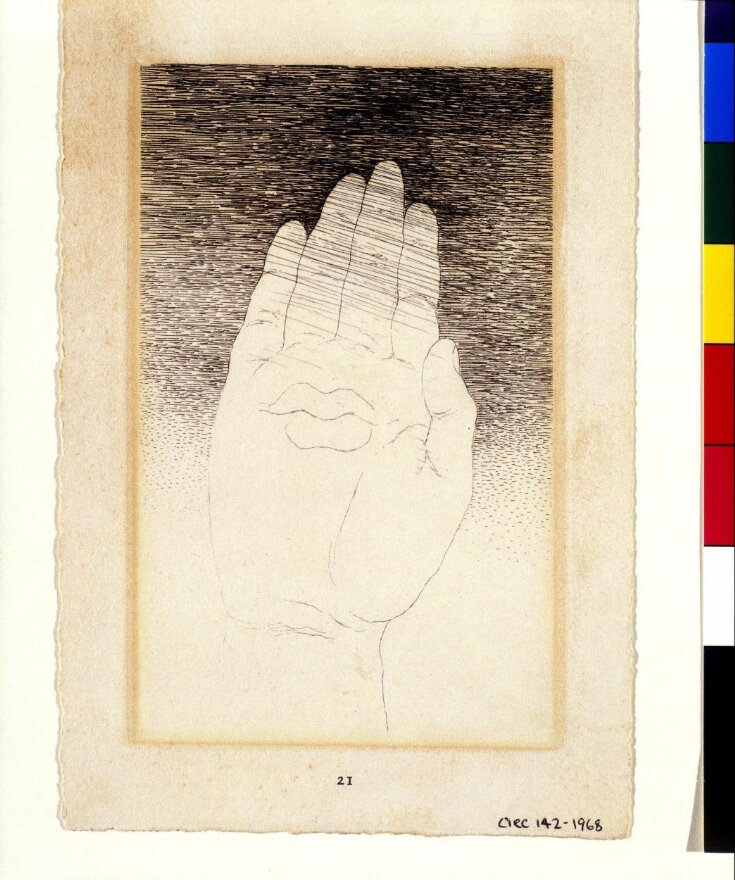
Louis Marcoussis (1878-1941) was affiliated with the Cubist movement, but like many of his peers worked in a style that moved freely between Cubism and Surrealism. He was a close friend of the poet Guillaume Apollinaire, who was, as Apollinaire's biographer Oliver Bernard points out, 'the first writer to understand what the Cubists were up to'. His illustrations of Apollinaire's collected works, Alcools, were made after Apollinaire's death, a tribute to the memory of his friend. This image illustrates a silent farewell to a beautiful woman, whom the poet never met, but followed through the streets for two hours until she disappeared into a house.
Object details
| Categories | |
| Object type | |
| Titles |
|
| Materials and techniques | printer's ink, paper, etching |
| Brief description | By Louis Marcoussis: 'Rosemunde', plate 21 of 34 illustrations for 'Alcool', the collected poems of Guillaume Apollinaire. Etching, 1934 |
| Physical description | Etching print on paper. A hand is palm up with lips added to it. |
| Dimensions |
|
| Style | |
| Production type | Proof |
| Copy number | Plate 21, illustrating the line 'Mes doigts jeterent des baisers' (Kisses flew up from my fingers), from the suite of 34, plus title page etc, illustrating 'Alcools', the collection of poems by Guillaume Apollinaire |
| Credit line | Acquired from Obelisk Gallery, London in 1968 |
| Production | The suite was printed by the artist on the press of the Académie Moderne, Paris, but was not published. Attribution note: the number of the print within the suite, 21, is printed in letterpress beneath the image. |
| Subjects depicted | |
| Literary reference | Alcools.The collected poems of Guillaume Apollinaire. 1934 |
| Summary | Louis Marcoussis (1878-1941) was affiliated with the Cubist movement, but like many of his peers worked in a style that moved freely between Cubism and Surrealism. He was a close friend of the poet Guillaume Apollinaire, who was, as Apollinaire's biographer Oliver Bernard points out, 'the first writer to understand what the Cubists were up to'. His illustrations of Apollinaire's collected works, Alcools, were made after Apollinaire's death, a tribute to the memory of his friend. This image illustrates a silent farewell to a beautiful woman, whom the poet never met, but followed through the streets for two hours until she disappeared into a house. |
| Bibliographic references |
|
| Other number | 21 - Plate number |
| Collection | |
| Accession number | CIRC.142-1968 |
About this object record
Explore the Collections contains over a million catalogue records, and over half a million images. It is a working database that includes information compiled over the life of the museum. Some of our records may contain offensive and discriminatory language, or reflect outdated ideas, practice and analysis. We are committed to addressing these issues, and to review and update our records accordingly.
You can write to us to suggest improvements to the record.
Suggest feedback
You can write to us to suggest improvements to the record.
Suggest feedback
| Record created | November 28, 2002 |
| Record URL |
Download as: JSONIIIF Manifest
