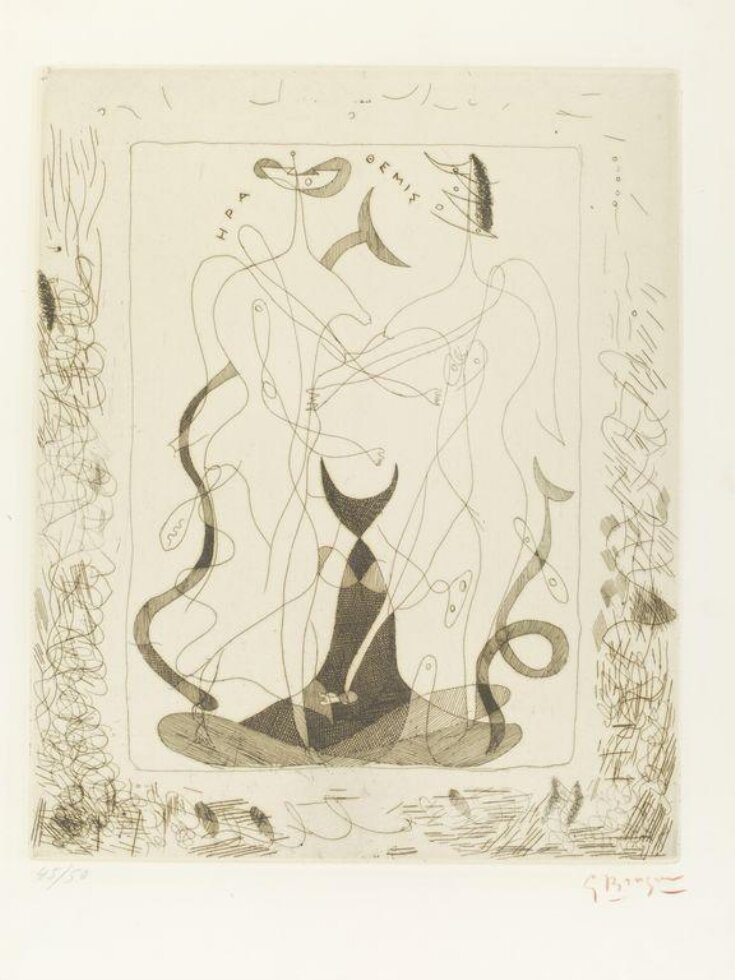


Hera et Themis
Print
1932-1939 (printed)
1932-1939 (printed)
| Artist/Maker | |
| Place of origin |
During the 1930s classical art and literature played an important role in the work of artists and writers throughout Europe, and especially in Paris, the cultural capital of the age. The interest Georges Braque (1882-1963) had in classical culture developed into something of an obsession, and when he was approached by the famous publisher Ambroise Vollard to illustrate a book, Braque chose Hesiod's Theogony. The story, as the title implies, revolves around the creation of the world through endless pairings and battles between the gods, two of which are seen here. The suite of prints is characterised by a linear style inspired by images found on very early Greek and Etruscan terracottas and bronzes.
Object details
| Categories | |
| Object type | |
| Title | Hera et Themis (assigned by artist) |
| Materials and techniques | Etching on paper |
| Brief description | Georges Braque Hera and Themis :illustration to Hesiod's Theogony. 1932-1939 |
| Physical description | print on paper |
| Dimensions |
|
| Styles | |
| Production type | Limited edition |
| Copy number | 45/50. One plate from a suite of 16 illustrations to Hesiod's Théogonie |
| Marks and inscriptions |
|
| Production | The exact date of the printing of Hera and Themis is uncertain, although it is thought to have been among the earlier releases of the group. Plates for the entire suite had been completed by Braque by 1932, but Galanis worked very slowly; although there is evidence that some plates had been produced by 1936, Galanis did not complete the printing of the suite until 1939. Attribution note: This impression is from the first edition. The suite was published as a book, with the plates trimmed of the remarques, by Editions Maeght in Paris, 1955. |
| Subjects depicted | |
| Association | |
| Literary reference | Hesiod: Theogony |
| Summary | During the 1930s classical art and literature played an important role in the work of artists and writers throughout Europe, and especially in Paris, the cultural capital of the age. The interest Georges Braque (1882-1963) had in classical culture developed into something of an obsession, and when he was approached by the famous publisher Ambroise Vollard to illustrate a book, Braque chose Hesiod's Theogony. The story, as the title implies, revolves around the creation of the world through endless pairings and battles between the gods, two of which are seen here. The suite of prints is characterised by a linear style inspired by images found on very early Greek and Etruscan terracottas and bronzes. |
| Bibliographic references |
|
| Collection | |
| Accession number | CIRC.102-1949 |
About this object record
Explore the Collections contains over a million catalogue records, and over half a million images. It is a working database that includes information compiled over the life of the museum. Some of our records may contain offensive and discriminatory language, or reflect outdated ideas, practice and analysis. We are committed to addressing these issues, and to review and update our records accordingly.
You can write to us to suggest improvements to the record.
Suggest feedback
You can write to us to suggest improvements to the record.
Suggest feedback
| Record created | November 28, 2002 |
| Record URL |
Download as: JSON
