Reliquary
ca. 1490-1500 (made)
| Artist/Maker | |
| Place of origin |
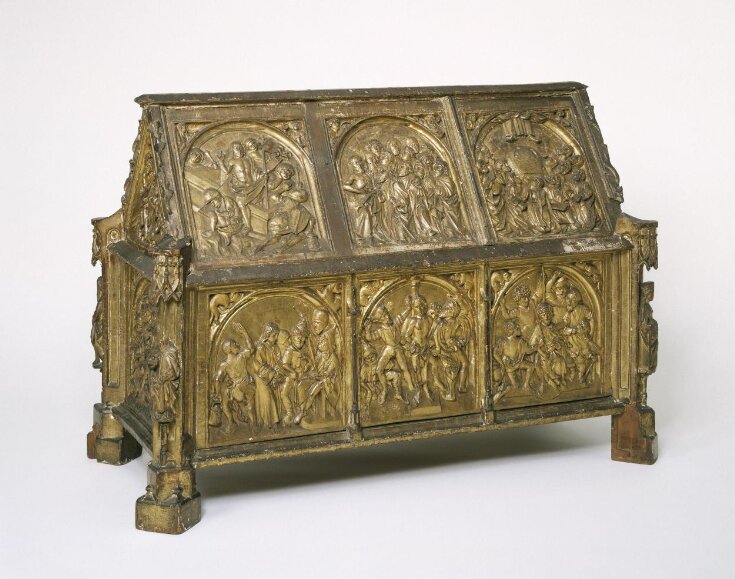
A reliquary is a container for keeping holy relics safe. Relics, the physical remains of saints or of items associated with them, are venerated in the Christian tradition. The triangular-sectioned lid here is removable, allowing access to the relics. This reliquary is supposed to have held the relics of St Boniface (born about 675, died about 755). He was an English saint and martyr who preached the Gospel to the heathen tribes of Germany and the Low Countries. This reliquary is in the form of a house-shaped shrine. It depicts 16 scenes from the Passion of Christ. Various animals, scrolls, prophets, angels and saints decorate the carved reliefs. Originally the reliquary had pinnacles at each corner and a cresting. Given its age, it is remarkable that most of the original gilding survives.
This reliquary is said to come from the church of the Franciscans at Constance. This is a very ancient town with a long ecclesiastical history, situated on the river Rhine in southern Germany. The carvings are similar to others that survive in the town. Several of them derive from engravings by Martin Schongauer (born about 1435-1450, died 1491), which he published between about 1470 and 1490.
This reliquary is said to come from the church of the Franciscans at Constance. This is a very ancient town with a long ecclesiastical history, situated on the river Rhine in southern Germany. The carvings are similar to others that survive in the town. Several of them derive from engravings by Martin Schongauer (born about 1435-1450, died 1491), which he published between about 1470 and 1490.
Object details
| Categories | |
| Object type | |
| Materials and techniques | Carved limewood, gilded |
| Brief description | German late 15th century |
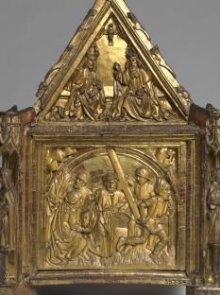
| Physical description | This reliquary, in the form of a house-shaped shrine, depicts sixteen scenes of the Passion in relief. These are placed on each of the longer sides, one on the small sides of both ends, six more on the sloping sides of the roof, and two on the gables. The sequence of the reliefs begins with three scenes on one of the longer sides: 1. Entry into Jerusalem, 2. The Last Supper, 3. The Agony in the Garden and continues on the small side with 4. The Taking of Christ, and on the other longer side with 5. Christ before Annas, 6. The Flagellation, 7. The Crowning with Thorns, and on the end with 8. The Bearing of the Cross. The narrative continues on the roof of the shrine with 9. Christ in Distress, 10. The Crucifixion, 11. The Entombment, then on the small side gable with 12. Christ in Limbo, and continues on the other side of the roof with 13. The Resurrection, 14. The Incredulity of St Thomas, 15. The Ascension of Christ, and concludes on the small-side gable with 16. The Trinity. All the reliefs are surmounted by a semi-circular arch. The spandrels contain crouching dogs, except the third scene which shows a monkey and an ibex, and the ninth scene which depicts a lion on the left side. The spandrels above scenes 9, 10 and 11 are decorated with foliated scrolls, while those of The Resurrection, The Incredulity of Thomas and The Ascension show the Two Maries, two prophets and two angels respectively. Standing under canopies are an angel, a prophet, St Stephen and St Catherine.The reliquary shrine consists of a rectangular container and triangular-sectioned lid which is removable. It is completely gilded on the outside; only the pupils, lips and eye-lids are painted black. The container comprises four panels along the sides, and one forming the bottom. The carved scenes on the four panels were carved integrally with their mouldings; the mouldings at the top are carved separately. Carved columns are attached at each corner, each with a figure attached, standing on a console, and with a canopy above. Holes drilled into the tops of each canopy show the original positions of the lost pinnacles. The moulding on top has five holes into which were fixed a now-lost cresting; the moulding with foliate scrolls surmounting the gables is carved separately. The head of the figure of St Stephen and the hands of the angel, are missing. The crockets of the triangular gables at each end are damaged. Most of the original gilding has been preserved, but is slightly damaged. |
| Dimensions |
|
| Gallery label |
|
| Object history | Provenance: Said to have come from the church of the Franciscans at Constance (Bammeville sale, catalogue cited below, lot 174; Robinson 1857, p. 9). The foundation attached to this church was dissolved on the 13 April 1808, and was converted into barracks in 1811, and the church was used from 1819 until 1844 as a drill-hall (Schmid 1978, p. 265-66). The premises were later employed as a school and as the Town Hall (Stengele 1889, p. 99). The reliquary was first recorded in the Castell collection, Constance (Catalogue Constance 1839 p. 1, no. 4: "Das schöne Kästchen, ringsum mit Basreliefs geschnitten, und vergoldet, welches bei der in diesem Hause 1417 gehaltenen Papstwahl als Scrutinium diente" (The beautiful casket with carved and gilded reliefs which served in this house in 1417 as a ballot box for the election of the Pope). The Castell collection was exhibited in Constance from about 1824-72, and the reliquary was shown with the title "Das Konstanzer Konzil" (The Constance Council [1414-18]) (Konrad 1993, p. 160). It entered the collection of a certain E.J. de Bammeville (location unknown) at an unknown date, and was sold in London in 1854 (Bammeville sale, London, Sotheby & Wilkinson, 13 May 1854, lot 174, bought for £37). I am grateful to the late Clive Wainwright for this information). Historical significance: Although the shrine was thought to date from the fourteenth century before it entered the Museum, Robinson (1857, p. 9) correctly identified it as a work of the late fifteenth century. Pollen (1874, p. 24) associated the present shrine with "Southern Germany or Switzerland ... the excellence of the modelling is equal to the finest work that could be found in Bavaria, or amongst the immediate predecessors of Holbein". This was the last occasion on which the present piece was published. The following reliefs are based on engravings by Martin Schongauer (about 1430- 1491): 3-7, 8, 9-13, (Bartsch 1980, pp. 222-226, 229-233,16-20). Not surprisingly, the stylistic features may be compared with carvings in Constance, for instance the Scenes of the Life of Christ of the door of the main portal, dated 1470, and the figurative reliefs of the choirstalls of the Minster in Constance of about 1466-71, probably executed by the workshop of Heinrich Iselin, who was active in Constance from about 1466 to 1513 (Reiners 1955, pp. 345-370, figs. 307-10, 315-317, 325-6). As most of Schongauer's engravings were produced between about 1470 and 1490 (Exh. Colmar 1991, p. 244) this would seem to be the approximate date for 357-1854. A reliquary shrine of St Hippolytus in gilded wood, preserved in the parochial church of St Pilt (Alsace), now on loan to the Musée d'Unterlinden in Colmar (Heck/Moench, 1984, pp. 38-39), shows a similar, but less elaborate architecture with painted figures of Christ and the Apostles after Schongauer (fig.*). For the latter a date of about 1486 has been suggested because of the presence of the coats of arms of René, Duke of Lorrain and Philippine of Gelderland-Egmont, who married in that year. |
| Subjects depicted | Trinity, Doctrine in Christianity Christianity House Dog Monkey Ibex Lion Leaf Scroll Prophet Angel Column Jesus Christ Thomas (Saint) Annas Stephen (Saint) Catherine (Saint Catherine of Alexandria) Christ's Entry Into Jerusalem The Last Supper The Agony in the Garden The Betrayal of Christ Christ Before Annas The Flagellation The Crowning With Thorns The Bearing of the Cross Christ in Distress The Crucifixion The Entombment Christ in Limbo The Resurrection The Doubting of Thomas The Ascension |
| Summary | A reliquary is a container for keeping holy relics safe. Relics, the physical remains of saints or of items associated with them, are venerated in the Christian tradition. The triangular-sectioned lid here is removable, allowing access to the relics. This reliquary is supposed to have held the relics of St Boniface (born about 675, died about 755). He was an English saint and martyr who preached the Gospel to the heathen tribes of Germany and the Low Countries. This reliquary is in the form of a house-shaped shrine. It depicts 16 scenes from the Passion of Christ. Various animals, scrolls, prophets, angels and saints decorate the carved reliefs. Originally the reliquary had pinnacles at each corner and a cresting. Given its age, it is remarkable that most of the original gilding survives. This reliquary is said to come from the church of the Franciscans at Constance. This is a very ancient town with a long ecclesiastical history, situated on the river Rhine in southern Germany. The carvings are similar to others that survive in the town. Several of them derive from engravings by Martin Schongauer (born about 1435-1450, died 1491), which he published between about 1470 and 1490. |
| Bibliographic references |
|
| Collection | |
| Accession number | 357-1854 |
About this object record
Explore the Collections contains over a million catalogue records, and over half a million images. It is a working database that includes information compiled over the life of the museum. Some of our records may contain offensive and discriminatory language, or reflect outdated ideas, practice and analysis. We are committed to addressing these issues, and to review and update our records accordingly.
You can write to us to suggest improvements to the record.
Suggest feedback
You can write to us to suggest improvements to the record.
Suggest feedback
| Record created | November 26, 2002 |
| Record URL |
Download as: JSONIIIF Manifest
