| Categories | |
| Object type | |
| Title | The Queen Elizabeth Virginal
(popular title) |
| Materials and techniques | Cypress case, soundboard and jacks; decorated with parchment, gilding, painting and inlay |
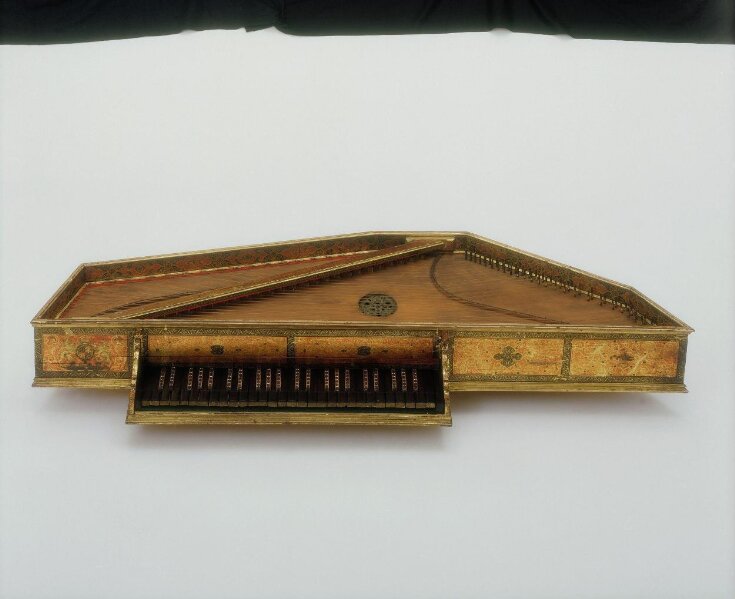
| Brief description | The Queen Elizabeth Virginal, painted cypress wood case and soundboard, ebony and bone certosina keys, by Giovanni Baffo(?), Venice, Italy, c1570. |
| Physical description | Virginal, Painted cypress wood case and soundboard, parchment rosette, ebony and bone certosina keys. |
| Dimensions | - Length: 190cm
- Width: 40.4cm
- Depth: 19cm
dimensions slightly revised 08/01 when object in cons studio (previously measured through wrapping at BH) |
| Marks and inscriptions | 1594 (This inscription is scratched on a blue paint layer abvoe the far righth end of the jackrail. It was descovered in 2002 by Nanke Schellmann, V&A Furniture Conservation.)
|
| Gallery label | - Queen Elizabeth's Virginals
Italian (Venice); about 1570
Cypress wood with gilt and painted decoration; the outer case (not shown) covered in crimson velvet with japanned inner faces, probably English about 1670
19-1887
This instrument, in fact a spinet, bears the Tudor royal arms and the badge of Anne Boleyn, a crowned falcon, also used by Queen Elizabeth. It bears strong resemblances to a spinet by Benedetto Floriano of Venice, dated 1571, now in Leipzig. The spinet is thus likely to have been made for Queen Elizabeth whom Sir James Melville heard play "excellently well" in 1564. The case is decorated in the moresque style which originated in Venice and was fashionable all over Europe from about 1530. A plate from the second book of Balthasar Sylvius, Maurusias (1554) is a typical example of moresque.
(c1990)
- British Galleries:
The painter decorated this spinet with the Queen's devices, including the falcon, the sceptre and the royal coat of arms. Elizabeth inherited the sceptre symbol from her mother, Anne Boleyn (about 1501-1536). Several contemporaries recorded that she was an excellent keyboard player and it is possible that she played on this very instrument. The painting illustrated shows Elizabeth dancing with Robert Dudley, 1st Earl of Leicester (about 1532-1588).(27/03/2003)
|
| Credit line | Purchased from Revd Nigel W. Gresley, Milbourne St Andrew, Blandford, Dorset |
| Object history | Purchased 'much worn and damaged' in 1887 for £125 from Revd Nigel W. Gresley, Milbourne St Andrew, Blandford, Dorset.
By 1619 the instrument was in the possession of Richard Connock (1554-1620), son of John Connock of Liskeard and, from 1603, auditor of the Duchy of Cornwall (Henry Frederick, Prince of Wales was Duke of Cornwall until his death in 1612). The instrument was probably given to him as a perquisite.
Connock bequeathed the instrument 'my best virginalls covered with crymson velvet being for a tyme the virginalls of the late Queene Elizabeth of famous memory and made at Venise' [quoted by Lorigan] to his godson and great-nephew Richard Vyvyan (c.1613-1665) of Trelowarren, Cornwall, and from 1660 Governor of St Mawes Castle. The instrument may have passed by descent within the family but disappears until 1788 when it was purchased in London by Arthur Chichester, 5th Earl Donegal (d.1799) whose seat was Fisherwick Hall, Staffs., where it was placed in the music room. The estate was sold in 1808 by Lord Spencer Chichester, and the instrument bought by Jonah Child (active 1815-38) of King Street, Dudley, Worcs., portrait painter and modeller. Child sold the instrument in 1842 to the Rev. John Morewood Gresley (d.1865) of Overseal (Derbyshire), within whose family it remained - during which time it was loaned to the 1872 Special Exhibition of Musical Instruments - until sold to the museum in 1887.
Lent to the exhibition 'Armada 1588 - 1988' at the National Maritime Museum, London (1988-89).
Published in the catalogue Armada. 1588 - 1988, London (National Maritime Museum) 1988, p.84, cat. 3.16, illustrated with its case |
| Production | The instrument bears a similarity to a virginal by Benedictus Florianus in Leipzig, dated 1571. However, the researches by Denzil Wraight, and comparisons of mouldings on Baffo instruments point to an attribution to Giovanni Antonio Baffo. |
| Subjects depicted | |
| Summary | Object Type
A spinet is a small harpsichord with oblique strings. When placed in a box, without legs, it is known as a virginal. The decoration of this instrument, popularly known as 'Queen Elizabeth's virginals' closely resembles a spinet made in 1571 by Benedictus Florianus of Venice (now in the Museum of Musical Instruments in Leipzig). It is lacquered and decorated with Islamic motifs, like other pieces of furniture made in Venice at the time. But the moulding is far closer to that used by Giovanni Baffo, also of Venice. The date 1594 was discovered on the jack-rail of the instrument.
People
The spinet almost certainly belonged to Elizabeth I. It bears the royal coat of arms and the falcon holding a sceptre, the private emblem of her mother, Anne Boleyn. Elizabeth is reported to have played 'excellently well...when she was solitary, to shun melancholy'.
Time
During Elizabeth's reign (1558-1603), some of England's greatest composers flourished, including Thomas Tallis and William Byrd. At the time, the best spinets came from Italy, particularly Venice. Spinets were considered more ladylike than lutes, as the player had less risk of developing rounded shoulders.
Place
The spinet was almost certainly imported from Venice but it cannot be associated with any specific royal palace. Having left the Royal Household soon after the death of Elizabeth, it resurfaced in 1798 at Fisherwick Park, Staffordshire. |
| Bibliographic references | - Wilk, Christopher, ed. . Western Furniture 1350 to the Present Day. London: Victoria and Albert Museum, 1996. 230p., ill. ISBN 085667463X.
- Baker, Malcolm, and Brenda Richardson (eds.), A Grand Design: The Art of the Victoria and Albert Museum, London: V&A Publications, 1999.
- Ralph Denzil Wraight: The Stringing of Itaian keyboard instruments, c. 1500 - 1650. Part Two, Catalogue of Instruments (Unpublished PhD thesis submitted to Belfast University, September 1996.
- Howard Schott: Catalogue of Musical Instruments in the Victoria and Albert Museum - Part I: Keyboard instruments. (London, 1998), pp. 29-31.
SPINET, (‘Queen Elizabeth’s Virginals’), Italian, c. 1570 Mus. No. 19-1887
1. The instrument is unsigned by its maker. The rear of the nameboard batten bears the inscription: Restored by Andrew Douglas/Oxford 1961.
2. The present keyboard compass is of fifty notes, GG/BB-c3. The standard measurement is 483mm. The naturals are of ebony with embossed gilt paper fronts. The key-heads are delicately rounded while the tails are completely flat. The naturals are 115mm long with a key-head of 36mm, and are 22mm wide. The sharps are of hard-wood inlaid with certosina work in ivory, silver, boxwood and ebony. They are bevelled, measuring 8-8.5mm wide and 69-75mm long. The key levers are made of sycamore and are faced at the sides with soft leather, an unusual feature. Wooden pins at the distal end slide in the slots cut in a rack at the rear of the key frame.
3. The cypress jacks are original. (As they are slightly too short for the present key-levers, the latter have been fitted with spacing blocks to compensate.) The jacks are provided with double sets of dampers and the tongues are fitted with brass springs. The scaling and plucking points are as follows: GG – 1281mm (150mm); C – 1240mm (177mm); c 873mm (190mm); c1 – 497mm (90mm); c2 – 268mm (83mm); c3 – 122mm (79mm)
The instrument is strung with modern replacement material.
4. The case and mouldings, jacks, jack-rail, soundboard and the left-hand bridge are of cypress. The right-hand bridge and wrest-plank are of beech. The box register is of beech and pine. The baseboard, framing, liners, corner blocks, soundboard ribs, key-frame and outer case are of pine.
The instrument is hexagonal with projecting keyboard and has the dimensions shown on the diagram below [omitted from citation]
HEIGHT: 184mm; 217mm in outer case
SCANTLINGS: sides, 3-4mk; spine, 4.0-4.4mm; bottom 12mm
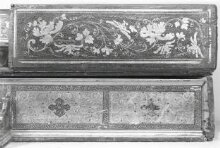
The forward-facing surfaces of the instrument are richly decorated with moresques in red and blue glazes on a gilded ground. The pattern is re¬served, however, so that it is rendered in the gold against a painted ground. (The blue glaze now shows as a green colour because of the yellowing of the varnish superimposed over the decoration.) To the left of the keyboard a panel bears the English royal arms as borne by the Tudor monarchs until the death of Queen Elizabeth I in 1603. On the right is a panel displaying the badge used by both Anne Boleyn and her daughter Elizabeth I — a falcon on a stump, crowned and holding a sceptre. In view of the apparent date of this spinet (c. 1570) the badge must in fact refer to Queen Elizabeth I, with whose name it has long been associated.
The outer case, believed to date from c. 1680, is lined with yellow silk except for the faces of the lid, which are japanned with stylized floral patterns executed in gold on a black ground in a close imitation of contemporary Japanese lacquer. The outside is surfaced with red velvet. The brass lock-plate is delicately engraved.
The soundboard contains a cut parchment rose. The thickness of the soundboard averages 3mm, from 2.7mm to about 4.0mm at the spine.
5. Nothing is known of the history of the instrument until its purchase by Lord Spencer Chichester before 1798 in London, where it had `lain sometime in obscurity'. He kept it at his country seat, Fisherwick in Staffordshire, and it was acquired at a sale held there in 1805 by a painter, Jonah Child of Dudley. He wrote a letter to the Gentleman's Magazine in June 1815, describing the instrument and mentioning that he `had no objection to transferring it to a more suitable possessor'. In about 1842 it was purchased by an anonymous 'late owner' from someone who stated that it had come from Fisherwick. It was later acquired by the Reverend Nigel Gresley, of Milbourne St Andrew, Blandford; Dorset, who finally sold it to the Museum for £125 in 1887.
6.In common with virtually all sixteenth-century Italian instruments, the spinet has undergone an alteration in its compass. The original range is uncertain. The present keyboard is unlikely to be the original one. The notches cut in the balance-rail of the key-frame point to an original compass of C-c3, d3 (without c sharp3) but this would certainly be most unusual. In any event, the keyboard has been extensively modified to change it from the type with a sliding blade and a sawcut rear guide to the present form with a wooden pin moving in a slot. The top note has also been transferred to the bass end. The need to add spacing-blocks at the ends of the keys to reach the jacks, the original ones, has already been noted. Some very faded and incomplete traces of lettering near the wrest-pins show no evidence of alteration, but the lettering at the treble end is confused, probably because some of the wrest-pins had to be moved in order to avoid fouling the strings. These traces of lettering do not suffice to clarify the question of the original compass.
The extraordinarily striking resemblance of this unsigned instrument to the Benedicti Floriani spinet of 1571 in Leipzig, both as regards construction and decoration, was noted over fifty years ago by JAMES [bibliography]. Detailed compararive studies of both might well justify an attribution to that Venetian maker. The similarity of such features as the profiles of the end-blocks of the keyboard and the curves of the bridges must be balanced against differences of scaling and dimensions that are not easily squared with an ascription to Floriani, however. Certainly the decoration is in a style much favoured in Venice at that period.
- Nanke Schellmann: "The Queen Elizabeth's Virginal, Scribbles, Scratches and Sgraffito", , Autumn 2002, No. 42, pp. 9-11.
- Victoria & Albert Museum: Fifty Masterpieces of Woodwork (London, 1955), no. 22.
Queen Elizabeth’s Virginal
The end of the sixteenth century was the golden age of English music, which owed much to the patronage of the Royal House of Tudor. It is related that Henry VIII ‘exercised himself dailie in plaieing at the recorders, Flute, virginals, setting of songes in making of ballades'. His daughter Elizabeth was no less accomplished. Her skill on the virginals is recorded in the account of her interview with Sir James Melville, who states that ‘placing himself by the tapestry that hung before the door, entered within the chamber, and stood a pretty space hearing her play excellently well’.
Possibly this instrument was the one on which the Queen played in the hearing of the Ambassador. It has been long known as ‘Queen Elizabeth’s Virginal' in accordance with the general English custom at this time of calling keyboard instruments virginals, but is more accurately described as a spinet. The shape, the style of decoration, and the presence of an outer case proclaim it an Italian instrument dating from about 1570, though the possibility that it was actually decorated in England by an immigrant craftsman is not to be excluded. Amid the elaborate decoration, the Royal Arms and the crowned falcon (the device of Boleyn) confirm its association with the Queen.
The history of the instrument can be traced from the end of the eighteenth century.
It was bought by the Museum in 1887
Italian; about 1570.
H. 8 ½ in., L. 65 in., D. 23 in.
- Music Recording
LP26902 Queen Elizabeth Virginal (19 – 1887) played on both sides by Margaret Hodsdon, V & A, 13. 11. 61.
Front (10FRM 108031)
1. The Queen's New Year Gift - 1' 09".
Anthony Holborne.
2. Branle Hobroken - 37"
3. Alman Prince - 37"
4. Like as the Lark in Merlin's Foot - 1' 01"
Dublin Virginal Book.
5. My Lady Carey's Dompe - 51".
6. Nancie - 2'10"
7. Pavan: Lachrymae - 2' 10".
Back (10 FRM 108032)
1. Galliard: Lachrymae - 2' 15"
2. First Part Galliard in Dance Time - 37".
Thomas Morley.
3. Lord Willobie's Welcome Home - 2'14"
4. The Carman's Whistle - 2' 32"
William Byrd
5. La Bounette - 1'00
6. I smile to see how you devise - 50"
7. When Griping Grief - 52"
- GABRIELE ROSSI ROGNONI, The Virginals of Benedetto Floriani (Venice, fl1568–1572) and a Proposal for a New Attribution, in The Galpin Society Journal LXVIII (2015), pp. 5-20, 178-183
p.7 Notes that the instrument was once attributed to Floriani on the basis of its decoration resembling that of the 1571 instrument in Leipzig, but that it has been re-attributed (with qualification) to Johannes Antonius Baffo by Denzil Wraight on the basis of its mouldings. [Ralph Denzil Wraight, ‘The stringing of Italian Keyboard Instruments c.1500–c.1650’, PhD Dissertation, Queen’s University of Belfast (Ann Arbor: UMI, 1997), vol.2, p.50 (W299)]
- PATEY, Carole and Moira Hulse: Musical Instruments at the Victoria and Albert Museum. (London, HMSO, 1978), p. 4-5
- Catherine Lorigan, "'Queen Elizabeth's Virginals': from Venice to the Victoria and Albert Musem" in Harpsichord & Fortepiano, vol. 25, no. 2 Spring 2021 pp.4-12
Traces the provenance of the instrument and illustrates a watercolour by Constance Lydia Fripp, depicting the instrument in an imaginary historic interior (illus. 9).
- THORNTON, Peter The Italian Renaissance Interior, 1400 – 1600 (London, 1991), p.99
The Venetian virginals that belonged to our Queen Elizabeth, dating from about 1570, are decorated in the same lacquered technique with miniature arabesques or moresques.[note 11] The lacquer (red, green, blue, black) is painted over the gold ground and is translucent, rather like some types of modern nail-varnish, so that the gold shows through. But the pattern is chiefly rendered by leaving its lines exposed (i.e. not covered with lacquer) so it is the ground that is lacquered while the pattern is `reserved', as it is called. The effect can be stunning and was much favoured in the second half of the sixteenth century and into the first half of the next century, for particularly sumptuous furnishings. Caskets and other small boxes might be decorated in the same way, a certain class of Venetian work being executed on a ground of mother-of-pearl which shone through the lacquer in the same way as the gold. Of course moresque patterns could equally well be painted with gold or opaque pigments, in the normal way, without the ground showing through.
|
| Collection | |
| Accession number | |