Casket
1530-1538 (made), 19th century (altered)
| Artist/Maker | |
| Place of origin |
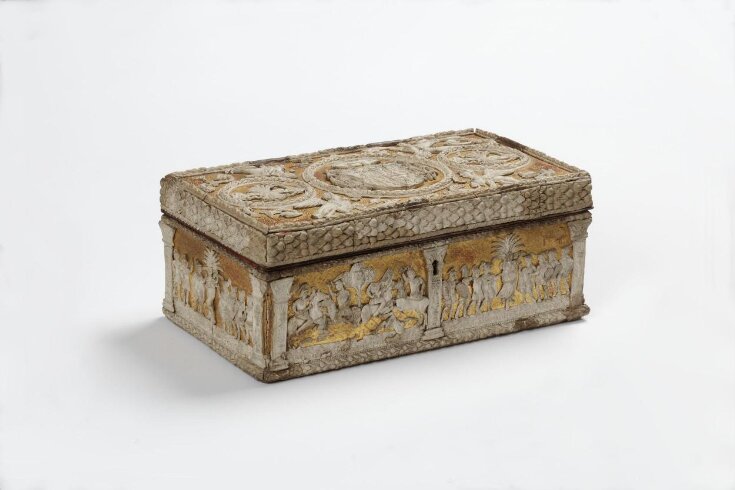
Gilt-boxes, decorated with scented lead-based paste (pasta di muschio) and illustrated with ancient Greek and Roman legends, were popular throughout Italy between about 1470 and 1570. They were used for storing trinkets and curios. This example is about the only one that can be closely dated and linked to its original owner. The coat of arms on the lid is that of Cardinal Bernardo Cles (1485-1539), and it marks his status as Prince-Bishop of Trent (or Trento, the capital of Trentino) and Cardinal. So the box must have been made after 1530 when he became a cardinal and before 1538 when he left his bishopric. Cles symbolised his opposition to Lutheranism with an emblem in the form of a bundle of rods (fasces) tied with a band labelled 'UNITAS' (Unity), a pair of which can also be seen on the lid.
Object details
| Categories | |
| Object type | |
| Materials and techniques | Alderwood, gilding and white lead pastiglia |
| Brief description | Casket, alderwood, Italy, 1530-1538. |
| Physical description | Rectangular box with pastiglia decoration on a gilt ground on the lid and the four sides. The lid is emblazoned with the coat of arms that Cardinal Bernardo Cles (1485 - 1539) used as Prince Bishop of Trento between 1514 and 1538 and his personal cipher, a bundle of sticks tied with a band inscribed UNITAS. The arms are surmounted with the hat of a cardinal, an office he held from 1530 onwards. Between the coat of arms and the ‘UNITAS’ cyphers are placed four Etruscan sphinxes, with scrolls emanating from the front and back. All these elements are of stamped white lead pastiglia on water-gilt background, punched into no particular pattern. The edges of the lid are decorated with a broad white lead pastiglia laurel and berry frieze. The front side is decorated with an equestrian battle on the left and the rape of Lucretia on the right. The Left side depicts a naked Priestess (of Delphi?) in front of a palm tree, flanked by Roman Soldiers, and the right side an equestrian battle. The back is decorated with the rape of Lucretia on the left and an equestrian battle on the right. The episodes on the front and back of the box are separated with a composite pilaster of white pastiglia, and the one at the front is pierced near the top for a key-hole. Two virtually identical pilasters converge at each of the four corners, and the base consists of a laurel wreath frieze. The bottom of the box is covered with dark blue leather and the inside is lined with royal blue velvet. It was fitted with a lock and two new hinges some time in the late nineteenth century. |
| Dimensions |
|
| Production type | Unique |
| Marks and inscriptions |
|
| Gallery label |
|
| Object history | This object originally belonged to Carinal Bernardo Cles (1485 - 1539), of Trento. It was loaned to the South Kensington Museum in 1876, and acquired in 1891, along with 112 other items, belonging to the 15th Lord Zouche (1851 - 1914), which were valued at a total of £5,000. PASTIGLIA BOXES Gilt pastiglia boxes were mostly made in Venice and Ferrara from about 1480 until 1550. Pastiglia or pasta is the name given to white lead paste, bound with egg white. This was often scented and described in contemporary inventories as pasta di muschio (musk paste). The pastiglia figures and motifs were shaped with a lead mould and then glued to the gilt surface of the box - hence their frequent recurrence on other boxes. The boxes are decorated with legends of Ancient Rome and the scenes copied from woodcuts such as Jacobus Argentoratensis' Triumph of Caesar (Venice, 1504) or illustrations of Livy's Roman History. (Label text, circa 2000, from old Medieval & Renaissance Galleries) Historical significance: This box is particularly important because of its original owner, Cardinal Bernardo Cles of Trento (1484 - 1539), a stout defender of Catholicism against Martin Luther (1483 - 1546), although he maintained contact with Desiderius Erasmus (1466 - 1536), often regarded as 'the Father of the Reformation'. This box is one of many in public collections decorated with a white lead and egg white-based paste called pastiglia, but it is virtually unique in that it can be dated with some precision, i.e. 1530 - 1538: Cles used his coat of arms as Bishop of Trento between 1514 and 1538, but he added the cardinal's hat as a crest, after he became one in 1530. This may have been presented to him in celebration of his elevation. As well as carrying this particular coats of arms and crest, the lid also bears Cles's personal emblem, placed either side of his coat of arms. This was a bundle of sticks bound with a tape inscribed with UNITAS (Unity), which symolized his abhorrence of Lutheranism, which he saw as causing the split within the church. |
| Historical context | Musk-scented boxes with white-lead decoration, like this example, were presented as lovers' gifts and used for storing trinkets and small curios. They were often decorated with classical themes extolling love or wifely virtues, such as the Rape of Lucretia in this example, and these became increasingly popular throughout Italy from about 1460, as myths and legends of Ancient Greece and Rome replaced Medieval Romances as decorative themes. Musk was included in the decoration to make both the box and the owner's hands smell pleasant. Thorton suggests that this would have been called a 'cassetta' or 'scatola' |
| Subjects depicted | |
| Association | |
| Summary | Gilt-boxes, decorated with scented lead-based paste (pasta di muschio) and illustrated with ancient Greek and Roman legends, were popular throughout Italy between about 1470 and 1570. They were used for storing trinkets and curios. This example is about the only one that can be closely dated and linked to its original owner. The coat of arms on the lid is that of Cardinal Bernardo Cles (1485-1539), and it marks his status as Prince-Bishop of Trent (or Trento, the capital of Trentino) and Cardinal. So the box must have been made after 1530 when he became a cardinal and before 1538 when he left his bishopric. Cles symbolised his opposition to Lutheranism with an emblem in the form of a bundle of rods (fasces) tied with a band labelled 'UNITAS' (Unity), a pair of which can also be seen on the lid. |
| Bibliographic references |
|
| Collection | |
| Accession number | 777-1891 |
About this object record
Explore the Collections contains over a million catalogue records, and over half a million images. It is a working database that includes information compiled over the life of the museum. Some of our records may contain offensive and discriminatory language, or reflect outdated ideas, practice and analysis. We are committed to addressing these issues, and to review and update our records accordingly.
You can write to us to suggest improvements to the record.
Suggest feedback
You can write to us to suggest improvements to the record.
Suggest feedback
| Record created | November 21, 2002 |
| Record URL |
Download as: JSONIIIF Manifest
