
Painting
ca. 1855 (made)
| Artist/Maker | |
| Place of origin |
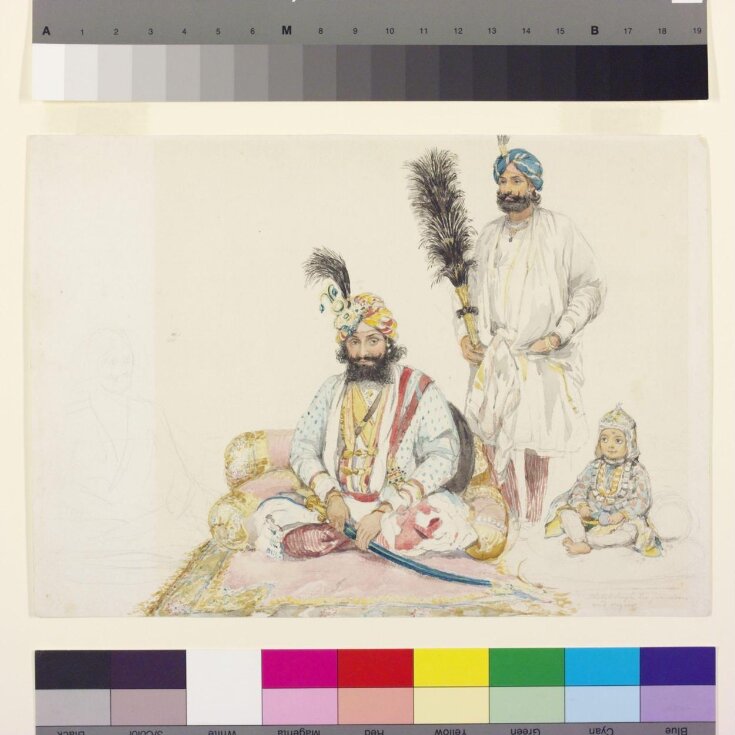
This portrait depicts Maharaja Gulab Singh of Jammu and Kashmir with his small grandson and an attendant, who stands behind him holding a fan of peacock feathers. The artist was William Carpenter (1819-99), who was born in London and was the son of the artist and miniaturist Margaret Sarah Carpenter and William Hookham Carpenter, Keeper of Prints and Drawings at the British Museum. William Carpenter first visited Indian in 1850 to paint portraits and make studies of Indian life and scenery. He remained there until the Great Mutiny, or First War of Independence, caused him to return to England in 1857. This was one of 134 works bought from the artist by the South Kensington Museum in 1880. The following year, the museum held an exhibition of Carpenter's Indian paintings.
Gulab Singh, born in 1792, was an influential member of the court of Maharaja Ranjit Singh, the first Sikh Maharaja of the Panjab (r. 1801-1839) who made Gulab Singh Raja of Jammu in 1822. He was a loyal servant of Ranjit Singh, but intrigued against his successors and finally allied himself with the British during the first Anglo-Sikh war (1845-46). For this, he gained extensive territories seized from the Sikh kingdom. The portrait was done in about 1855, after the second Anglo-Sikh war and the annexation of the Panjab to the British Empire in 1849.
Gulab Singh, born in 1792, was an influential member of the court of Maharaja Ranjit Singh, the first Sikh Maharaja of the Panjab (r. 1801-1839) who made Gulab Singh Raja of Jammu in 1822. He was a loyal servant of Ranjit Singh, but intrigued against his successors and finally allied himself with the British during the first Anglo-Sikh war (1845-46). For this, he gained extensive territories seized from the Sikh kingdom. The portrait was done in about 1855, after the second Anglo-Sikh war and the annexation of the Panjab to the British Empire in 1849.
Object details
| Categories | |
| Object type | |
| Materials and techniques | Watercolour on paper |
| Brief description | Maharaja Gulab Singh of Jammu and Kashmir with his grandson, by William Carpenter (British); watercolour on paper; India; ca.1855. |
| Physical description | Gulab Singh of Kashmir sits cross-legged on a mat, his back against a bolster, with his grandson sitting on the ground to his left and an attendant standing behind holding a fan of peacock feathers. Watercolour on paper. |
| Dimensions |
|
| Credit line | Purchased from William Carpenter |
| Object history | Museum numbers IS.33-1888 to IS.166-1888 purchased from William Carpenter for £500. This acquisition information reflects that found in the Museum records (Asia Department registers and/or Central Inventory) as part of a 2023 provenance research project. |
| Subjects depicted | |
| Summary | This portrait depicts Maharaja Gulab Singh of Jammu and Kashmir with his small grandson and an attendant, who stands behind him holding a fan of peacock feathers. The artist was William Carpenter (1819-99), who was born in London and was the son of the artist and miniaturist Margaret Sarah Carpenter and William Hookham Carpenter, Keeper of Prints and Drawings at the British Museum. William Carpenter first visited Indian in 1850 to paint portraits and make studies of Indian life and scenery. He remained there until the Great Mutiny, or First War of Independence, caused him to return to England in 1857. This was one of 134 works bought from the artist by the South Kensington Museum in 1880. The following year, the museum held an exhibition of Carpenter's Indian paintings. Gulab Singh, born in 1792, was an influential member of the court of Maharaja Ranjit Singh, the first Sikh Maharaja of the Panjab (r. 1801-1839) who made Gulab Singh Raja of Jammu in 1822. He was a loyal servant of Ranjit Singh, but intrigued against his successors and finally allied himself with the British during the first Anglo-Sikh war (1845-46). For this, he gained extensive territories seized from the Sikh kingdom. The portrait was done in about 1855, after the second Anglo-Sikh war and the annexation of the Panjab to the British Empire in 1849. |
| Bibliographic references |
|
| Collection | |
| Accession number | IS.153-1882 |
About this object record
Explore the Collections contains over a million catalogue records, and over half a million images. It is a working database that includes information compiled over the life of the museum. Some of our records may contain offensive and discriminatory language, or reflect outdated ideas, practice and analysis. We are committed to addressing these issues, and to review and update our records accordingly.
You can write to us to suggest improvements to the record.
Suggest feedback
You can write to us to suggest improvements to the record.
Suggest feedback
| Record created | November 13, 2002 |
| Record URL |
Download as: JSONIIIF Manifest
