Astrolabe
1667 (dated)
| Artist/Maker | |
| Place of origin |
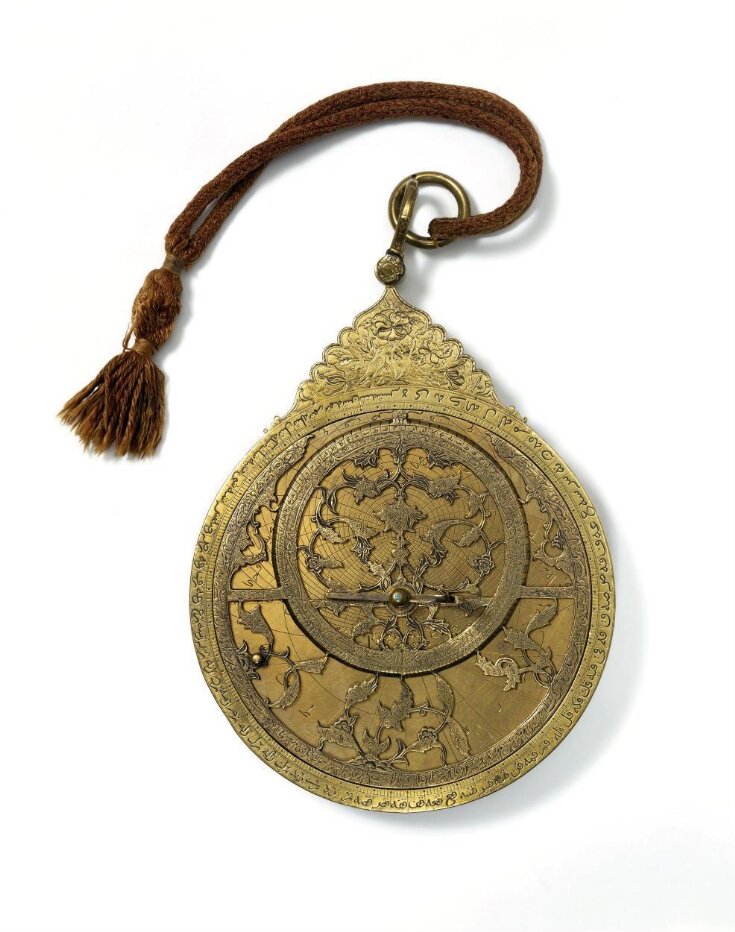
This astrolabe was made in Isfahan in 1667. It could have been used in scientific enquiry. It might have served religious purposes, such as telling the times of the five daily prayers or establishing the direction of Mecca. Astrolabes were also used in astrology, for example to cast horoscopes.
For centuries, the astronomers of the Islamic Middle East led the world in their knowledge of the heavens. Astronomical instruments such as globes and astrolabes were produced in large numbers to a very high standard.
Like the celestial globe, the astrolabe was inherited from Greek and Roman astronomy. It shows the relative positions of the sun and stars on a flat surface. The solid plates are engraved for different latitudes. To use the astrolabe, astronomers placed one plate in the casing (mater) under the openwork disc (rete). The rete is a star map with pointers showing the position of the stars. They moved it to the correct position once an observation has been made with the sighting device (alidade).
For centuries, the astronomers of the Islamic Middle East led the world in their knowledge of the heavens. Astronomical instruments such as globes and astrolabes were produced in large numbers to a very high standard.
Like the celestial globe, the astrolabe was inherited from Greek and Roman astronomy. It shows the relative positions of the sun and stars on a flat surface. The solid plates are engraved for different latitudes. To use the astrolabe, astronomers placed one plate in the casing (mater) under the openwork disc (rete). The rete is a star map with pointers showing the position of the stars. They moved it to the correct position once an observation has been made with the sighting device (alidade).
Object details
| Categories | |
| Object type | |
| Materials and techniques | Engraved and chased brass |
| Brief description | Astrolabe, Iran (Isfahan), dated 1667. |
| Physical description | Brass, pierced and engraved. Signed as made by Khalil (Muhammad) son of Husayn 'Ali, and decorated by Muhammad Mahdi son of Amin of Yazd. |
| Dimensions |
|
| Styles | |
| Gallery label |
|
| Credit line | Clarke-Thornhill Gift |
| Summary | This astrolabe was made in Isfahan in 1667. It could have been used in scientific enquiry. It might have served religious purposes, such as telling the times of the five daily prayers or establishing the direction of Mecca. Astrolabes were also used in astrology, for example to cast horoscopes. For centuries, the astronomers of the Islamic Middle East led the world in their knowledge of the heavens. Astronomical instruments such as globes and astrolabes were produced in large numbers to a very high standard. Like the celestial globe, the astrolabe was inherited from Greek and Roman astronomy. It shows the relative positions of the sun and stars on a flat surface. The solid plates are engraved for different latitudes. To use the astrolabe, astronomers placed one plate in the casing (mater) under the openwork disc (rete). The rete is a star map with pointers showing the position of the stars. They moved it to the correct position once an observation has been made with the sighting device (alidade). |
| Bibliographic reference | Tim Stanley (ed.), with Mariam Rosser-Owen and Stephen Vernoit, Palace and Mosque: Islamic Art from the Middle East, London, V&A Publications, 2004
p.13 |
| Collection | |
| Accession number | M.38-1916 |
About this object record
Explore the Collections contains over a million catalogue records, and over half a million images. It is a working database that includes information compiled over the life of the museum. Some of our records may contain offensive and discriminatory language, or reflect outdated ideas, practice and analysis. We are committed to addressing these issues, and to review and update our records accordingly.
You can write to us to suggest improvements to the record.
Suggest feedback
You can write to us to suggest improvements to the record.
Suggest feedback
| Record created | November 12, 2002 |
| Record URL |
Download as: JSONIIIF Manifest
