Spoon
15th century (made)
| Artist/Maker | |
| Place of origin |
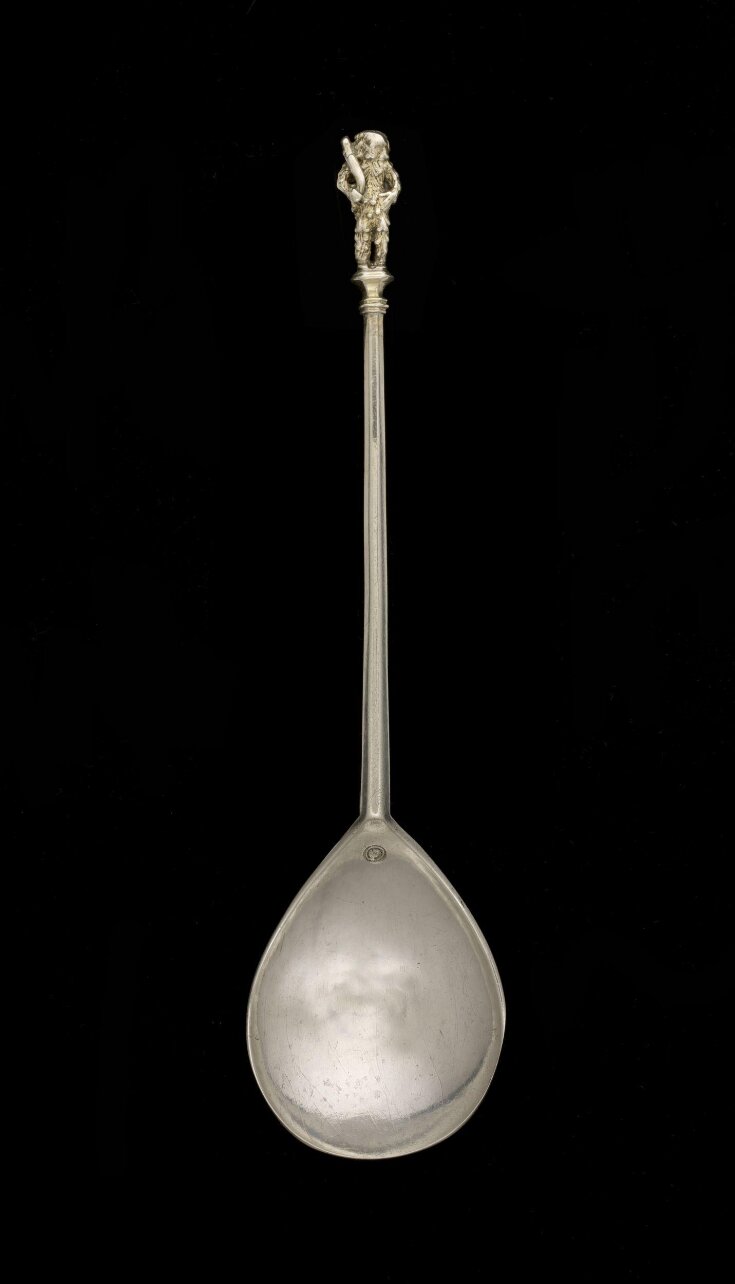
A silver spoon was an intimate treasured possession that its owner would carry much of the time.This spoon is punched with the leopard's head mark, representing the English sterling standard, or quality, of silver. Many late medieval spoons have finials in the form of saints or sometimes in the form of animals.The wildman finial figure on this spoon is one of only four surviving examples known, however. The spoon displays the common late medieval and Renaissance feature of a fig shaped bowl and a slender six sided stem. The wildman or "wodewose" was a popular figure in the medieval period, included in romance stories and love imagery, and in religious and moral tales. He also appeared in a heraldic context, holding up shields with coats of arms. From the 14th century the wildman was particularly associated with desire and lust. The appearance of the wildman upon this spoon may have been a playful symbol of desire, or perhaps it served as a reminder of the wildness within human nature.
Object details
| Categories | |
| Object type | |
| Materials and techniques | Silver |
| Brief description | Silver spoon, British, 15th century with wildman knop. |
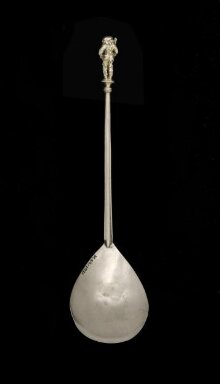
| Physical description | Silver with a fig shaped bowl and slender six-sided stem terminating in a moulded capital which forms a pedestal for the figure of a wodewose (wildman). |
| Dimensions |
|
| Marks and inscriptions | Leopard's Head (Town mark: London or possibly Coggeshall, Essex) |
| Object history | The Museum purchased this spoon together with six other early spoons (Museum nos M.66 to M.71-1921) for a total of £400 from H. D. Ellis of 7 Roland Gardens, SW7 (see the acquisition Registered File 21 / 1199). This spoon, which is one of only four to survive, could have belonged to an artisan or a noble. Spoons survive in larger numbers than any other object from before c.1700. Silversmiths made and sold silver spoons in every market town. Although silver was an expensive commodity, it was not as rare or as costly as gold. A wide variety of people could afford items of silver. A silver spoon weighing 1.5 to 2oz was a luxury costing an artisan around a week's wages. Nevertheless such items were the personal and treasured possessions of yeomen, workmen, widows and small shopkeepers. Wealthier members of society might own several silver spoons. In 1517 it is recorded that the Earl of Berkeley owned 20 dozen spoons. Until c. 1300 spoons with round bowls were the most common design. Later, until around 1700, spoons traditionally had a fig-shaped bowl and a thin, six-sided stem. It was also common for the spoon to have a decorative finial at the end of the stem. From the late 15th century, Apostle spoons were particularly popular. They were sometimes made in sets of 13, depicting the 12 apostles and Jesus Christ. Other times they were given singularly as gifts. "Maidenhead" spoons portrayed the head and shoulders of the Virgin Mary. Knops were also figured into animals such as lions or (more rarely) birds including owls, falcons and doves. This spoon has the typical bowl and stem of the pre 1700 period. However, the finial is particularly rare. Wrongly described by H. D. Ellis, who sold it to the Museum, as the apostle St James the Less with a Fuller's bat, this spoon actually depicts a wildman holding a club. The wildman or "wodewose" was a popular figure in the medieval period. He was included in romance stories and love imagery, and also in religious and moral tales. He also appeared in a heraldic context, holding up shields with coats of arms. From the 14th century the wildman was particularly associated with desire and lust. The appearance of the wildman upon this spoon may have been a playful symbol of desire, or perhaps it served as a reminder of the wild nature within us all. The leopard's head mark upon this spoon shows that the spoon has been tested by the London assay office and verified as sterling silver (ie. 92.5% of the metal is silver). In the statute on establishing the purity of silver proclaimed in 1363 it was called the King's Mark. In 1478 the mark was adapted to include a crown upon the head of the leopard, and a letter, punched beside the leopard mark to indicate the year of assay, was introduced. |
| Historical context | Spoons in the medieval period were intimate possessions that were often carried on the person. They were commonly presented as christening gifts but were also passed on in wills. In the Renaissance spoons of silver were offered as lottery prizes and required at election to corporations. The fingers, the knife and the spoon were the principal aids for eating in this period, At a banquet, spoons might be used so that the guests could dip into a communal dish. Whilst spoons of wood or horn were commonly used in the Middle Ages, medieval inventory records show that silver spoons were also used to dine with. However, spoons may also have been given as personal gifts. |
| Summary | A silver spoon was an intimate treasured possession that its owner would carry much of the time.This spoon is punched with the leopard's head mark, representing the English sterling standard, or quality, of silver. Many late medieval spoons have finials in the form of saints or sometimes in the form of animals.The wildman finial figure on this spoon is one of only four surviving examples known, however. The spoon displays the common late medieval and Renaissance feature of a fig shaped bowl and a slender six sided stem. The wildman or "wodewose" was a popular figure in the medieval period, included in romance stories and love imagery, and in religious and moral tales. He also appeared in a heraldic context, holding up shields with coats of arms. From the 14th century the wildman was particularly associated with desire and lust. The appearance of the wildman upon this spoon may have been a playful symbol of desire, or perhaps it served as a reminder of the wildness within human nature. |
| Bibliographic references |
|
| Collection | |
| Accession number | M.65-1921 |
About this object record
Explore the Collections contains over a million catalogue records, and over half a million images. It is a working database that includes information compiled over the life of the museum. Some of our records may contain offensive and discriminatory language, or reflect outdated ideas, practice and analysis. We are committed to addressing these issues, and to review and update our records accordingly.
You can write to us to suggest improvements to the record.
Suggest feedback
You can write to us to suggest improvements to the record.
Suggest feedback
| Record created | October 31, 2002 |
| Record URL |
Download as: JSONIIIF Manifest
