
Patola Sari
late 19th century-early 20th century (made)
| Artist/Maker | |
| Place of origin |
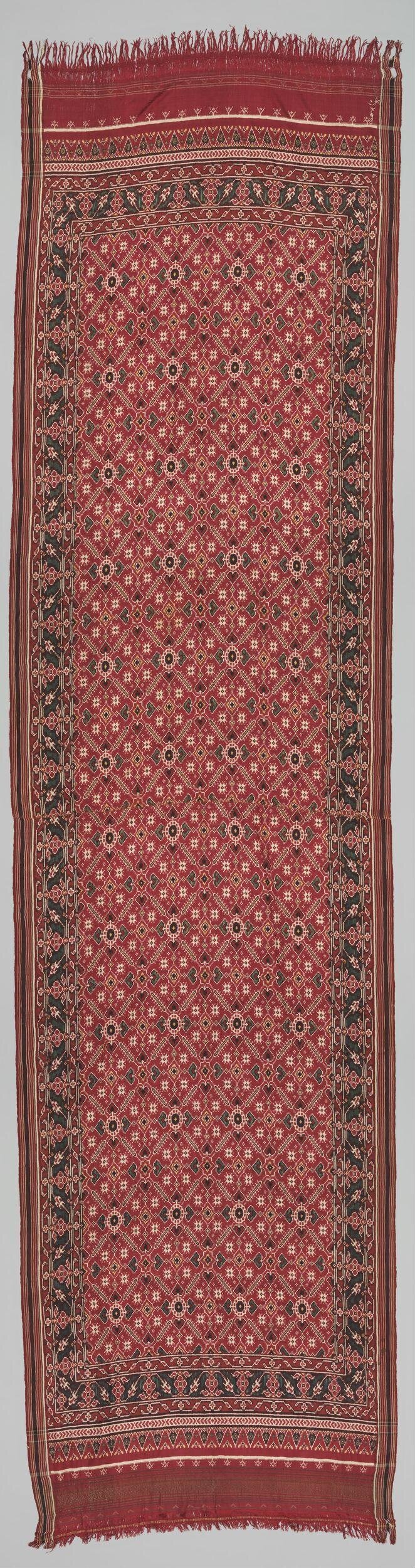
This beautiful patola sari is made in the double ikat technique, in which both warp and weft threads are tie-dyed to conform to the desired pattern before weaving. Genuine patola are made only by the Salvi community in Gujarat, and today are produced exclusively in the town of Patan. Their extremely time-consuming and difficult method of manufacture makes them highly prized and much sought-after for weddings and other special occasions, and they are considered one of the most auspicious types of all Indian textiles. They were traditionally made in a number of different designs, and this one is particularly associated with the Vohra community of Ismaili Muslims.
Object details
| Categories | |
| Object type | |
| Materials and techniques | |
| Brief description | Woman's wrapped garment (sari), double ikat dyed and woven silk, Gujarat, late 19th century-early 20th century |
| Physical description | Wedding sari (patolu) of double tie-dyed silk ikat before weaving. With a geometric design of stylised leaves, stars and other motifs combined with multi-layered end patterns. In green, brown, red, orange, yellow and white. |
| Dimensions |
|
| Object history | The non-figurative pattern is particularly favoured by the Ismaili Muslim merchant community of the Vohras. |
| Summary | This beautiful patola sari is made in the double ikat technique, in which both warp and weft threads are tie-dyed to conform to the desired pattern before weaving. Genuine patola are made only by the Salvi community in Gujarat, and today are produced exclusively in the town of Patan. Their extremely time-consuming and difficult method of manufacture makes them highly prized and much sought-after for weddings and other special occasions, and they are considered one of the most auspicious types of all Indian textiles. They were traditionally made in a number of different designs, and this one is particularly associated with the Vohra community of Ismaili Muslims. |
| Bibliographic reference | Indian ikat textiles / Rosemary Crill. London: V&A Publications, 1998 Number: 1851772421
pp.34-35, pl.25 |
| Collection | |
| Accession number | IS.190-1960 |
About this object record
Explore the Collections contains over a million catalogue records, and over half a million images. It is a working database that includes information compiled over the life of the museum. Some of our records may contain offensive and discriminatory language, or reflect outdated ideas, practice and analysis. We are committed to addressing these issues, and to review and update our records accordingly.
You can write to us to suggest improvements to the record.
Suggest feedback
You can write to us to suggest improvements to the record.
Suggest feedback
| Record created | September 24, 2002 |
| Record URL |
Download as: JSONIIIF Manifest
