Bowl
1351-1352 (made)
| Artist/Maker | |
| Place of origin |
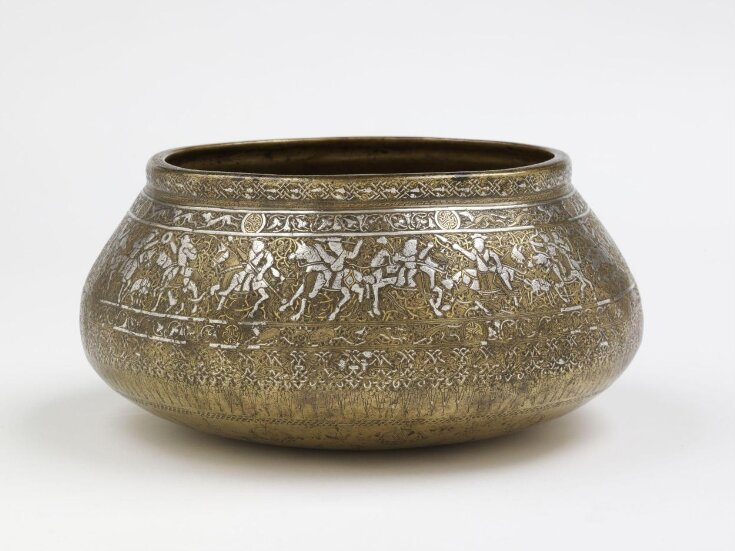
This base metal bowl has been transformed by sophisticated inlaid surface decoration. Here it depicts six scenes of horsemen in the frieze. They are loosely based on the Persian epic The Book of Kings. In one, the legendary King Faridun, shown riding an ox, is followed by a captive on foot. The snakes growing from the captive’s shoulders identify him as the evil king Zahhak, whom Faridun overthrew.
To create larger motifs, metalworkers chiselled out small areas of base metals such as copper or brass and filled with them with thin sheets of silver and gold. They added detail by chasing the surface of the softer metals and created contrast with a black filler.
To create larger motifs, metalworkers chiselled out small areas of base metals such as copper or brass and filled with them with thin sheets of silver and gold. They added detail by chasing the surface of the softer metals and created contrast with a black filler.
Object details
| Categories | |
| Object type | |
| Materials and techniques | Copper alloy engraved and overlaid in silver and gold |
| Brief description | Bowl, brass with silver inlay, with scenes based on the Shahnameh, Iran, dated 752H, 1351-52 |
| Physical description | Vessel with broad curving base, almost flat in the central area, convex sides bending back over inner surface and topped by a short rim with a flat edge facing upwards. Raised brass, decorated with champlevé designs engraved over the inlaid silver foil, the ground filled with black composition. Two bands of formal ornament are inlaid on the flat edge of the rim facing upwards and on its everted side. On the sides two narrow bands broken up into sections by interlocking roundels alternately enclose formal ornament and running animals. They frame a continuous figurative frieze of horsemen set against a scrolling ground. Below, a lambrequin based on symmetrical scrolls carrying bi-lobed half-palmettes. The underside has a chain pattern. |
| Dimensions |
|
| Style | |
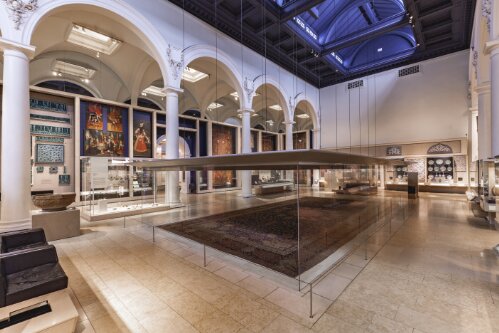
| Gallery label | Jameel Gallery
Bowl with Horsemen
Iran
Dated 1351
The six scenes of horsemen in the frieze are loosely based on the Persian epic, The Book of Kings. In one, the legendary King Faridun, shown riding an ox, is followed by a captive on foot. The snakes growing from the captive's shoulders identify him as the evil king Zahhak, whom Faridun overthrew.
Brass inlaid with silver, gold and a black composition. Signed by Turanshah
Museum no. 760-1889(Jameel Gallery) |
| Object history | Historical significance: This bowl bears the name of its maker Turanshah and the name of the patron for whom it was made, Muhammad al-Jurjani. It is unique in its decorative scheme, much of which is based upon the Shahnama (Book of Kings). It presents a unique example of a metalworking school in Iran after the Mongol invasions. |
| Production | Dated AH 752 |
| Summary | This base metal bowl has been transformed by sophisticated inlaid surface decoration. Here it depicts six scenes of horsemen in the frieze. They are loosely based on the Persian epic The Book of Kings. In one, the legendary King Faridun, shown riding an ox, is followed by a captive on foot. The snakes growing from the captive’s shoulders identify him as the evil king Zahhak, whom Faridun overthrew. To create larger motifs, metalworkers chiselled out small areas of base metals such as copper or brass and filled with them with thin sheets of silver and gold. They added detail by chasing the surface of the softer metals and created contrast with a black filler. |
| Bibliographic references |
|
| Collection | |
| Accession number | 760-1889 |
About this object record
Explore the Collections contains over a million catalogue records, and over half a million images. It is a working database that includes information compiled over the life of the museum. Some of our records may contain offensive and discriminatory language, or reflect outdated ideas, practice and analysis. We are committed to addressing these issues, and to review and update our records accordingly.
You can write to us to suggest improvements to the record.
Suggest feedback
You can write to us to suggest improvements to the record.
Suggest feedback
| Record created | September 12, 2002 |
| Record URL |
Download as: JSONIIIF Manifest
