Carpet
1500-1600 (made)
| Artist/Maker | |
| Place of origin |
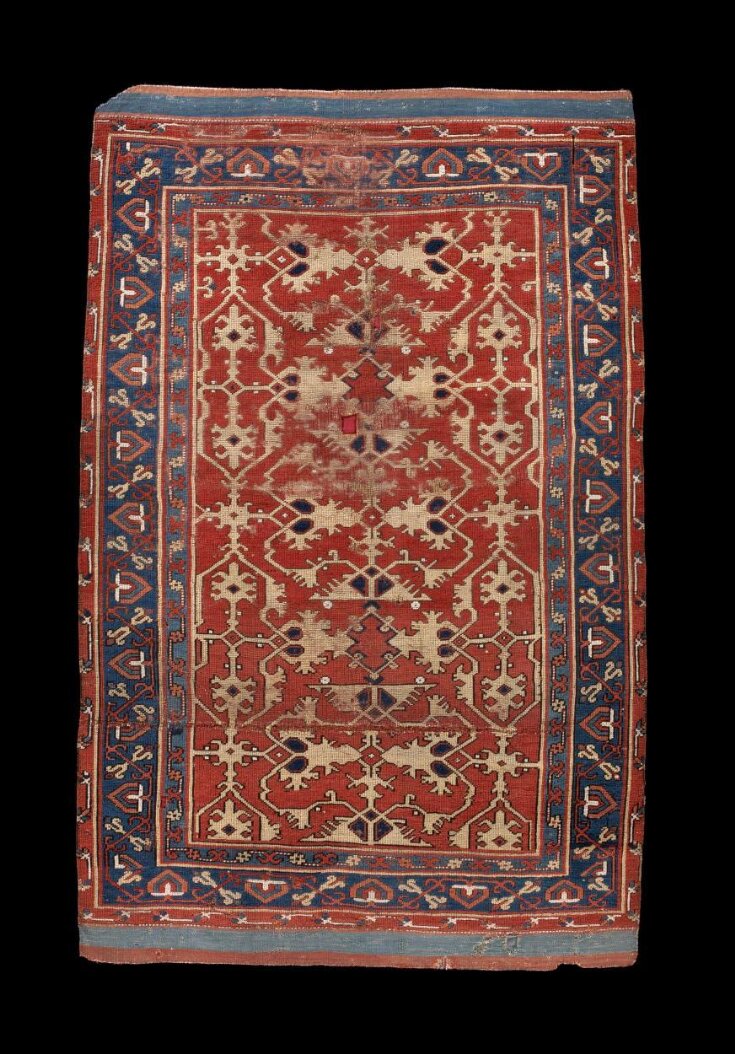
Carpets with this distinctive yellow and red design are often called the Lotto carpets because the Italian artist Lorenzo Lotto [c.1480-1556] is said to have depicted several in his paintings.
There are two obvious features in this carpet: a large area of re-knotting in the centre and the fact that the upper border has been knotted in slightly different colours - the dark brown used in the other three borders is missing. This yellow and red design was popular for over a century. It was worked from drawings and so its proportions could be easily changed by selecting which part of the repeating design was to be woven. There is horizontal repair across most of the upper part of this carpet. If you look at the left hand end (just inside the red field) you will see that the lines of knots above and below the repair are not parallel. This part of the carpet was badly woven and a ridge would have formed when it was on the floor. Someone later cut the carpet and rejoined it to make it lie flat.
There are two obvious features in this carpet: a large area of re-knotting in the centre and the fact that the upper border has been knotted in slightly different colours - the dark brown used in the other three borders is missing. This yellow and red design was popular for over a century. It was worked from drawings and so its proportions could be easily changed by selecting which part of the repeating design was to be woven. There is horizontal repair across most of the upper part of this carpet. If you look at the left hand end (just inside the red field) you will see that the lines of knots above and below the repair are not parallel. This part of the carpet was badly woven and a ridge would have formed when it was on the floor. Someone later cut the carpet and rejoined it to make it lie flat.
Object details
| Categories | |
| Object type | |
| Materials and techniques | Hand knotted woollen pile, on woollen warp and weft; symmetrical knot; 80 knots per sq. in (640 per sq. dm) |
| Brief description | Middle East, Carpet. Carpet, wool knotted pile on wool foundation, "Lotto" design, possibly Ushak, Turkey, 1500-1600 |
| Physical description | Carpet, Lotto design, hand knotted woollen pile on woollen warp and weft, Turkish, 16th/17th century WARP: light brown wool; Z2S; 16 threads per inch (64 per dm) WEFT: light red wool; Z-spun , unplied; 2 shoots after each row of knots; 10 knots per inch (40 per dm) PILE: wool; 9 colours: red, light red, yellow, green, dark blue, blue, light blue, dark brown, white; symmetrical knot tied around two threads; 80 knots per inch (640 per sq. dm) SIDE FINISH: one cord oversewn with red wool END FINISH: Both incomplete. Lower: 3 cm plain weave with red weft followed by 4 cms plain weave with green weft and then by 1 cm plain weave with red weft in the middle of which is one pass of thick white weft which goes over 2 threads and under 2 threads. Upper: as lower but the outer band of plain weave with red weft is only 2 cms deep. DESIGN: Field: red ground with a typical Lotto design with yellow arabesques and blue infillings frequently outlined with red. Main border: blue ground with an angular red meander linking alternately inward- and outward-facing red/blue triangles. The diagonal bar of the meander is crossed by a pair of yellow flowers. Inner border: light blue ground with a red and white dotted meander linking flowerheads and a pair of leaves. Outer Border: red ground with a white meandering stem in the upper and lower borders; in the side borders the stems is not continuous. Catalogue Date: 8.3.96 |
| Dimensions |
|
| Gallery label | ‘Lotto’ Carpet
16th or 17th century
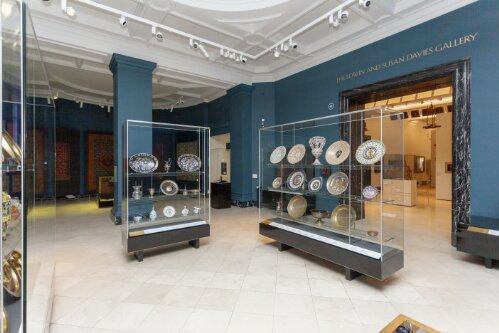
Carpets were a popular feature of interiors across Italy, particularly in Venice with its trade links with the Middle East. They were draped over furniture to conceal plain surfaces, and hung from balconies on special occasions, but only sometimes put on the floor. The distinctive design of this carpet is named after Lorenzo Lotto, who often included such carpets in his paintings. [62 words]
Western Turkey, probably Ushak
Wool; cut horizontally and rejoined at a later date
V&A: T.348-1920(5 Oct 2006 - 7 Jan 2007) |
| Production | Western Turkey, probably Ushak. Purchased with 4 other pieces (T.349/352-1920) from Harold Wallis Esq., St. Albans, Godstone Road, Purley, from his father's estate. for £35/-/-. 1 rug, Asia Minor, arabesques in yellow on red ground. Illustration and comment "Turkish Carpets in the V & A", by M. Franses & R. Pinner (intro by Donald King), analyses by S. Jarman. Hali 1984, Vol. 6, no.4, p. 354, 365, 367, 380, 381. "A Turkish carpet known as a 'Lotto@ carpet, 16th century. The name 'Lotto', after the painter Lorenzo Lotto (c.1480-1556) who depicted some in his work, is used as a convenient label for carpets with this type of endless, angular arabesque pattern - most often yellow on red. There is a seam in this carpet which runs almost across the entire width; it begins at the top, towards the left hand side. It suggests that the carpet did not lie flat when it was cut from the loom and that a narrow ridge was formed - uneven tension on the warp threads would have caused this. This ridge would have worn quickly into a long tear, which has subsequently been repaired." |
| Subject depicted | |
| Summary | Carpets with this distinctive yellow and red design are often called the Lotto carpets because the Italian artist Lorenzo Lotto [c.1480-1556] is said to have depicted several in his paintings. There are two obvious features in this carpet: a large area of re-knotting in the centre and the fact that the upper border has been knotted in slightly different colours - the dark brown used in the other three borders is missing. This yellow and red design was popular for over a century. It was worked from drawings and so its proportions could be easily changed by selecting which part of the repeating design was to be woven. There is horizontal repair across most of the upper part of this carpet. If you look at the left hand end (just inside the red field) you will see that the lines of knots above and below the repair are not parallel. This part of the carpet was badly woven and a ridge would have formed when it was on the floor. Someone later cut the carpet and rejoined it to make it lie flat. |
| Bibliographic reference | Ajmar-Wollheim, Marta and Flora Dennis, At Home in Renaissance Italy, London: V&A Publishing, 2006.
|
| Collection | |
| Accession number | T.348-1920 |
About this object record
Explore the Collections contains over a million catalogue records, and over half a million images. It is a working database that includes information compiled over the life of the museum. Some of our records may contain offensive and discriminatory language, or reflect outdated ideas, practice and analysis. We are committed to addressing these issues, and to review and update our records accordingly.
You can write to us to suggest improvements to the record.
Suggest feedback
You can write to us to suggest improvements to the record.
Suggest feedback
| Record created | September 2, 2002 |
| Record URL |
Download as: JSONIIIF Manifest
