Carpet
1450-1500 (made)
| Artist/Maker | |
| Place of origin |
Pile carpets are one of many types of floor covering used in the Middle East. They are the most familiar to western Europeans as they have been imported from Turkey since at least the mid-15th century. Examples appear in Italian Renaissance paintings and are also depicted by north European artists such as Hans Holbein. Certain carpet designs became known in Europe by the names of the artists who painted them, including Holbein and Lorenzo Lotto.
A major centre of carpet production was the town of Usak in western Turkey. Weavers there began to use new designs based on medallions of different types during the reign of Sultan Mehmet the Conqueror (1451–81). Mehmet himself probably commissioned these designs. They were then used in commercial production for several centuries afterwards.
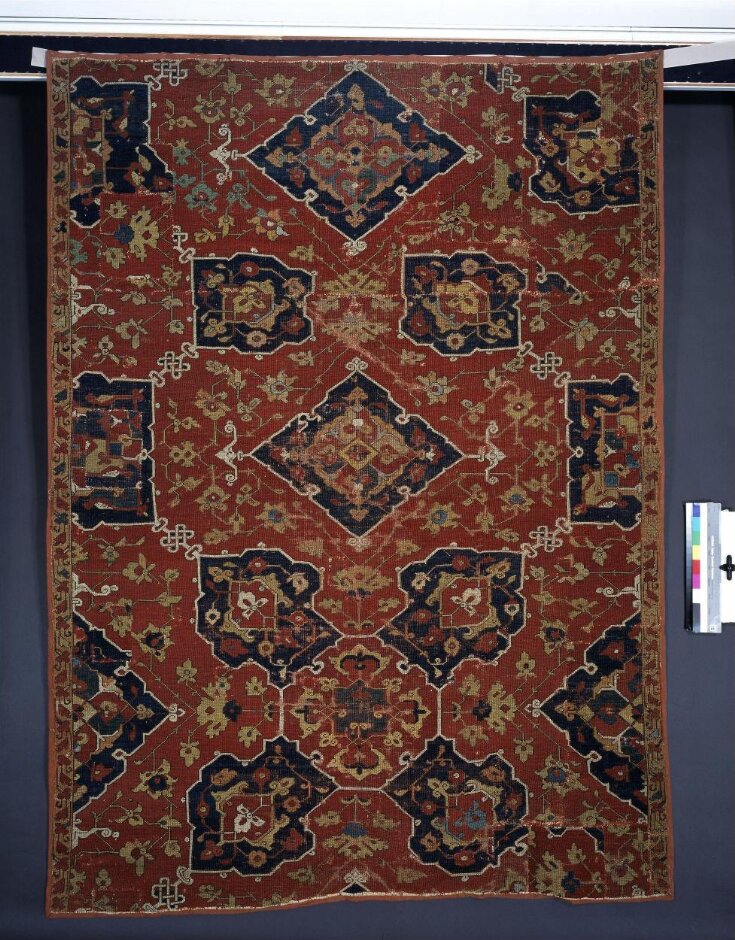
This fragment is made up of a number of pieces cut from the same carpet. The original design was one of the most accomplished variations of the so-called 'star Usak' pattern, and it may be one of the earliest examples.
A major centre of carpet production was the town of Usak in western Turkey. Weavers there began to use new designs based on medallions of different types during the reign of Sultan Mehmet the Conqueror (1451–81). Mehmet himself probably commissioned these designs. They were then used in commercial production for several centuries afterwards.
This fragment is made up of a number of pieces cut from the same carpet. The original design was one of the most accomplished variations of the so-called 'star Usak' pattern, and it may be one of the earliest examples.
Object details
| Categories | |
| Object type | |
| Materials and techniques | Hand knotted woollen pile on woollen warp and weft |
| Brief description | Carpet fragment, Turkey (probably Usak), 1450-1500. |
| Physical description | Carpet fragments, Variant Star Ushak pattern, hand knotted woollen pile on woollen warp and weft, Turkish, 16th century WARP: white wool; Z2S; 16 threads per inch (64 per dm). WEFT: red wool; Z spun, unplied; 2 shoots after every row of knots;10 knots per inch (40 per dm). PILE: wool; 9 colours: red, yellow, dark green, light green, dark blue, blue, black, white; symmetrical knot tied around 2 threads; 80 knots per sq. inch (1280 per sq. dm). SIDE FINISH: cut END FINISH: cut DESIGN: Field: Red ground; the elements preserved in these fragments include, towards the lower end, a red indented ocatgon within four, dark blue knot-linked, broad-leaf shapes; above is a dark blue indented diamond and, above the join, a second. At the edges, half of the diamond is at 90 degrees; these and the other figures ar filled with flowers that also grow on the light green stems that are traced across the field. Inner border: yellow ground with a black meander with buds and leaves. Catalogue Date: 15.07.98 |
| Dimensions |
|
| Style | |
| Gallery label | Jameel Gallery
Carpet Fragment
Turkey, probably Uşak
1450–1500
This fragment is made up of a number of pieces cut from the same carpet. The original design was one of the most accomplished variations of the so-called ‘star Uşak’ pattern, and it may be one of the earliest examples.
Wool warps (Z2S), wool wefts and pile
Museum no. 278-1906
(Jameel Gallery) |
| Summary | Pile carpets are one of many types of floor covering used in the Middle East. They are the most familiar to western Europeans as they have been imported from Turkey since at least the mid-15th century. Examples appear in Italian Renaissance paintings and are also depicted by north European artists such as Hans Holbein. Certain carpet designs became known in Europe by the names of the artists who painted them, including Holbein and Lorenzo Lotto. A major centre of carpet production was the town of Usak in western Turkey. Weavers there began to use new designs based on medallions of different types during the reign of Sultan Mehmet the Conqueror (1451–81). Mehmet himself probably commissioned these designs. They were then used in commercial production for several centuries afterwards. This fragment is made up of a number of pieces cut from the same carpet. The original design was one of the most accomplished variations of the so-called 'star Usak' pattern, and it may be one of the earliest examples. |
| Bibliographic references |
|
| Collection | |
| Accession number | 278-1906 |
About this object record
Explore the Collections contains over a million catalogue records, and over half a million images. It is a working database that includes information compiled over the life of the museum. Some of our records may contain offensive and discriminatory language, or reflect outdated ideas, practice and analysis. We are committed to addressing these issues, and to review and update our records accordingly.
You can write to us to suggest improvements to the record.
Suggest feedback
You can write to us to suggest improvements to the record.
Suggest feedback
| Record created | August 13, 2002 |
| Record URL |
Download as: JSONIIIF Manifest
