
Design
1735-1739 (designed)
| Artist/Maker | |
| Place of origin |
This design is from an album that contains 104 designs for fine woven silk cloth. A constant supply of fashionable new designs from which to create new lines was required, so patternmakers and master weavers like James Leman supplied a wide range of designs for different weavers. The album contains some of his work from the period 1706-1716, as well as five designs from the 1730s, including this one which is from about 1735-1739.
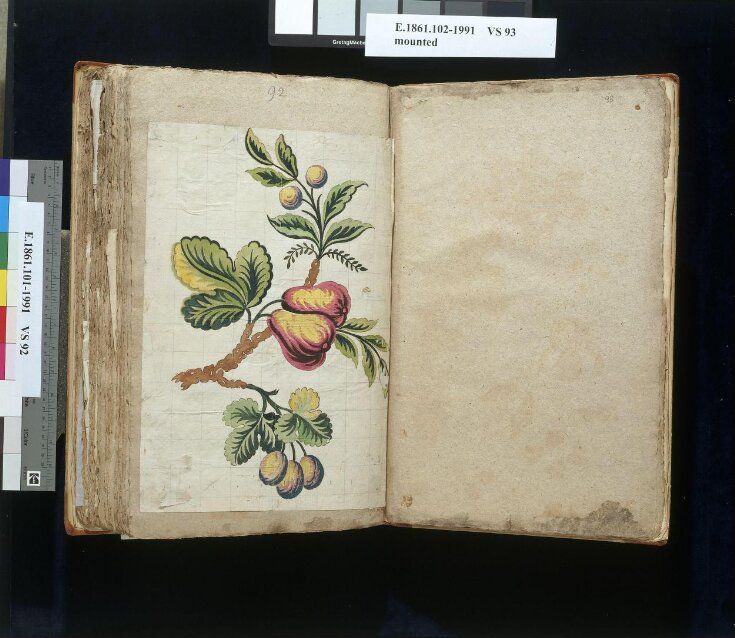
Natalie Rothstein stated in Silk Designs of the Eighteenth Century that 'this rather simple design with points rentrés modelling seems to date from the later 1730s'. Points rentrés modelling was an adaptation of a technique used by tapestry weavers which enabled tones of colour to be dovetailed, thus producing the effect of three dimensional form. The brocading weft is only taken across the width of the motif rather than from selvedge to selvedge (edge to edge) of the cloth which is the case with the main weft.
This design may be a French original even though it is squared off for drafting in point paper before entering the pattern onto the loom. It is somewhat similar to a design now in the Musée Historique des Tissus at Lyon.
James Leman was born in 1688 into a weaving family of Huguenot descent. In 1702 he was apprenticed to his father, Peter, and lived with his family in Stewart Street, Spitalfields in London.
Natalie Rothstein stated in Silk Designs of the Eighteenth Century that 'this rather simple design with points rentrés modelling seems to date from the later 1730s'. Points rentrés modelling was an adaptation of a technique used by tapestry weavers which enabled tones of colour to be dovetailed, thus producing the effect of three dimensional form. The brocading weft is only taken across the width of the motif rather than from selvedge to selvedge (edge to edge) of the cloth which is the case with the main weft.
This design may be a French original even though it is squared off for drafting in point paper before entering the pattern onto the loom. It is somewhat similar to a design now in the Musée Historique des Tissus at Lyon.
James Leman was born in 1688 into a weaving family of Huguenot descent. In 1702 he was apprenticed to his father, Peter, and lived with his family in Stewart Street, Spitalfields in London.
Object details
| Categories | |
| Object type | |
| Materials and techniques | Pencil, pen and ink, watercolour and bodycolour on laid paper |
| Brief description | Design for woven silk from the 'Leman Album', pencil, pen and ink, watercolour and bodycolour on laid paper, 1735-1739 |
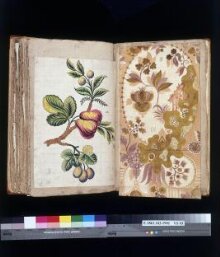
| Physical description | Design for woven silk from the 'Leman Album', in pencil, pen and ink, watercolour and bodycolour on laid paper, depicting a branch bearing pears, leaves, plums and rounded fruit. Squared up in pencil for cords and dezines, with dezines numbered in pencil. |
| Dimensions |
|
| Marks and inscriptions | Squared up in pencil for cords and dezines, with dezines numbered in pencil. (Handwritten makers' and designer's marks in pencil, on the front of the design.) |
| Credit line | Purchased with Art Fund support and the National Heritage Memorial Fund |
| Object history | This is a design from the so-called 'Leman album' which was bought from Vanners Silks Ltd. in 1991. Natalie Rothstein catalogued the designs before the album was bought by the Victoria and Albert Museum. She gave each design a VS number (for Vanners Silks) in her catalogue Silk Designs of the Eighteenth Century. The designs have been subsequently numbered by the Prints, Drawings and Paintings Department, however, a concordance exists. Historical significance: The designs collected in the album are, with the exception of some fragmentary medieval examples in Italian collections, the earliest silk designs known to exist. |
| Production | The following information is taken from Natalie Rothstein, Silk Designs of the Eighteenth Century. Please see the bibliographic reference under 'References' for more details. 'This rather simple design with points rentrés modelling seems to date from the later 1730s. Although this is squared off for drafting, this too may be a French original. It is somewhat similar to a design now in the Musée Historique des Tissus at Lyons.' Rothstein also stated that this drawing is one of five (E.1861.2-1991 (VS.1), E.1861.55-1991 (VS.97), E.1861.85-1991 (VS.76), E.1861.101-1991 (VS.92), E.1861.105-1991 (VS.96)) 'which fall outside the main body of the Vanners Silks Set. They are all of much later date. This can be seen by comparing them with dated designs in the [Anna Maria] Garthwaite Set [in the Prints, Drawings and Paintings Department at the V&A] and with dated French designs in Paris and Lyon. The choice of motifs, the much greater degree of naturalism and the use in all but VS.76 [E.1861.85-1991] of points rentrésindicate for all of them a date in the 1730s. It is conceivable that some of these drawings are by James Leman who was still alive in the 1730s. The short English inscription on VS.76 [E.1861.85-1991] may be in his hand and the inscription itself, together with the fact that three of the drawings have been squared off for drafting, does seem to indicate that these patterns were woven in England. But the superb design VS.96 [E.1861.105-1991] and to a lesser extent VS.96 [E.1861.85-1991] and VS.92 [E.1861.101-1991], so resemble French designs of the period that they must either be actual French drawings or close copies of them. There can be no doubt that VS.96 [E.1861.105-1991] is French and possibly by Jean Revel himself. It would have been perfectly in accordance with the practice at Spitalfields for Leman to have been in possession of French designs for woven silks: among the group of designs belonging to Garthwaite is a whole series labelled 'French Patterns'. The present five designs [E.1861.2-1991 (VS.1), E.1861.55-1991 (VS.97), E.1861.85-1991 (VS.76), E.1861.101-1991 (VS.92), E.1861.105-1991 (VS.96)] may represent some of Leman's 'French Patterns'.' |
| Summary | This design is from an album that contains 104 designs for fine woven silk cloth. A constant supply of fashionable new designs from which to create new lines was required, so patternmakers and master weavers like James Leman supplied a wide range of designs for different weavers. The album contains some of his work from the period 1706-1716, as well as five designs from the 1730s, including this one which is from about 1735-1739. Natalie Rothstein stated in Silk Designs of the Eighteenth Century that 'this rather simple design with points rentrés modelling seems to date from the later 1730s'. Points rentrés modelling was an adaptation of a technique used by tapestry weavers which enabled tones of colour to be dovetailed, thus producing the effect of three dimensional form. The brocading weft is only taken across the width of the motif rather than from selvedge to selvedge (edge to edge) of the cloth which is the case with the main weft. This design may be a French original even though it is squared off for drafting in point paper before entering the pattern onto the loom. It is somewhat similar to a design now in the Musée Historique des Tissus at Lyon. James Leman was born in 1688 into a weaving family of Huguenot descent. In 1702 he was apprenticed to his father, Peter, and lived with his family in Stewart Street, Spitalfields in London. |
| Bibliographic reference | Rothstein, Natalie. Silk Designs of the Eighteenth Century in the Collection of the Victoria and Albert Museum, London with a Complete Catalogue with 473 Illustrations, 371 in Colour. London: Thames and Hudson, 1990. 351p., ill. ISBN 0500235899.
p. 107
Full text of the entry is as follows:
'[Unnumbered, no inscription]
Squared up in pencil for cords and dezines, with dezines numbered in pencil. This rather simple design with points rentrés modelling seems to date from the later 1730s. Although this is sqaured off for drafting, this too may be a French original. It is somewhat similar to a design now in the Musée Historique des Tissus at Lyon.
15 7/8" (40.3) x 10 7/8" (27.6)
HJ.554 VS92' |
| Other number | VS.92 - Vanners Silks number |
| Collection | |
| Accession number | E.1861:101-1991 |
About this object record
Explore the Collections contains over a million catalogue records, and over half a million images. It is a working database that includes information compiled over the life of the museum. Some of our records may contain offensive and discriminatory language, or reflect outdated ideas, practice and analysis. We are committed to addressing these issues, and to review and update our records accordingly.
You can write to us to suggest improvements to the record.
Suggest feedback
You can write to us to suggest improvements to the record.
Suggest feedback
| Record created | May 8, 2002 |
| Record URL |
Download as: JSONIIIF Manifest
