Seated crowned Buddha
Sculpture
11th century-12th century (made)
11th century-12th century (made)
| Artist/Maker | |
| Place of origin |
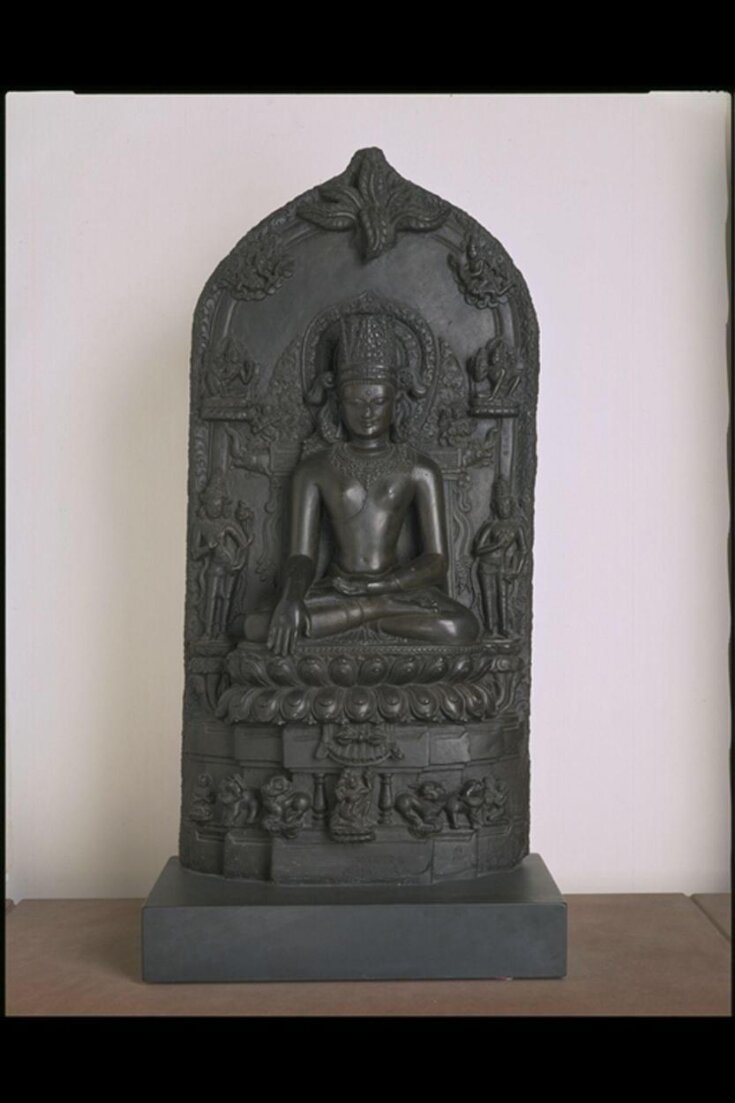
This sculpture shows Buddha Shakyamuni wearing the crown and ornaments of a monarch combined with the simple monastic robes of a monk. The tall tripartite crown, necklace and earrings contrast dramatically with the unadorned transparent robe.
This representation clearly uses royal imagery to evoke spiritual authority. The Buddha is seated on a double-lotus throne beneath which rests a thunderbolt sceptre (vajra), symbol of an enlightened mind. With his right hand he points to the earth as witness of his resistance to the temptations of wordly attachment, represented here by the demonic goddess Mara.
The throne is decorated with an elaborate aureole and back plate with makara (sea monster) finials upon which are perched kinnara (half-bird celestial musicians). Beneath the lotus-throne appears the Earth Goddess Prithvi, bearing witness to the Buddha's yogic asceticism. The goddess is flanked by lion and elephant throne-supports, emblematic of the Buddha’s strength and nobility.
The two kneeling figures may be identified as a donor couple. The Buddha is attended by the bodhisattvas Avalokitesvara and Maitreya, each standing on a lotus stem. Seated on lotus-thrones above the standing figures are the bodhisattvas Vajrapani and Manjusri. They are identified by their lotus-borne emblems, the vajra and the manuscript book of scripture respectively. Above are celestial adorers, presenting and bearing garlands. A roughly incised inscription is visible on the base mouldings along with depictions of offerings and ritual utensils.
This representation clearly uses royal imagery to evoke spiritual authority. The Buddha is seated on a double-lotus throne beneath which rests a thunderbolt sceptre (vajra), symbol of an enlightened mind. With his right hand he points to the earth as witness of his resistance to the temptations of wordly attachment, represented here by the demonic goddess Mara.
The throne is decorated with an elaborate aureole and back plate with makara (sea monster) finials upon which are perched kinnara (half-bird celestial musicians). Beneath the lotus-throne appears the Earth Goddess Prithvi, bearing witness to the Buddha's yogic asceticism. The goddess is flanked by lion and elephant throne-supports, emblematic of the Buddha’s strength and nobility.
The two kneeling figures may be identified as a donor couple. The Buddha is attended by the bodhisattvas Avalokitesvara and Maitreya, each standing on a lotus stem. Seated on lotus-thrones above the standing figures are the bodhisattvas Vajrapani and Manjusri. They are identified by their lotus-borne emblems, the vajra and the manuscript book of scripture respectively. Above are celestial adorers, presenting and bearing garlands. A roughly incised inscription is visible on the base mouldings along with depictions of offerings and ritual utensils.
Object details
| Categories | |
| Object type | |
| Title | Seated crowned Buddha (generic title) |
| Materials and techniques | Black stone or marble |
| Brief description | Seated figure of the Buddha, Bengal or Bihar, 11/12th century. |
| Physical description | The unusual Buddha-type is represented crowned and bejewelled in the style of a royal figure. The Buddha wears a tall crown and transparent robe which clings to the body and is adorned with a necklace and earrings. The use of royal imagery to evoke spiritual authority is most manifest in this representation. He is seated on a lotus throne beneath which rests a thunderbolt sceptre (vajra), symbol of an enlightened mind, and with his right hand he points to the earth as witness of his enlightenment (bhumisparsha mudra). Beneath the vajra appears the Earth Goddess Prithvi, bearing witness to the Buddha's authority. On either side of the goddess are lion and elephant throne-supports and the kneeling figures of two female devotees. To the Buddha's left stands a Bodhisattva perhaps Maitreya, with his right hand holding a rosary pressed to his breast. The left hand holds a leafy plant. To the Buddha's right stands the Bodhisattva Padmapani holding the stem of a lotus in his left hand, the right displaying the abhaya mudra or gesture of protection. Seated on lotus thrones above the standing figures are the Bodhisattvas Vajrapani (to the Buddha's right) and Manjusri, their emblems, the thunderbolt and the book of scripture, supported by lotuses at their sides. Above these in conventional clouds fly two celestial beings bearing scarves, each with a smaller figure to the rear. Behind the Buddha is his throne, the top of which ends in makara (sea monster) heads and supports an aureole with a kinnara (bird-legged celestial musician) perched on either side. |
| Dimensions |
|
| Style | |
| Marks and inscriptions | Inscription recording the donor and his spouse: Vikva (or Vikra?) and Pratāpadevi. (Two line donor inscription on the central projection at the base of the sculpture. Slight damage to the final akṣara of the first line and initial akṣara of the second line allow tentative reading.)
|
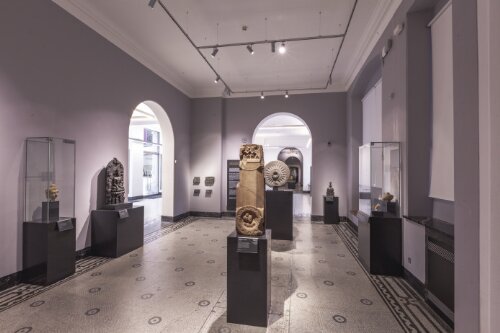
| Gallery label | Crowned Buddha
AD 1000–1100
Pala dynasty
Bihar, North-East India
Basalt
This image shows Buddha Shakyamuni at the moment
of his enlightenment at Bodhgaya. He wears the
crown and ornaments of a king with the simple
monastic robes of a monk, together evoking his
spiritual authority. His unshakeable state is represented
by the vajra or thunderbolt sceptre under the
lotus throne.
Museum no. 617-1872
1000–1100(1/4/2009) |
| Object history | Whitechapel Art Gallery: The Arts of Bengal 9.11.1979 to 30.12.1979. Purchased from W.J Hagger in 1872 for £5. |
| Production | Bengal or Bihar, Eastern India |
| Subject depicted | |
| Summary | This sculpture shows Buddha Shakyamuni wearing the crown and ornaments of a monarch combined with the simple monastic robes of a monk. The tall tripartite crown, necklace and earrings contrast dramatically with the unadorned transparent robe. This representation clearly uses royal imagery to evoke spiritual authority. The Buddha is seated on a double-lotus throne beneath which rests a thunderbolt sceptre (vajra), symbol of an enlightened mind. With his right hand he points to the earth as witness of his resistance to the temptations of wordly attachment, represented here by the demonic goddess Mara. The throne is decorated with an elaborate aureole and back plate with makara (sea monster) finials upon which are perched kinnara (half-bird celestial musicians). Beneath the lotus-throne appears the Earth Goddess Prithvi, bearing witness to the Buddha's yogic asceticism. The goddess is flanked by lion and elephant throne-supports, emblematic of the Buddha’s strength and nobility. The two kneeling figures may be identified as a donor couple. The Buddha is attended by the bodhisattvas Avalokitesvara and Maitreya, each standing on a lotus stem. Seated on lotus-thrones above the standing figures are the bodhisattvas Vajrapani and Manjusri. They are identified by their lotus-borne emblems, the vajra and the manuscript book of scripture respectively. Above are celestial adorers, presenting and bearing garlands. A roughly incised inscription is visible on the base mouldings along with depictions of offerings and ritual utensils. |
| Bibliographic references |
|
| Collection | |
| Accession number | 617-1872 |
About this object record
Explore the Collections contains over a million catalogue records, and over half a million images. It is a working database that includes information compiled over the life of the museum. Some of our records may contain offensive and discriminatory language, or reflect outdated ideas, practice and analysis. We are committed to addressing these issues, and to review and update our records accordingly.
You can write to us to suggest improvements to the record.
Suggest feedback
You can write to us to suggest improvements to the record.
Suggest feedback
| Record created | February 28, 2002 |
| Record URL |
Download as: JSONIIIF Manifest
