Bottle
1347-1370 (made)
| Artist/Maker | |
| Place of origin |
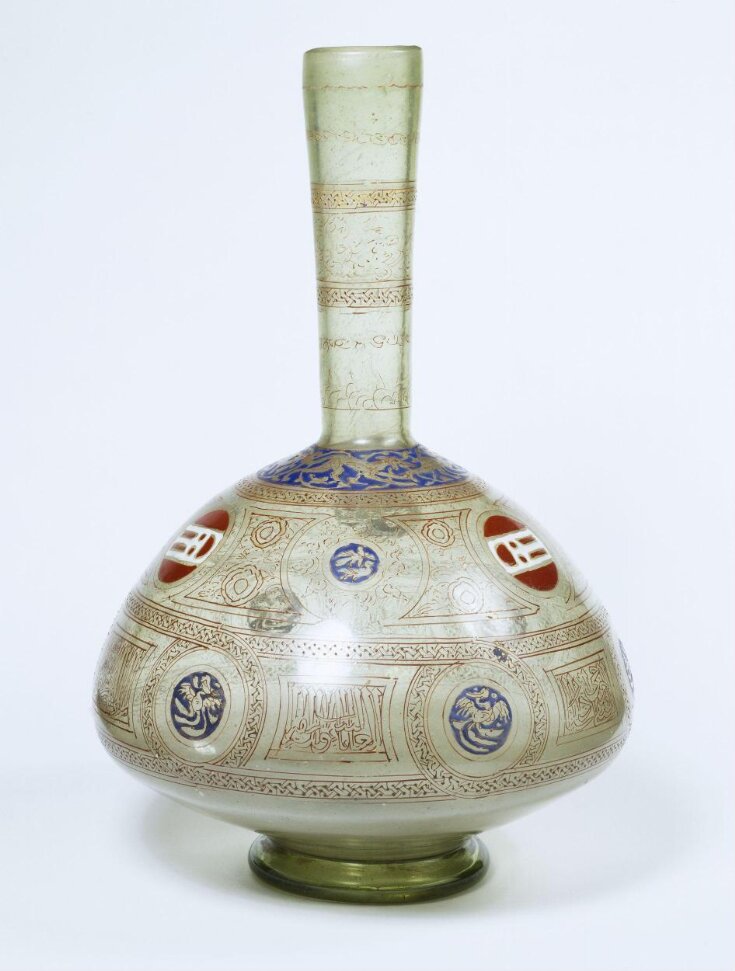
This bottle was purchased by the V&A as one of the largest and finest of its kind. The decoration is relatively sparse. It includes cartouches of calligraphy in praise of Sayf al-Din Jurji, who served the Mamluk Sultan Hasan of Egypt in the mid 14th century.
A conspicuous motif with two dots and two stripes appears several times in the upper register of the body. This is a stylised penbox and indicates Sayf al-Din Jurji’s high rank in the Sultan’s household.
A conspicuous motif with two dots and two stripes appears several times in the upper register of the body. This is a stylised penbox and indicates Sayf al-Din Jurji’s high rank in the Sultan’s household.
Object details
| Categories | |
| Object type | |
| Materials and techniques | Glass, blown, fired, gilded and enamelled, and fired again |
| Brief description | Bottle, gilded and enamelled glass, with Arabic inscription to Sayf al-Din Jurji, Commander in Chief under Mamluk Sultan Hasan, Egypt or Syria, around 1350 |
| Physical description | Bottle with long neck, flaring slightly at mouth. Body of globular form leading to narrow foot. Design sketched and painted in gold. Body features series of alternating roundels and cartouches, the former encircled by two strips of braid which run parallel to each other between each roundel. The cartouches are rectangular in form, enclosing an inscription in Arabic. Above this are a further set of medallions featuring heraldic emblems alternating with decorative medallions against a background of arabesque. Above this is a band of running animals against an arabesque background around the base of the neck of the bottle. The neck features two bands of braided motif against sketchy arabesque. |
| Style | |
| Marks and inscriptions |
|
| Gallery label |
|
| Object history | The shape of this bottle links it to a similarly shaped and sparsely-decorated example in the Museum of Islamic Art, Cairo (E. Atil, Renaissance.., fig. 49) which she dates to the late 13th- early 14th century. Medallions were a popular type of motif, but are used here to enclose the blazon of Saif al-Din Jurgi, the Major-domo of the Noble Porte. Blazons became increasingly important in the decoration of enamelled glass during the 14th century. |
| Summary | This bottle was purchased by the V&A as one of the largest and finest of its kind. The decoration is relatively sparse. It includes cartouches of calligraphy in praise of Sayf al-Din Jurji, who served the Mamluk Sultan Hasan of Egypt in the mid 14th century. A conspicuous motif with two dots and two stripes appears several times in the upper register of the body. This is a stylised penbox and indicates Sayf al-Din Jurji’s high rank in the Sultan’s household. |
| Bibliographic reference | Mayer, Saracenic Heraldry, p.134. |
| Other number | 8266 - Glass gallery number |
| Collection | |
| Accession number | 223-1879 |
About this object record
Explore the Collections contains over a million catalogue records, and over half a million images. It is a working database that includes information compiled over the life of the museum. Some of our records may contain offensive and discriminatory language, or reflect outdated ideas, practice and analysis. We are committed to addressing these issues, and to review and update our records accordingly.
You can write to us to suggest improvements to the record.
Suggest feedback
You can write to us to suggest improvements to the record.
Suggest feedback
| Record created | December 13, 1997 |
| Record URL |
Download as: JSONIIIF Manifest
