
Manuscript Page
ca. 1630 (made)
| Artist/Maker | |
| Place of origin |
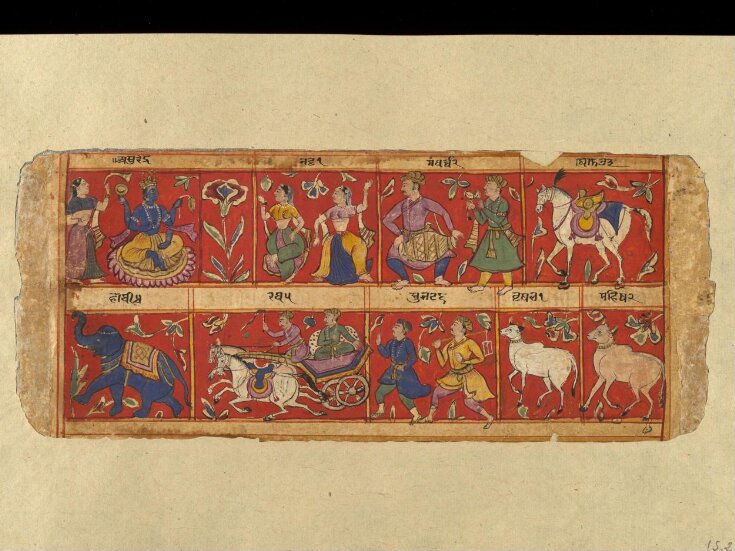
This Samgrahanisutra text presents a particular aspect of the Jain cosmological view. It shows the great world rulers, who are represented as subordinate deities in the service of the Jinas (saviour-teachers).
This painting depicts the first named ruler, Asurakumara, seated on a lotus throne in the upper left. He is associated with the Vedic deity Indra and wears a crown adorned with peacock feathers. His yellow dhoti contrasts dramatically with his dark complexion.
Asurakumarae is accompanied by his so-called ‘six jewels’, who celebrate him in song and dance. These jewels are the celestial dancers (‘natta’), the celestial musicians (‘gandharva’), the horse (‘ghoda’), the elephant (‘hathi’), the chariot (‘ratha’), and the soldiers (‘subhata’). In addition, the two right-hand frames of the lower register depict a young bull and a buffalo.
In the early 17th century, editions of the Samgrahanisutra followed the prevalent Mughal style. This painting represents a clear break from the lingering medieval Jain conventions. It combines Mughal elements with the traditional Western Indian format that used compartments and registers. The treatment of the costumes is inspired by Mughal conventions. The decorative handling of landscape, with schematic use of tree and flower motifs, illustrates the non-Mughal elements.
This painting depicts the first named ruler, Asurakumara, seated on a lotus throne in the upper left. He is associated with the Vedic deity Indra and wears a crown adorned with peacock feathers. His yellow dhoti contrasts dramatically with his dark complexion.
Asurakumarae is accompanied by his so-called ‘six jewels’, who celebrate him in song and dance. These jewels are the celestial dancers (‘natta’), the celestial musicians (‘gandharva’), the horse (‘ghoda’), the elephant (‘hathi’), the chariot (‘ratha’), and the soldiers (‘subhata’). In addition, the two right-hand frames of the lower register depict a young bull and a buffalo.
In the early 17th century, editions of the Samgrahanisutra followed the prevalent Mughal style. This painting represents a clear break from the lingering medieval Jain conventions. It combines Mughal elements with the traditional Western Indian format that used compartments and registers. The treatment of the costumes is inspired by Mughal conventions. The decorative handling of landscape, with schematic use of tree and flower motifs, illustrates the non-Mughal elements.
Object details
| Categories | |
| Object type | |
| Materials and techniques | Painted in watercolour on paper |
| Brief description | Manuscript page, folio recto from a Samgrahanisutra Manuscript, Asurakumara, paint on paper, Rajasthan or Gujarat, ca. 1630 |
| Physical description | Manuscript folio recto, watercolour paint on paper. In the early seventeenth century, editions of the Samgrahanisutrawere produced in a manner reflecting aspects of the prevalent Mughal style. Painting such as the one illustrated represent a clear break from the lingering medieval Jain conventions. They demonstrate an adoption of Moghul elements wedded to a traditional Western Indian format with its use of compartments and registers. The conventions employed for the depiction of horses, with slender legs issuing from rounded bodies, seem to derive directly from Moghul styles developed in the late-sixteenth century Akbari period. Similarly, the costume conventions are of Moghul inspiration, but the decorative and unnaturalistic handling of landscape betrays the intervention of non-Moghul elements (witness the schematic use of tree and flower motifs). The origins of this style remain unclear, though southern or eastern Rajasthan rather than Gujarat seems most likely, judging from similarities to early-seventeenth century Mewari painting. This text presents a particular aspect of the Jain cosmological view, that of the great world rulers, who are represented as subordinate deities in the service of the Jinas. These rulers are grouped in ten classes, and it is the first named, Asurakumara, who is depicted in this painting, seated on a lotus throne in the upper left. He is associated with Indra, a Vedic deity from whom he is ultimately derived, and wears a crown adorned with peacock feathers. Asurakumara, whose yellow dhoti contrasts dramatically with his dark complextion, is accompanied by his so-called " six jewels," who celebrate him in song and dance. These jewels are the celestial dancers (natta), the celestial musicians (gandharva), the horse (ghoda), the elephant (hathi), the chariot (ratha), and the soldiers (subhata). In addition, the two right-hand frames of the lower register depict a young bull and a buffalo. . |
| Dimensions |
|
| Content description | Asurakumara, seated on a lotus throne in the upper left. |
| Style | |
| Gallery label | PAGES FROM TWO SAMGRAHANISUTRA MANUSCRIPTS
ABOVE: THE GOD ASURAKUMARA AND HIS SIX JEWELS
Opaque watercolour on paperWestern India, probably Rajasthan, c.1630
IS.2-1984
The Samgrahanisutra is a cosmological text. Asurakumara is one of the Bhavanavasin gods of the highest of the underworlds. He is shown seated on a lotus throne with six ‘jewels’including dancers, musicians, a chariot and soldiers. A bull and a buffalo also appear. This painting shows marked influence from the Mughal style developed from the late 16th century.(14/05/2010) |
| Subjects depicted | |
| Summary | This Samgrahanisutra text presents a particular aspect of the Jain cosmological view. It shows the great world rulers, who are represented as subordinate deities in the service of the Jinas (saviour-teachers). This painting depicts the first named ruler, Asurakumara, seated on a lotus throne in the upper left. He is associated with the Vedic deity Indra and wears a crown adorned with peacock feathers. His yellow dhoti contrasts dramatically with his dark complexion. Asurakumarae is accompanied by his so-called ‘six jewels’, who celebrate him in song and dance. These jewels are the celestial dancers (‘natta’), the celestial musicians (‘gandharva’), the horse (‘ghoda’), the elephant (‘hathi’), the chariot (‘ratha’), and the soldiers (‘subhata’). In addition, the two right-hand frames of the lower register depict a young bull and a buffalo. In the early 17th century, editions of the Samgrahanisutra followed the prevalent Mughal style. This painting represents a clear break from the lingering medieval Jain conventions. It combines Mughal elements with the traditional Western Indian format that used compartments and registers. The treatment of the costumes is inspired by Mughal conventions. The decorative handling of landscape, with schematic use of tree and flower motifs, illustrates the non-Mughal elements. |
| Bibliographic references |
|
| Collection | |
| Accession number | IS.2-1984 |
About this object record
Explore the Collections contains over a million catalogue records, and over half a million images. It is a working database that includes information compiled over the life of the museum. Some of our records may contain offensive and discriminatory language, or reflect outdated ideas, practice and analysis. We are committed to addressing these issues, and to review and update our records accordingly.
You can write to us to suggest improvements to the record.
Suggest feedback
You can write to us to suggest improvements to the record.
Suggest feedback
| Record created | June 7, 2001 |
| Record URL |
Download as: JSONIIIF Manifest
