Armchair
ca. 1876 (made)
| Artist/Maker | |
| Place of origin |
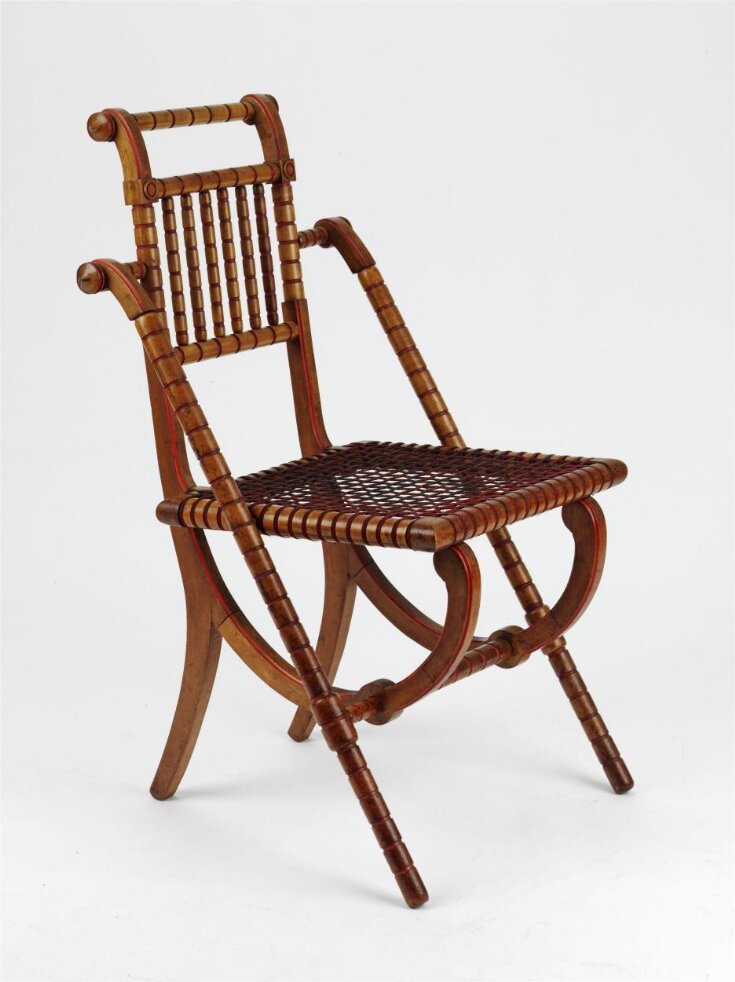
This chair was designed by George Hunzinger in New York and made around 1876. It reflected the desire of nineteenth-century designers to experiment with technologically innovative furniture-making techniques.
Nearly all the wood parts are turned rather than carved (the traditional means of treatment), a method of decoration which Hunzinger preferred. Hunzinger took out two patents for this chair. The second patent introduced wire or flat metal strips in place of cane for seats and backs ‘to insure great strength and beauty’. The strips were secured by pins and were ‘covered with threads wound or braided . . . and might be painted or varnished’ so the sitter did not come into direct contact with the metal. The result is a chair that has a remarkably strong structure.
Nearly all the wood parts are turned rather than carved (the traditional means of treatment), a method of decoration which Hunzinger preferred. Hunzinger took out two patents for this chair. The second patent introduced wire or flat metal strips in place of cane for seats and backs ‘to insure great strength and beauty’. The strips were secured by pins and were ‘covered with threads wound or braided . . . and might be painted or varnished’ so the sitter did not come into direct contact with the metal. The result is a chair that has a remarkably strong structure.
Object details
| Categories | |
| Object type | |
| Materials and techniques | Turned and painted maple, with steel seat and back |
| Brief description | Armchair (chair), turned and painted maple with steel, New York. Designed and made by George Hunzinger, ca. 1876. |
| Physical description | The body of the chair is made of turned and painted maple, with a back rail of six individual turned rails, the back uprights curving benath and supporting a strapwork steel seat (each metal strip being covered with braided wool). Stamped. |
| Dimensions |
|
| Marks and inscriptions | HUNZINGER / PAT MARCH 30 / 1869 / N.Y. / PAT APRIL 18 1876 (Stamp; back of rear right leg - first four lines upside down) |
| Gallery label |
|
| Object history | Two patents are represented in this chair: the first was for the diagonal side braces designed to strengthen the connection of seat and back, which Hunzinger described as the part of any chair most liable to loosening, "particularly the case with the more expensive character of chairs, where there are not any side rails between the back and front legs" (United States patent 88, 297, 309 March 1869). The second patent covered the use of wire or flat metal strips in place of cane for seats and backs "to insure great strength and beauty" (United States Patent 176, 314, 18 April 1876). The strips were "covered with threads wound or braided . . . and might be painted or varnished" so that the sitter did not come into direct contact with the metal. The patent covered the manner in which the strips were laid into grooves cut into the seat frame and the technique for securing the strips by means of pins set into the underside of the frame. This ingenious use of metal resulted in a remarkably strong structure. |
| Historical context | In 19th-century America patents were used not only to protect original designs or the technical features of products but, increasingly, as a selling device to signal novelty and innovation. In 1867, George Hunzinger advertised himself as 'Manufacturer of Patent Folding, Reclining and Extension CHAIRS', and virtually all his extant pieces are marked with details of his patents. In an expanding and increasingly competitive marketplace, patents represented a way for Hunzinger and others to distinguish their goods and to establish an identity. Hunziger was born in Tuttlingen, Württemberg, Germany, into a family of cabinet-makers with whom he served his apprenticeship. He worked as a journeyman in Geneva, Switzerland, for a time and came to New York in the 1850s during the peak of German emigration to America. Hunzinger built a large and successful business which prospered until the 1920s. |
| Production | Attribution note: Nearly all of the wood parts are turned which Hunziger preferred "as being ornamental, but not expensive" (US Patent 88, 297, 30 March 1869) The grooves in the turned surfaces were painted bright red to contrast with the light maple and to match the seat (which is ornamented with grey-green flecks); together, paint and textile give the chair a polychromatic effect. |
| Summary | This chair was designed by George Hunzinger in New York and made around 1876. It reflected the desire of nineteenth-century designers to experiment with technologically innovative furniture-making techniques. Nearly all the wood parts are turned rather than carved (the traditional means of treatment), a method of decoration which Hunzinger preferred. Hunzinger took out two patents for this chair. The second patent introduced wire or flat metal strips in place of cane for seats and backs ‘to insure great strength and beauty’. The strips were secured by pins and were ‘covered with threads wound or braided . . . and might be painted or varnished’ so the sitter did not come into direct contact with the metal. The result is a chair that has a remarkably strong structure. |
| Bibliographic references |
|
| Collection | |
| Accession number | W.14-1985 |
About this object record
Explore the Collections contains over a million catalogue records, and over half a million images. It is a working database that includes information compiled over the life of the museum. Some of our records may contain offensive and discriminatory language, or reflect outdated ideas, practice and analysis. We are committed to addressing these issues, and to review and update our records accordingly.
You can write to us to suggest improvements to the record.
Suggest feedback
You can write to us to suggest improvements to the record.
Suggest feedback
| Record created | June 1, 2001 |
| Record URL |
Download as: JSONIIIF Manifest
