
Chair
1836-1840 (made)
| Artist/Maker | |
| Place of origin |
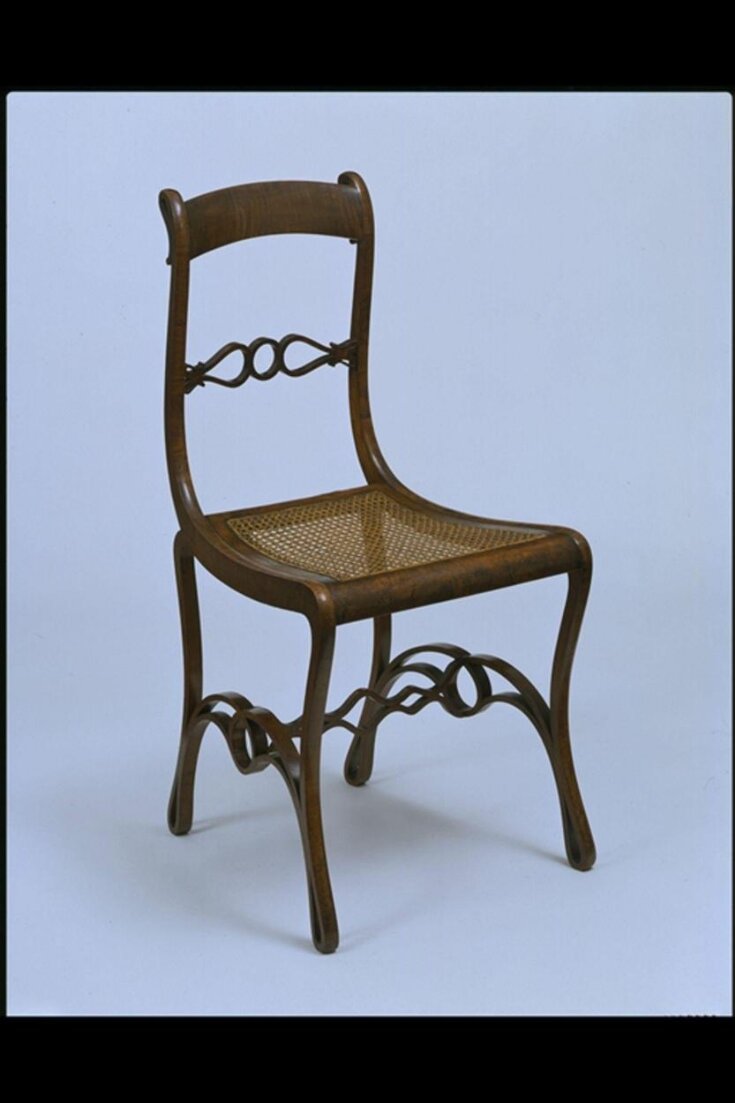
This chair made of moulded wood was designed by Michael Thonet (1796-1871), a German furniture maker and designer. The individual components are laminated wood that was first boiled in glue and then moulded into curvilinear shapes. (Thonet patented this inventive new process in Prussia in 1840). The result is a lightweight chair - this chair weighs 2.1 kg - with great tensile strength. It is also a cheaper method of production than joining together solid carved or turned wood parts. Thonet's later 'bentwood' furniture - moulded from solid lengths of wood - made at his factory in Vienna was very successful from around 1850 onwards. Mass-produced furniture of the bentwood kind was primarily intended for restaurants, cafés and hotels.
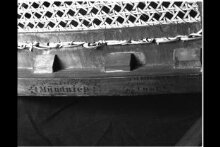
This chair was probably made by Peter Mündnich, a cabinet-maker accredited to the Court at Coblenz on the Rhine, almost certainly after Thonet's design. Peter Mündnich (1811-91) was a cabinet-maker in Coblenz, 15 km from Boppard. It is not known when he learned his profession; it is possible that it was under Thonet. The first mention of his 'Möbel Magazin' (furniture store) was in 1840. In June 1843, Mündnich became a 'Hof Tischler' and also exhibited furniture at various fairs, Coblez (1839), Berlin (1844) and Trier (1855). A report of the Berlin exhibition describes a chair which was constructed with laminated vereers, as in this example.
This chair was probably made by Peter Mündnich, a cabinet-maker accredited to the Court at Coblenz on the Rhine, almost certainly after Thonet's design. Peter Mündnich (1811-91) was a cabinet-maker in Coblenz, 15 km from Boppard. It is not known when he learned his profession; it is possible that it was under Thonet. The first mention of his 'Möbel Magazin' (furniture store) was in 1840. In June 1843, Mündnich became a 'Hof Tischler' and also exhibited furniture at various fairs, Coblez (1839), Berlin (1844) and Trier (1855). A report of the Berlin exhibition describes a chair which was constructed with laminated vereers, as in this example.
Object details
| Categories | |
| Object type | |
| Materials and techniques | Laminated walnut frame, with cane seat |
| Brief description | Chair, bentwood, German (Boppard-am-Rhein); 1836-1840. Designed by Michael Thonet and manufactured by Peter Mündnich |
| Physical description | Curvilinear laminated walnut frame with walnut surface veneers, with curved back splat, curved stretcher and cane seat. Solid wood bracing blocks to back, rear stretcher missing. |
| Dimensions |
|
| Marks and inscriptions |
|
| Gallery label |
|
| Object history | Historical significance: Made of laminated rather than carved wood, this chair is well-documented to be among his very earliest work. Stacks of thinly cut veneers were boiled in glue and moulded into curvilinear shapes using a process patented by Thonet in Prussia in 1840 and later in France and Austro-Hungary. These were sanded and joined, and veneers were applied to most surfaces to hide the striations of the veneers, giving the chair a more uniform surface appearance. The result was a lightweight chair - this chair weighs 2.1 kg - possessing great tensile strength. Only a few similar examples are known. Thonet's 'Wienerstühle, which evolved from this chair, became widely famed. |
| Historical context | Michael Thonet, in an attempt to lower costs, began to look for an alternative to cutting or carving wood and experimented with the use of bentwood for furniture. Thonet's technical innovation was part of the search for improved methods of manufacture spurred on by increased competition and made possible by the availability of woodworking machinery, including the circular saw. The 1820s saw not only the importation of many technical methods and machines from England but the invention and patenting of scores of new woodworking machines. Thonet himself was to spend the 1840s perfecting methods for bending laminated and solid wood, and by the 1850s he was mass-producing 'bentwood' furniture made from solid wood manufactured in a modern factory using machinery designed and built by his own firm, Gebrüder Thonet (Thonet Brothers). |
| Production | Attribution note: The seat frame is cut in one piece from a 5-laminate sheet. The front edge has a thicker core on the front upper edge, tapering towards the front lower edge. The legs and stretchers are all laminated (with varying numbers - 5 to 13 - at different points on the continuous curves). The visible surfaces of the legs and the stretchers are veneered. The side stretchers show one continuous curve starting and ending at the back, with the front to back curve cut to fit within this. The veneers on the front of surface of the top rail show wavy line joints, approximately 100mm apart. The caning show no sign of pegging and is all tied. Veneer is blistered at the back of the seat. Old tearing, which has been repaired, shows at the left of the top rail. |
| Summary | This chair made of moulded wood was designed by Michael Thonet (1796-1871), a German furniture maker and designer. The individual components are laminated wood that was first boiled in glue and then moulded into curvilinear shapes. (Thonet patented this inventive new process in Prussia in 1840). The result is a lightweight chair - this chair weighs 2.1 kg - with great tensile strength. It is also a cheaper method of production than joining together solid carved or turned wood parts. Thonet's later 'bentwood' furniture - moulded from solid lengths of wood - made at his factory in Vienna was very successful from around 1850 onwards. Mass-produced furniture of the bentwood kind was primarily intended for restaurants, cafés and hotels. This chair was probably made by Peter Mündnich, a cabinet-maker accredited to the Court at Coblenz on the Rhine, almost certainly after Thonet's design. Peter Mündnich (1811-91) was a cabinet-maker in Coblenz, 15 km from Boppard. It is not known when he learned his profession; it is possible that it was under Thonet. The first mention of his 'Möbel Magazin' (furniture store) was in 1840. In June 1843, Mündnich became a 'Hof Tischler' and also exhibited furniture at various fairs, Coblez (1839), Berlin (1844) and Trier (1855). A report of the Berlin exhibition describes a chair which was constructed with laminated vereers, as in this example. |
| Bibliographic references |
|
| Collection | |
| Accession number | W.5-1976 |
About this object record
Explore the Collections contains over a million catalogue records, and over half a million images. It is a working database that includes information compiled over the life of the museum. Some of our records may contain offensive and discriminatory language, or reflect outdated ideas, practice and analysis. We are committed to addressing these issues, and to review and update our records accordingly.
You can write to us to suggest improvements to the record.
Suggest feedback
You can write to us to suggest improvements to the record.
Suggest feedback
| Record created | May 24, 2001 |
| Record URL |
Download as: JSONIIIF Manifest
