
Evening Dress
ca. 1950 (made)
| Artist/Maker | |
| Place of origin |
Formal evening gowns were an essential part of a society lady’s wardrobe. Accessorised with jewels, these gowns provided a glittering show at receptions and balls, the opera or the theatre.
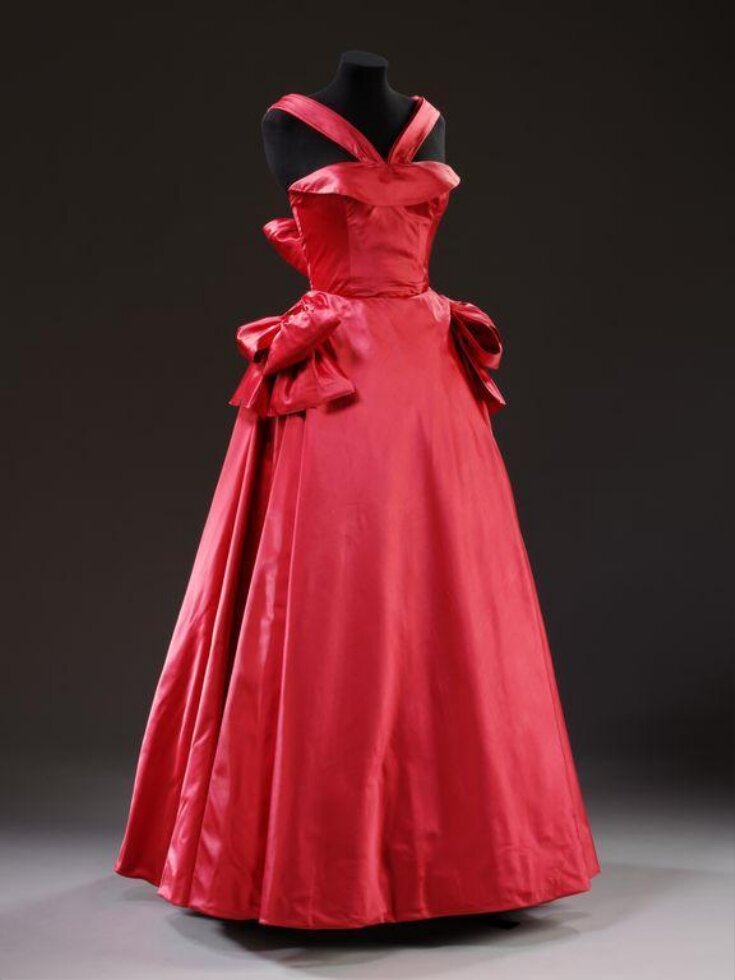
This evening dress from around 1950, designed by the London couturier Hardy Amies (1909–2003), is made of crimson silk satin and looks very sumptuous. However, the shape of the dress is created by a lining of thick paper-like material called Vilene, instead of the layers of tulle and silk net petticoats traditionally used by French couturiers. Textile rationing had only just been lifted in Britain (1949) and fabric was still very scarce, so Vilene was used as an economical alternative.
This evening dress from around 1950, designed by the London couturier Hardy Amies (1909–2003), is made of crimson silk satin and looks very sumptuous. However, the shape of the dress is created by a lining of thick paper-like material called Vilene, instead of the layers of tulle and silk net petticoats traditionally used by French couturiers. Textile rationing had only just been lifted in Britain (1949) and fabric was still very scarce, so Vilene was used as an economical alternative.
Object details
| Categories | |
| Object type | |
| Materials and techniques | Machine stitched silk satin, lined with vilene |
| Brief description | Evening dress of crimson silk satin, lined with Vilene |
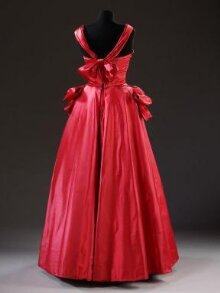
| Physical description | Long evening dress made of crimson satin. Sleeveless, heavily boned and wired bodice with flap band of satin at top. Large, draped straps cross the shoulders from the front of the bodice to the back of the bodice ending into a large bow. Long, large and slightly gathered skirt with 2 bows on each side at hips level. The skirt is lined with vilene for stiffness. The back zip has been re-tacked. |
| Dimensions |
|
| Production type | Haute couture |
| Marks and inscriptions | Hardy Amies (Label in the skirt) |
| Gallery label | Evening dress
Hardy Amies (1909-2003)
London
Early 1950s
This behemoth of an evening dress is heavily boned and wired, and lined with stiff Vilene, a less expensive alternative to the multiple layers of silk net used by Parisian couturiers. Amies wrote, 'Today, any dress, whether day or evening, demands that it shall flatter the bust into well defined roundness. The depth of décolleté now permissible is also considerable.'
Silk satin, lined with Vilene
Given by Mrs Lister Bolton
V&A: T.86-2001(22/09/2007-06/01/2008) |
| Credit line | Given by Lister Bolton |
| Object history | This dress was made for Mrs Jean Follett Holt in 1954. Mrs Follett Holt was the President of The Red Cross, Chelmsford, and wore the dress to The Red Cross Ball in London. She was painted wearing the dress in a portrait by Baron Killi di Pauli. |
| Historical context | Textile rationing was lifted in Britain in 1949, following the extreme scarcity of fabrics in the war, and immediate post-war, years. Vilene was used as a less expensive alternative to layers of silk net to create fullness. |
| Production | Late 1940s / early 1950s |
| Summary | Formal evening gowns were an essential part of a society lady’s wardrobe. Accessorised with jewels, these gowns provided a glittering show at receptions and balls, the opera or the theatre. This evening dress from around 1950, designed by the London couturier Hardy Amies (1909–2003), is made of crimson silk satin and looks very sumptuous. However, the shape of the dress is created by a lining of thick paper-like material called Vilene, instead of the layers of tulle and silk net petticoats traditionally used by French couturiers. Textile rationing had only just been lifted in Britain (1949) and fabric was still very scarce, so Vilene was used as an economical alternative. |
| Bibliographic reference | |
| Collection | |
| Accession number | T.86-2001 |
About this object record
Explore the Collections contains over a million catalogue records, and over half a million images. It is a working database that includes information compiled over the life of the museum. Some of our records may contain offensive and discriminatory language, or reflect outdated ideas, practice and analysis. We are committed to addressing these issues, and to review and update our records accordingly.
You can write to us to suggest improvements to the record.
Suggest feedback
You can write to us to suggest improvements to the record.
Suggest feedback
| Record created | May 18, 2001 |
| Record URL |
Download as: JSON
