
Kit
ca. 1670 (made)
| Artist/Maker | |
| Place of origin |
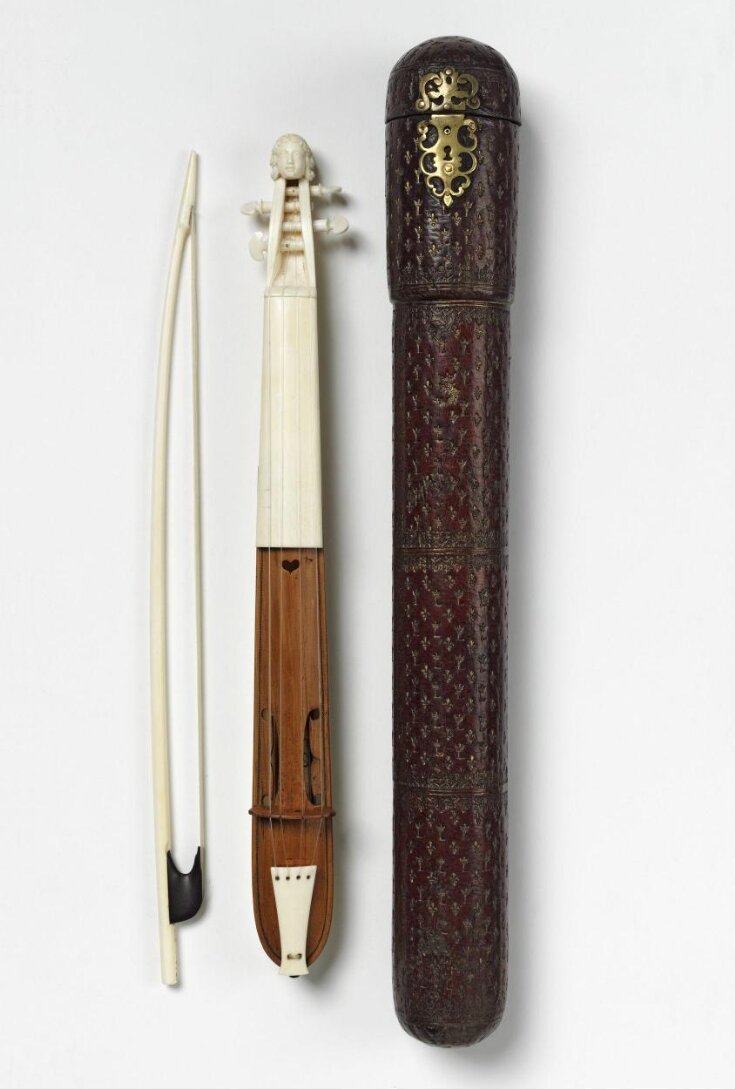
Kits were small and narrow variants of violins. They were known as pochettes in France because they could easily be fitted in the coat-pocket of a dancing master, who would play briefly on this instrument, slip it into his pocket and then demonstrate the appropriate steps. Very little music was composed specifically for the kit so the performer generally played violin pieces or popular tunes.
Virtually nothing is known about Dimanche Drouyn, the maker, but he was clearly important enough to supply musical instruments to the household of the Grand Dauphin Louis (1661-1711), the oldest son of Louis XIV (reigned 1643-1715). This kit was made of ivory, a costly material, and came in a handsome leather case, stamped with a crowned dolphin, the emblem of the heir to the throne of France. The hair-style of the female head crowning the instrument would have been highly fashionable in about 1670.
Virtually nothing is known about Dimanche Drouyn, the maker, but he was clearly important enough to supply musical instruments to the household of the Grand Dauphin Louis (1661-1711), the oldest son of Louis XIV (reigned 1643-1715). This kit was made of ivory, a costly material, and came in a handsome leather case, stamped with a crowned dolphin, the emblem of the heir to the throne of France. The hair-style of the female head crowning the instrument would have been highly fashionable in about 1670.
Object details
| Categories | |
| Object type | |
| Parts | This object consists of 3 parts.
|
| Materials and techniques | The instrument of carved ivory and planed sycamore with twisted silver wire, the bow of carved ivory and ebony, the case of tooled and part gilt leather with a brass clasp |
| Brief description | Kit by Dimanche Drouyn. Paris, ca. 1670. |
| Physical description | 'Narrow model, with five-faced ivory body. Belly with purfling simulated with inlaid silver twisted wire, and with a heart-shaped soundhole and two inwards-facing C-holes with central points. Ivory fingerboard and pegbox, with the finial in the form of a woman's head with plait at back. On the back of the body is written in Indian ink: 370 P.R. With the instrument is an ivory bow. The tubular, tooled and gilt red leather case is decorated in a manner practised in France during the second half of the seventeenth century. The fleur-de-lis gives no indication of date. The crowned L's are associated with Louis XIII and XIV in the seventeenth century, as well as with earlier and later kings of that name. The crowned dolphin which also appears on it, however, was borne only by the Dauphin; and only the Dauphin of the second half of the century was Louis, le Grand Dauphin (1661-1711), the eldest son of Louis XIV. He is more likely to have had use for a pochette during the earlier part of his life, during the third quarter of the century. The hair-style of the lady on the finial also suggests this date. Thus this kit must presumably be a French royal piece. It is also interesting to note that the inlaid stringing of spiral silver wire, seen on the belly of the instrument itself, occurs on some French gun-stocks. The wire for this purpose was normally straight before and after this period but, during the third quarter of the seventeenth century, it was often spiralled. The maker, Drouyn, seems to be otherwise unrecorded. Anthony Baines, Catalogue of Musical Instruments in the Victoria and Albert Museum: Part II: Non-Keyboard Instruments (London, 1978), pp. 20-21. |
| Dimensions |
|
| Production type | Unique |
| Marks and inscriptions | Dimanche Drouyn/ A Paris (1) Makers's mark 2) Signature; French; Cursive; On label inside the instrument.; inscribed; ink)
|
| Gallery label |
|
| Production | 'The crowned dolphin which also appears on the case was borne only by the Dauphin; and the only Dauphin of the second half od the century was Louis, le Grand Dauphin (1661 - 1711), the eldest son of Louis XIV. He is more likely to have had use for a pochette during the earlier part of his life, during the third quarter of the seventeenth century. The hair-style of the lady on the finial also suggests this date' - Anthony Baines, Non-Keyboard Instruments pp. 20 - 21. |
| Summary | Kits were small and narrow variants of violins. They were known as pochettes in France because they could easily be fitted in the coat-pocket of a dancing master, who would play briefly on this instrument, slip it into his pocket and then demonstrate the appropriate steps. Very little music was composed specifically for the kit so the performer generally played violin pieces or popular tunes. Virtually nothing is known about Dimanche Drouyn, the maker, but he was clearly important enough to supply musical instruments to the household of the Grand Dauphin Louis (1661-1711), the oldest son of Louis XIV (reigned 1643-1715). This kit was made of ivory, a costly material, and came in a handsome leather case, stamped with a crowned dolphin, the emblem of the heir to the throne of France. The hair-style of the female head crowning the instrument would have been highly fashionable in about 1670. |
| Bibliographic reference | Lütgendorff, Die Geigen-und Lautenmacher, Vol. 11.
Peter Thornton, Musical Instruments as Works of Art (H.M.S.O., 1968), figs. 26a and 26b.
Connaissance des Arts, undated article in Departmental Catalogue.
London, Victoria & Albert Museum, Catalogue of Musical Instruments in the Victoria & Albert Museum. Part II, Anthony Baines: Non-keyboard instruments (London, 1998), pp. 20 - 21. |
| Collection | |
| Accession number | 519 to B-1872 |
About this object record
Explore the Collections contains over a million catalogue records, and over half a million images. It is a working database that includes information compiled over the life of the museum. Some of our records may contain offensive and discriminatory language, or reflect outdated ideas, practice and analysis. We are committed to addressing these issues, and to review and update our records accordingly.
You can write to us to suggest improvements to the record.
Suggest feedback
You can write to us to suggest improvements to the record.
Suggest feedback
| Record created | May 16, 2001 |
| Record URL |
Download as: JSONIIIF Manifest
