Hurdy-Gurdy
ca. 1770-1785 (made)
| Artist/Maker | |
| Place of origin |
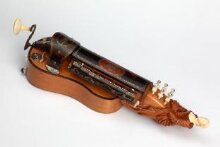
The hurdy-gurdy is a stringed instrument, shaped like the body of a guitar or lute, with a winding handle which turns a disc to sound the strings. The left hand presses the buttons to produce the melody, while the right hand rotates the disc to produce a background drone. It was a widespread instrument in Europe during the Middle Ages in both religious and secular contexts. Although used at every level of society it became particularly associated with itinerant minstrels, peasants, beggars and blind musicians.
The decoration points to the status of this instrument as a fashionable accessory, rather than an instrument to be played seriously. Nevertheless, from 1731 to 1733 the hurdy-gurdy was featured with orchestral accompaniment at the Concert Spirituel in Paris and the renewed interest in the instrument led to the production of a musical repertory. In 1739 the French composer Nicholas Chédeville (1705-1782) published Le printems, ou Les saisons amusantes (1739) an arrangement of Vivaldi's The Four Seasons for hurdy-gurdy or musette, violin, and flute.
The decoration points to the status of this instrument as a fashionable accessory, rather than an instrument to be played seriously. Nevertheless, from 1731 to 1733 the hurdy-gurdy was featured with orchestral accompaniment at the Concert Spirituel in Paris and the renewed interest in the instrument led to the production of a musical repertory. In 1739 the French composer Nicholas Chédeville (1705-1782) published Le printems, ou Les saisons amusantes (1739) an arrangement of Vivaldi's The Four Seasons for hurdy-gurdy or musette, violin, and flute.
Object details
| Categories | |
| Object type | |
| Materials and techniques | Sycamore body, carved and turned ivory, other parts of turtle shell inlaid with silver and brass piqué work (some turtle shell lacquered with silver and brass piqué work), silver roses, and partly silvered brass keys inset with faceted rock crystal and engraved mother-of-pearl |
| Brief description | French, 1770-80 |
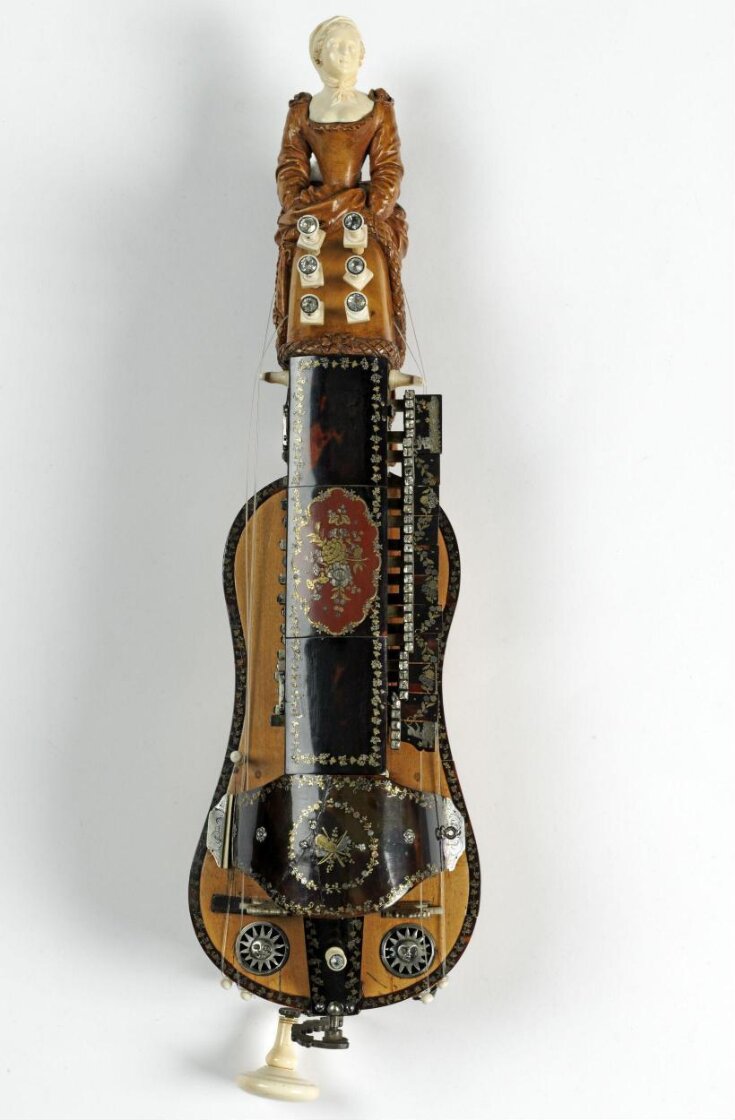
| Physical description | 'A small sized, highly ornamented instrument, made no doubt as a drawing-room toy. Guitar-shaped body of sycamore. The belly is edged with a band of tortoiseshell with silver and brass piqué work, and has two roses of pierced and stamped silver with sun motifs. The tailpiece, wheel-guard, and keybox lid are likewise decorated, the last having a central panel of reddish-brown lacquer also inlaid with a floral design. On the wheel-guard, a garland within which is a trophy of musical instruments. The main keys are similarly decorated. The short keys are set with paste imitation stones, as are the six ivory pegs. The finial of the pegbox is finely carved in wood with the figure of a woman, her neck and head being of ivory. Her open gown is pulled back to form the sides of the pegbox, while her petticoat forms the top which holds the pegs.' Anthony Baines, Catalogue of Musical Instruments in the Victoria and Albert Museum: Part II: Non-Keyboard Instruments (London, 1978), p. 27. |
| Dimensions |
|
| Production type | Unique |
| Gallery label |
|
| Object history | The instrument was cleaned and restored in the Museum's conservation department in 1963. |
| Historical context | During the eighteenth century rusticity was in vogue; Queen Marie-Antoinette of France (1755-1793) created her own village and farm in the grounds of Versailles between 1783 and 1784, and made an idealised version of the peasant life fashionable. The hurdy-gurdy, with its rustic associations, was taken up by the French aristocracy. Disguised as shepherds and shepherdesses, they played the instrument at the fêtes champêtres at Versailles, and ladies and gentlemen at court played this instrument as well as musettes (bagpipes). This small, unsigned but beautifully decorated instrument was more suitable for the drawing-room. The rustic associations of the hurdy-gurdy are reflected in the carved ivory and sycamore female figure on this instrument, who is dressed like an idyllic version of a peasant. |
| Subjects depicted | |
| Summary | The hurdy-gurdy is a stringed instrument, shaped like the body of a guitar or lute, with a winding handle which turns a disc to sound the strings. The left hand presses the buttons to produce the melody, while the right hand rotates the disc to produce a background drone. It was a widespread instrument in Europe during the Middle Ages in both religious and secular contexts. Although used at every level of society it became particularly associated with itinerant minstrels, peasants, beggars and blind musicians. The decoration points to the status of this instrument as a fashionable accessory, rather than an instrument to be played seriously. Nevertheless, from 1731 to 1733 the hurdy-gurdy was featured with orchestral accompaniment at the Concert Spirituel in Paris and the renewed interest in the instrument led to the production of a musical repertory. In 1739 the French composer Nicholas Chédeville (1705-1782) published Le printems, ou Les saisons amusantes (1739) an arrangement of Vivaldi's The Four Seasons for hurdy-gurdy or musette, violin, and flute. |
| Bibliographic references |
|
| Collection | |
| Accession number | 95-1870 |
About this object record
Explore the Collections contains over a million catalogue records, and over half a million images. It is a working database that includes information compiled over the life of the museum. Some of our records may contain offensive and discriminatory language, or reflect outdated ideas, practice and analysis. We are committed to addressing these issues, and to review and update our records accordingly.
You can write to us to suggest improvements to the record.
Suggest feedback
You can write to us to suggest improvements to the record.
Suggest feedback
| Record created | May 16, 2001 |
| Record URL |
Download as: JSONIIIF Manifest
