
Keyed Monochord
about 1890 (Made)
| Artist/Maker | |
| Place of origin |
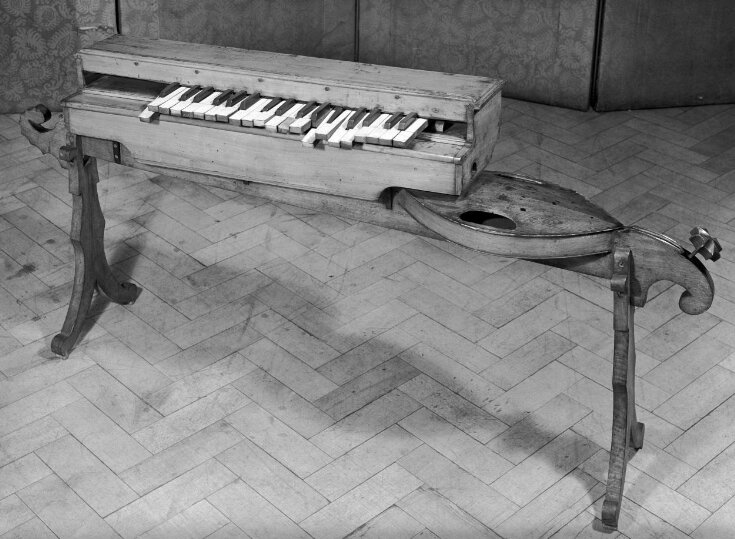
The keyed-monochord (literally 'one string') is fitted with one large string (often of horse-hair), and played partly with key-operated blades, rather like a clavichord, and partly with a bow. Its oval body rests on a stand. J. Pousette of France invented the keyed monochord (or monochorde à clavier) in 1883 and intended it for church music.
Object details
| Category | |
| Object type | |
| Materials and techniques | Carved and planed pine body and stand; pine keyboard; ivory-covered naturals; ebony sharps. |
| Brief description | Keyed monochord, pine sound-box, French, about 1890. |
| Physical description | "The instrument, which is mounted on a central stand, consists of a narrow box of pine containing a key action, fixed by iron brackets to a longitudinal central member. On the right is an oval soundbox of pine, with two C-shaped soundholes with central nicks, placed back to back, and with a knob-like peg for tuning the single string, which passes over a bridge and runs through the keybox. The string is sounded with a separate bow. On the front of the keybox is a three-octave keyboard with twenty-two ivory natural keys and fifteen sharps. The keys actuate brass levers which strick and stop the string in the manner of the keys of a clavichord'. - Anthony Baines, Catalogue of Musical Instruments in the Victoria and Albert Museum - Part II: Non-keyboard instruments (London, 1998), pp. 27 - 28. |
| Dimensions |
|
| Gallery label | KEYED MONOCHORD
French; about 1886
Pine soundboard and ivory naturals. The instrument has a range of three octaves.
Non-Keyboard Catalogue No.: 6/7
The Monocorde Clavier was invented by J. Pousset in 1883 and first built in 1886, being intended for churches. The string, usually of horse hair is sounded by a bow and brass tangents that were activated by the keys, like a clavichord.
W.38-1917
Bequeathed by Henry Saint-George, Esq.(pre September 2000) |
| Credit line | Given to the Museum by Henry Saint-George, Esq. |
| Object history | This instrument was given to the museum by Henry Saint-George, in 1917. |
| Summary | The keyed-monochord (literally 'one string') is fitted with one large string (often of horse-hair), and played partly with key-operated blades, rather like a clavichord, and partly with a bow. Its oval body rests on a stand. J. Pousette of France invented the keyed monochord (or monochorde à clavier) in 1883 and intended it for church music. |
| Bibliographic reference | Anthony Baines: Catalogue of Musical Instruments in the Victoria and Albert Museum - Part II: Non-keyboard instruments. (London, 1998), pp. 27 - 28. |
| Collection | |
| Accession number | W.38-1917 |
About this object record
Explore the Collections contains over a million catalogue records, and over half a million images. It is a working database that includes information compiled over the life of the museum. Some of our records may contain offensive and discriminatory language, or reflect outdated ideas, practice and analysis. We are committed to addressing these issues, and to review and update our records accordingly.
You can write to us to suggest improvements to the record.
Suggest feedback
You can write to us to suggest improvements to the record.
Suggest feedback
| Record created | May 16, 2001 |
| Record URL |
Download as: JSONIIIF Manifest
