Guitar
1693 (made)
| Artist/Maker | |
| Place of origin |
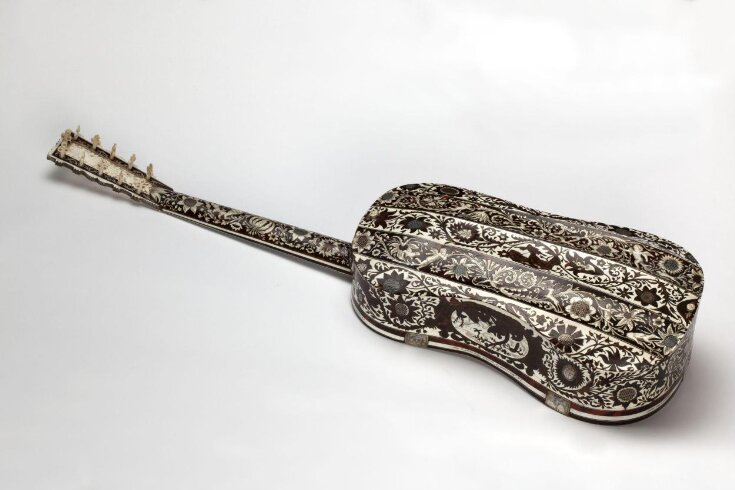
This guitar was made in Hamburg in 1693 by Joachim Tielke (1641-1719), who built a large number of highly prestigious stringed instruments, of which fifteen guitars are known to survive today. The instruments were often elaborately decorated with ivory and tortoiseshell inlay similar to the floral motifs on this example.
From about 1650, the guitar became a highly fashionable instrument throughout Europe, and guitarists like Francesco Corbetta (ca. 1615-1681) and Robert de Visée (ca. 1650-1725) could make a good living at the courts of Charles II of England and Louis XIV of France respectively. These two composed melodious works at a time when much guitar music consisted of strumming sequences of chords, named after letters of the alphabet ( all’alfabeto), as opposed to notes and keys.
From about 1650, the guitar became a highly fashionable instrument throughout Europe, and guitarists like Francesco Corbetta (ca. 1615-1681) and Robert de Visée (ca. 1650-1725) could make a good living at the courts of Charles II of England and Louis XIV of France respectively. These two composed melodious works at a time when much guitar music consisted of strumming sequences of chords, named after letters of the alphabet ( all’alfabeto), as opposed to notes and keys.
Object details
| Category | |
| Object type | |
| Materials and techniques | Softwood, ivory and turtle shell veneer, mother-of-pearl and ebony, with engraved marquetry, gilt vellum rosette and carved ivory openwork head |
| Brief description | Guitar of pine, decorated with marquetry of ivory and tortoishell, with ebony, pewter and mother-of-pearl; rose of vellum. Signed by Joachim Tielke, Hamburg, 1693 |
| Physical description | 'Vaulted back of five broad ribs of engraved marquetry of tortoiseshell, ivory and pewter in floral designs, cupids and classical scenes identified by short inscriptions; also with putti running through foliage in chase scenes. The sides are of marquetry, similarly decorated. The pine belly, with ladder-pattern purfling in ebony, ivory and pewter, is inlaid with floral marquetry in tortoiseshell, ivory and ebony in the star-shaped surround to the rose. The sunk rose is of vellum, of extreme complexity, partly gilded. The bridge is decorated with engraved mother-of-pearl and flanked by floral scrolls in tortoiseshell marquetry applied to the belly. The neck is decorated on the back with tortoiseshell and ivory marquetry, and the extension of the belly wood is inlaid with leaves in engraved mother-of-pearl. The flush ebony fingerboard is bordered with ivory fillets, and is without frets. The head has openwork of carved ivory in a floral design with putto. There are eleven pegs of carved and turned ivory, for six courses of strings, the first single, the rest double.' Anthony Baines, Catalogue of Musical Instruments in the Victoria and Albert Museum - Part II: Non-Keyboard Instruments (London, 1978), p. 57. |
| Dimensions |
|
| Style | |
| Marks and inscriptions |
|
| Gallery label |
|
| Object history | This instrument was bought for £53 from Messrs Goldschmidt of Frankfurt in September, 1872. It was first thought to be French, 17th century. It was "cleaned and repaired in detail in the Conservation Department" in 1963 (cf. Furniture & Woodwork Departmental Catalogues), when the signature and date would have been found. It was subsequently recorded in Anthony Baines: Catalogue of Musical Instruments in the Victoria and Albert Museum - Part II: Non-keyboard instruments (London, H.M.S.O., 1968). A discussion of Tielke's marquetry can be found in Friedemann Hellwig, 'Die Marketerien auf den Instrumenten Joachim Tielke', Die Kunst der Ebenisten: Quellenstudien, technologische Untersuchengen und innovative Verfahren in der Holzresaurierung, ed. Jorg Weber (Potsdam: Verlag der Fachhochschule, 2017, pp. 34-41. Copy in departmental file for the object. |
| Subjects depicted | |
| Summary | This guitar was made in Hamburg in 1693 by Joachim Tielke (1641-1719), who built a large number of highly prestigious stringed instruments, of which fifteen guitars are known to survive today. The instruments were often elaborately decorated with ivory and tortoiseshell inlay similar to the floral motifs on this example. From about 1650, the guitar became a highly fashionable instrument throughout Europe, and guitarists like Francesco Corbetta (ca. 1615-1681) and Robert de Visée (ca. 1650-1725) could make a good living at the courts of Charles II of England and Louis XIV of France respectively. These two composed melodious works at a time when much guitar music consisted of strumming sequences of chords, named after letters of the alphabet ( all’alfabeto), as opposed to notes and keys. |
| Bibliographic references |
|
| Collection | |
| Accession number | 676-1872 |
About this object record
Explore the Collections contains over a million catalogue records, and over half a million images. It is a working database that includes information compiled over the life of the museum. Some of our records may contain offensive and discriminatory language, or reflect outdated ideas, practice and analysis. We are committed to addressing these issues, and to review and update our records accordingly.
You can write to us to suggest improvements to the record.
Suggest feedback
You can write to us to suggest improvements to the record.
Suggest feedback
| Record created | May 16, 2001 |
| Record URL |
Download as: JSONIIIF Manifest
