
Chitarrone
1614 (made)
| Artist/Maker | |
| Place of origin |
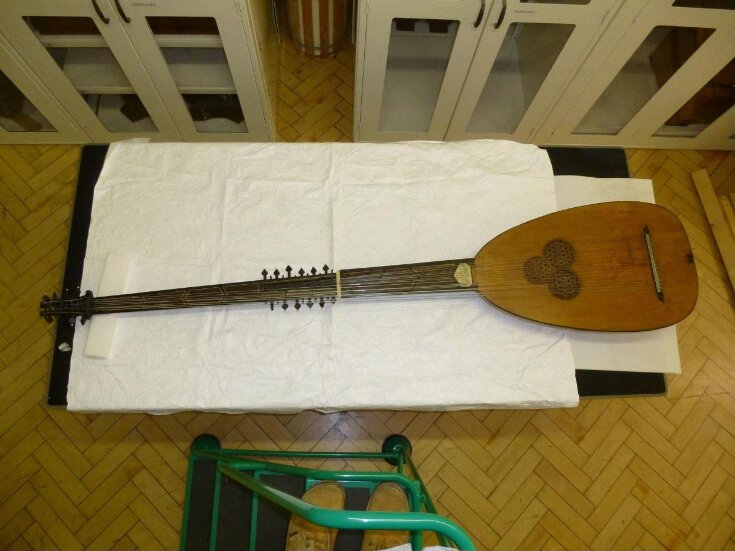
Chitarrone literally means 'big guitar' and because its upper strings are pitched an octave lower than those of the lute, it sounds remarkably like the modern classcial guitar. The chitarrone had a particularly long neck which ended in an extra pegbox for the bass strings. The longest examples were made by Matteo Buechenberg (d. 1628), a German who settled in Rome in about 1590.
Buechenberg made this instrument in 1614 for the household of Cosimo II, Grand Duke of Tuscany (reigned 1609-1621). The Duke was the patron and protector of the astronomer Gallileo Gallilei (1564-1642) whose father and younger brother both happened to be professional lutenists and composers. The finest music for chitarrone was probably written by Giovanni Girolamo Kapsberger, who published four books of lute and chitarrone music in Rome between 1604 and 1640.
Buechenberg made this instrument in 1614 for the household of Cosimo II, Grand Duke of Tuscany (reigned 1609-1621). The Duke was the patron and protector of the astronomer Gallileo Gallilei (1564-1642) whose father and younger brother both happened to be professional lutenists and composers. The finest music for chitarrone was probably written by Giovanni Girolamo Kapsberger, who published four books of lute and chitarrone music in Rome between 1604 and 1640.
Object details
| Categories | |
| Object type | |
| Materials and techniques | Carved pine soundboard, planed ribs of yew, ebony neck and ivory stringing |
| Brief description | Italian, Rome, Matteo Buechenberg, 1614 |
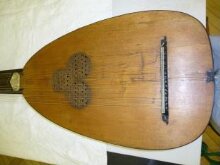
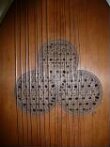
| Physical description | Body of forty-one shaded ribs of yew. Pine belly carved with a triple rose. The neck is of ebony, with ivory stringing forming angular panels on the fingerboard; the ebony and an unidentified dark brown wood form a diagonal chequerboard pattern. The main pegbox is for six double courses. The upper pegbox, for eight single strings, has clearly been sawn off and replaced on the front face of the head. There are also signs of splicing and repairs at the lower end of the head below the main pegbox. |
| Dimensions |
|
| Marks and inscriptions |
|
| Gallery label | CHITARRONE
By Matteo Buechenberg (German, d. 1628), Italy, Rome, 1614
Signed Matheus Buecheberg/ Roma 1614
Pine top and yew ribs. Neck, considerably altered later, with ivory stringing.
Non-Keyboard Catalogue No.: 7/11
The chitarrone was developed in the 1580s. Larger than the theorbo, it served both for solo playing and accompaniment for singing. Its extended neck allowed for extra bass strings, usually eight in number.
Matteo Buechenberg (d. 1628), a German who settled in Rome in the 1590s, was among the earliest makers of these instruments. The instrument is thought to have belonged to Grand Duke Cosimo II of Tuscany.
190-1882(pre September 2000) |
| Object history | This formed part of the collection of Carl Engel (1818 - 1882), a leading musicologist who published the Descriptive Catalogue of the Musical Instruments in the South Kensington Museum (London, 1874). Engel's collection was bought by the museum in 1882, nos. 150 to 350, for £555. 6s. 0d. RP 2315/1882 Bought for £8 Probably this instrument was genuinely built as a chitarrone, but the neck later chopped down and spliced. The Grand-Ducal crown, on an engraved ivory panel at base of fingerboard, would, if authentic, indicate Cosimo II de' Medici, though the top ball lacks the small fleur-de-lis with which it should be furnished. Buechenberg is perhaps the most famous of the early makers of the chitarrone, which was also described in his day as the 'Roman theorbo'. (Baines) |
| Summary | Chitarrone literally means 'big guitar' and because its upper strings are pitched an octave lower than those of the lute, it sounds remarkably like the modern classcial guitar. The chitarrone had a particularly long neck which ended in an extra pegbox for the bass strings. The longest examples were made by Matteo Buechenberg (d. 1628), a German who settled in Rome in about 1590. Buechenberg made this instrument in 1614 for the household of Cosimo II, Grand Duke of Tuscany (reigned 1609-1621). The Duke was the patron and protector of the astronomer Gallileo Gallilei (1564-1642) whose father and younger brother both happened to be professional lutenists and composers. The finest music for chitarrone was probably written by Giovanni Girolamo Kapsberger, who published four books of lute and chitarrone music in Rome between 1604 and 1640. |
| Bibliographic references |
|
| Collection | |
| Accession number | 190-1882 |
About this object record
Explore the Collections contains over a million catalogue records, and over half a million images. It is a working database that includes information compiled over the life of the museum. Some of our records may contain offensive and discriminatory language, or reflect outdated ideas, practice and analysis. We are committed to addressing these issues, and to review and update our records accordingly.
You can write to us to suggest improvements to the record.
Suggest feedback
You can write to us to suggest improvements to the record.
Suggest feedback
| Record created | May 16, 2001 |
| Record URL |
Download as: JSONIIIF Manifest
