
Positive Organ
1627 (made)
| Artist/Maker | |
| Place of origin |
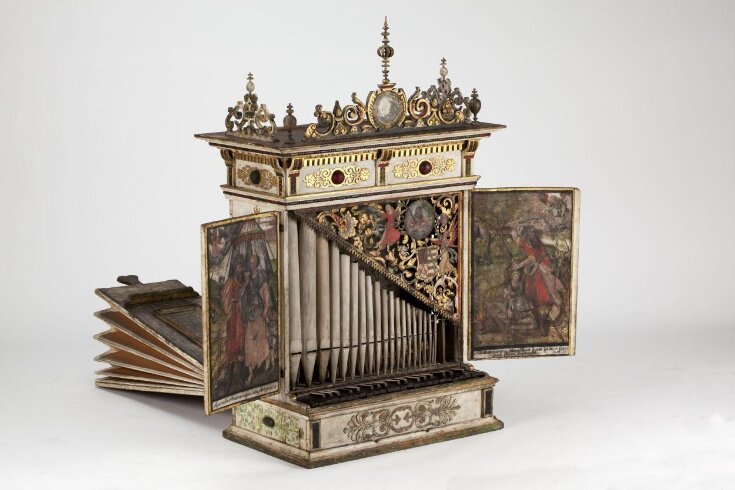
Though organs are mostly associated with church music the positive organ was a smaller version, most often used in domestic settings in the 16th and 17th centuries. It would be set on a table, and the player would press the keys while an assistant pumped the bellows from the back in order to produce the sound.
This instrument may have belonged to Johann Georg I Duke of Saxony (1585-1656), whose portrait is painted on the instrument. The crest of the organ is decorated with openwork scrolls, known as 'strapwork', a style popular throughout Northern Europe during the Duke's lifetime.
This instrument may have belonged to Johann Georg I Duke of Saxony (1585-1656), whose portrait is painted on the instrument. The crest of the organ is decorated with openwork scrolls, known as 'strapwork', a style popular throughout Northern Europe during the Duke's lifetime.
Object details
| Categories | |
| Object type | |
| Parts | This object consists of 4 parts. (Some alternative part names are also shown below)
|
| Materials and techniques | Pine case, carved, painted and gilt; birch keys, slides and windchest; paper organ pipes |
| Brief description | German, Saxony, Gottfried Fritzche, 1627 German, Saxony, Gottfried Fritzche, 1627 German, Saxony, Gottfried Fritzche, 1627 stop lever and fragments from organ |
| Physical description | The wooden case of the instrument and the open-work ornament above the cornice are carved, painted and gilt in renaissance style. The leather pipe shade is painted in tempera with designs with designs which include angels, and the arms and a medallion-portrait of Johann Georg I, Duke of Saxony (1585-1656). The painted design is outlined by the cutting away of the leather background. On the insides of the two shutters of the case are painted in tempera the Dismissal of Hagar and the Sacrifice of Abraham. All the pipes are made of hard, thick paper, and are glued into their footholes. Blowing was originally effected from the rear by means of feeders (now missing). |
| Dimensions |
|
| Production type | Unique |
| Marks and inscriptions |
|
| Gallery label | POSITIVE ORGAN
German
Possibly by Gottfried Fritzsche (1578-1638), 1627
Inscribed DG. IOAN. GEOR. D. SAX. ML. CL. & MON. ELEC, with a portrait of Johann Georg I of Saxony. Inside the shutters are painted the stories of The Dismissal of Hagar and The Sacrifice of Isaac.
The case is of pine and the keys, slides and windchest are of birch. The three ranks of pipes are made of layered paper.
The instrument's range is forty-one notes, C/E - g2, a2.
Keyboard Catalogue No.: 13
Gottfried Fritzsche was organ builder to Johann Georg I, Elector of Saxony during the 1620s, and worked extensively in Hamburg during the 1630s. It is thought that the pipes were originally of lead.
2-1867(pre September 2000) |
| Production | 'The organ has long been believed to be the work of Gottfried Fritzsche (1578 - 1638), organ builder to the Electoral Court of Saxony ... During restoration of the case work in 1967, a faint pencilled inscription was found on the key-frame, reading: "Erbaut 1741 Tobias Defrain Orgelbauer a Dresden". This doubtless refers to a renovation of the instrument rather than to its initial construction. The organ's compass and the portrait of Duke Johann Georg I (1585 - 1656), who reigned from 1611, all confirn its seventeenth century origin. The specific date 1627, traditionally associated with this organ and given in previous catalogues, is therefore not improbable. It cannot, however, be substantiated at present.' - Howard Schott. |
| Subjects depicted | |
| Literary references |
|
| Summary | Though organs are mostly associated with church music the positive organ was a smaller version, most often used in domestic settings in the 16th and 17th centuries. It would be set on a table, and the player would press the keys while an assistant pumped the bellows from the back in order to produce the sound. This instrument may have belonged to Johann Georg I Duke of Saxony (1585-1656), whose portrait is painted on the instrument. The crest of the organ is decorated with openwork scrolls, known as 'strapwork', a style popular throughout Northern Europe during the Duke's lifetime. |
| Collection | |
| Accession number | 2:1 to 3-1867 |
About this object record
Explore the Collections contains over a million catalogue records, and over half a million images. It is a working database that includes information compiled over the life of the museum. Some of our records may contain offensive and discriminatory language, or reflect outdated ideas, practice and analysis. We are committed to addressing these issues, and to review and update our records accordingly.
You can write to us to suggest improvements to the record.
Suggest feedback
You can write to us to suggest improvements to the record.
Suggest feedback
| Record created | May 16, 2001 |
| Record URL |
Download as: JSONIIIF Manifest
