Octave Spinet
ca. 1600 (made)
| Artist/Maker | |
| Place of origin |
Octave spinets were portable keyboard instruments, widely used in private homes in Italy throughout the seventeenth and eighteenth centuries to accompany singing. Dr Charles Burney (1726-1814), the great English musicologist of his day, wrote in The present state of music in France and Italy (London, 1771): 'throughout Italy they generally have little octave spinets to accompany singing, in private houses, sometimes in triangular form, but more frequently in the shape of our old virginals; of which the keys are so noisy, and the tone so feeble, that more wood is heard than wire'.
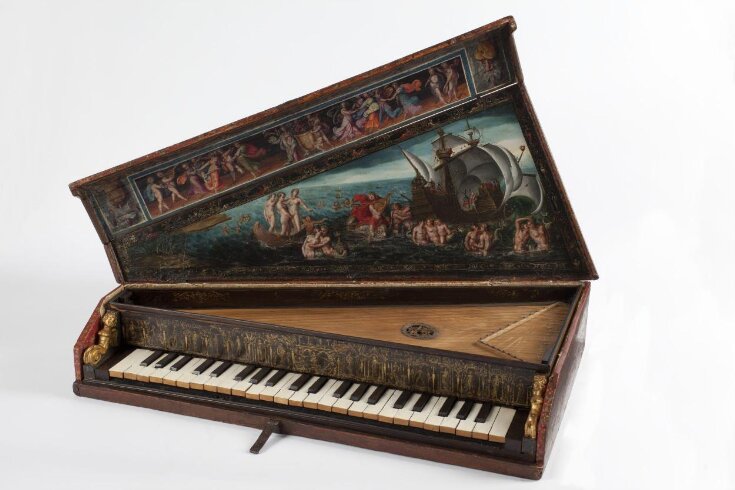
The inside lid of this example is painted with the tale of Arion and the Dolphin, a suitable decorative theme for a musical instrument, as the story tells of a famous singer, from ancient Greece, who was rescued by a dolphin after being robbed and thrown overboard by pirates.
The inside lid of this example is painted with the tale of Arion and the Dolphin, a suitable decorative theme for a musical instrument, as the story tells of a famous singer, from ancient Greece, who was rescued by a dolphin after being robbed and thrown overboard by pirates.
Object details
| Categories | |
| Object type | |
| Parts | This object consists of 4 parts.
|
| Materials and techniques | Cypress body and soundboard, with sycamore bridge and pearwood wrest-plank; painted inside of lid and board above keys, with carved and gilded putti at each end of the keyboard |
| Brief description | Octave spinet, Italian, about 1600. Body and soundboard of cypress, the name board decorated in grotesques. The painted inside of the lid illustrates the story of Arion and the Dolphin. The sharps are ebony and the naturals covered with ivory. |
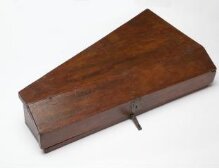
| Physical description | 'The spinet can be removed from its outer case. The cypress is painted black, on which gold ground decoration is applied. There are sparse arabesques on the inner faces and a delicate arcaded pattern of portière motifs with figures on the panel behind the keyboard. Gilded cherubs form the key-blocks at the ends of the keyboard. The outer case, painted plain brown without, bears two paintings within on the lid and falling front. The larger painting shows a mythological scene, including a large ship and a merfolk. On the smaller hinged flap are depicted a number of dancing figures and musical trophies. (Some draperies added to the nude figures, presumably out of prudery, at some later date, were removed when the case was cleaned in 1964.) The outer case has a lining of cloth to protect the spinet as it is removed and replaced. The nameboard and mouldings are ebony, as is the jack-rail on which traces of the former decoration can still be discerned.' Howard Schott, Catalogue of Musical Instruments in the Victoria and Albert Museum - Part I: Keyboard Instruments(London, 1978), p.46. |
| Dimensions |
|
| Production type | Unique |
| Gallery label |
|
| Object history | Many jacks had to be replaced when the instrument was restored to playing order by Mr John Barnes in 1965. The jacks originally had quill springs, Mr Barnes reported, but these had subsequently been replaced by brass wire springs (the new replacement jacks have plastic springs). The instrument was originally quilled and portions of these quill plectra were still present at the time of restoration. The jacks, made of pearwood, are weighted with lead and fitted with double dampers. In 1965 it was observed that the tone was a little shallow compared with that of a full-sized spinet and that the lowest octave lacked the tone given by longer strings. However, the sound was bright, clear and adequately loud, and the key-noise not excessive. Mr Barnes suspected that the deficiencies Dr Burney observed in 1770 during his tour of Italy may have been due to poor maintenance which may have been general in Italy at that time, judging from the poor standard of the workmanship of the replacements and modifications found on this and several other old Italian instruments. |
| Production | When the instrument was acquired in 1870, the paintings were attributed to Frederigo Zucchero. |
| Subjects depicted | |
| Summary | Octave spinets were portable keyboard instruments, widely used in private homes in Italy throughout the seventeenth and eighteenth centuries to accompany singing. Dr Charles Burney (1726-1814), the great English musicologist of his day, wrote in The present state of music in France and Italy (London, 1771): 'throughout Italy they generally have little octave spinets to accompany singing, in private houses, sometimes in triangular form, but more frequently in the shape of our old virginals; of which the keys are so noisy, and the tone so feeble, that more wood is heard than wire'. The inside lid of this example is painted with the tale of Arion and the Dolphin, a suitable decorative theme for a musical instrument, as the story tells of a famous singer, from ancient Greece, who was rescued by a dolphin after being robbed and thrown overboard by pirates. |
| Bibliographic reference | Ajmar-Wollheim, Marta and Flora Dennis, At Home in Renaissance Italy, London: V&A Publishing, 2006.
|
| Collection | |
| Accession number | 218:1, 2-1870 |
About this object record
Explore the Collections contains over a million catalogue records, and over half a million images. It is a working database that includes information compiled over the life of the museum. Some of our records may contain offensive and discriminatory language, or reflect outdated ideas, practice and analysis. We are committed to addressing these issues, and to review and update our records accordingly.
You can write to us to suggest improvements to the record.
Suggest feedback
You can write to us to suggest improvements to the record.
Suggest feedback
| Record created | May 16, 2001 |
| Record URL |
Download as: JSONIIIF Manifest
