
Crinolette
ca. 1870 (made)
| Artist/Maker | |
| Place of origin |
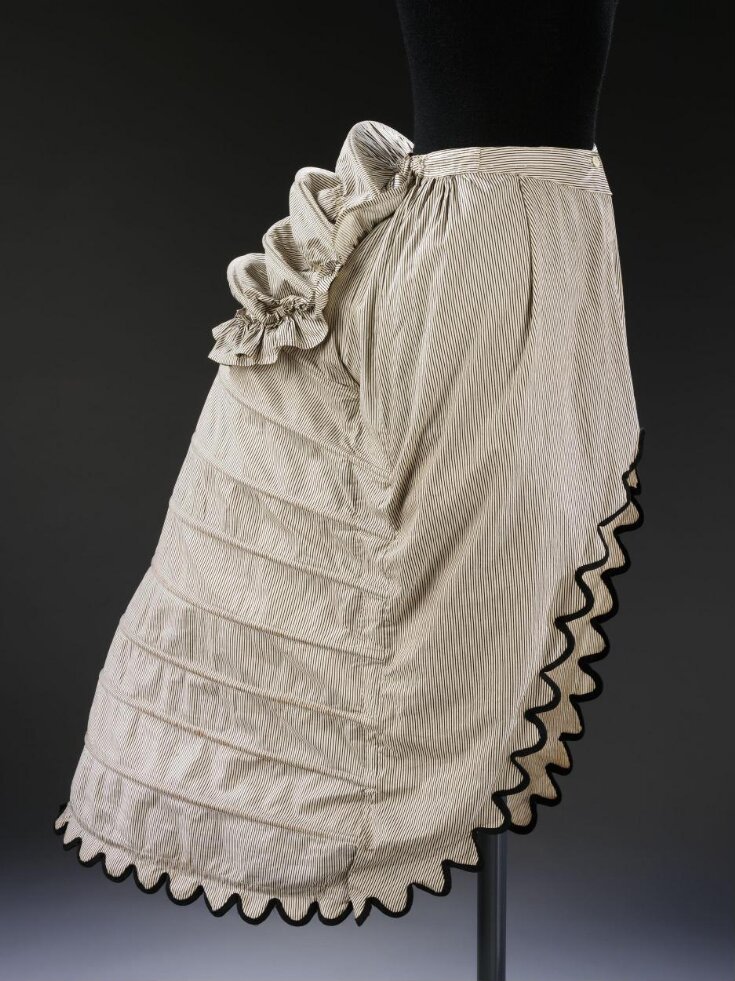
By 1865 the outline of the fashionable dress changed. The shape at the back of the body grew more exaggerated with a distinctive flattening at the front. Crinolettes, or half-crinolines, marked the mid-point between the cage crinoline and the bustle. They often had extra loops of steel, which acted as a bustle.
Some crinolettes laced like a corset. The wearer used this lacing and internal tapes to adjust the shape of the bustle and the width of petticoat. Gaps in the tape made it possible to remove some of the steels when washing the petticoat.
Some crinolettes laced like a corset. The wearer used this lacing and internal tapes to adjust the shape of the bustle and the width of petticoat. Gaps in the tape made it possible to remove some of the steels when washing the petticoat.
Delve deeper
Discover more about this object

Object details
| Categories | |
| Object type | |
| Materials and techniques | Spring steel hoops, covered in striped cotton, fastened and adjusted with metal eyelets and tapes |
| Brief description | Crinolette, British, 1870s. Spring steel hoops covered in black and white striped cotton |
| Physical description | Black and white striped cotton, and covered spring steel; black cotton braid edging. Internal tapes allow for the adjustable shaping of both the bustle and the width of petticoat. Open fronted with scalloped edge. |
| Dimensions |
|
| Gallery label |
|
| Credit line | Given by Messrs Harrods Ltd. |
| Object history | This was part of a very large collection of items of dress and accessories which was given to the Museum by Harrods, the department store, in 1913. The collection had been formed by the artist Talbot Hughes, who wrote a book on the history of dress, illustrated with photographs of models wearing items from his collection. A large firm in America had offered to buy the collection and present it to the Metropolitan Museum, New York, but Hughes did not want it to go abroad. At the suggestion of Cecil Harcourt Smith of the V&A, Harrods bought it for £2,500 and gave it to the Museum for the 'public good'. Harrods displayed the collection for three weeks in December 1913. |
| Association | |
| Summary | By 1865 the outline of the fashionable dress changed. The shape at the back of the body grew more exaggerated with a distinctive flattening at the front. Crinolettes, or half-crinolines, marked the mid-point between the cage crinoline and the bustle. They often had extra loops of steel, which acted as a bustle. Some crinolettes laced like a corset. The wearer used this lacing and internal tapes to adjust the shape of the bustle and the width of petticoat. Gaps in the tape made it possible to remove some of the steels when washing the petticoat. |
| Collection | |
| Accession number | T.775C-1913 |
About this object record
Explore the Collections contains over a million catalogue records, and over half a million images. It is a working database that includes information compiled over the life of the museum. Some of our records may contain offensive and discriminatory language, or reflect outdated ideas, practice and analysis. We are committed to addressing these issues, and to review and update our records accordingly.
You can write to us to suggest improvements to the record.
Suggest feedback
You can write to us to suggest improvements to the record.
Suggest feedback
| Record created | May 16, 2001 |
| Record URL |
Download as: JSONIIIF Manifest
