| Bibliographic references | - Ancient and Modern Furniture & Woodwork in the South Kensington Museum, described with an introduction by John Hungerford Pollen, (London, 1874), pp.42-46
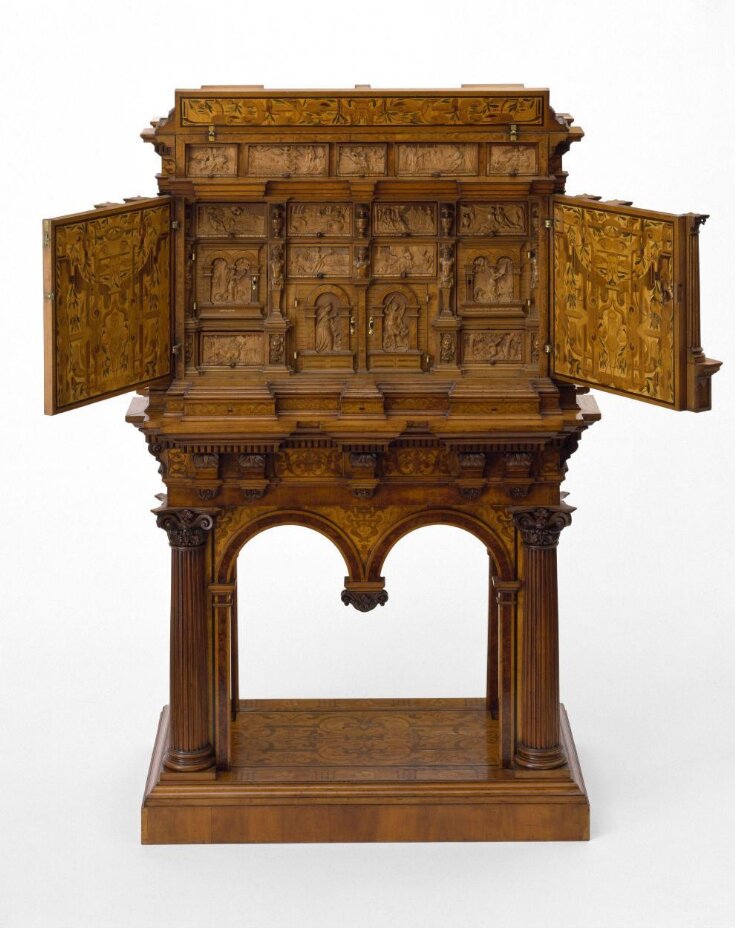
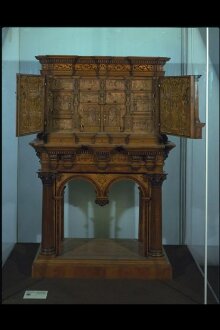
Cabinet. Wood. Principally pear-tree, inlaid with marquetry of other coloured woods, supported by four columns upon a base, on which may be seen the Tudor rose and portcullis. The cabinet is carved on the ends and exterior of the folding doors with battle-pieces in high relief, and on the internal drawer fronts with moral and allegoric subjects.
English. 16th century.
H. 4 ft. 7 in., W. 3 ft. 11 ½ in., D. 2 ft.
Bought, 500l.
This remarkable piece of furniture is of the finest Tudor period, and is perhaps of mixed German and English workmanship. The carvings bear some resemblance to Holbein’s style, and the design has been attributed to that artist. The cabinet is supported on a stand, or framework of pillars and arches between 3 one at each end and a double arch on the fides. The double arches have no central pillars, the centre spandrels ending in hanging brackets. Architectural piers within the columns turn over to form the arches. This arrangement has much of the character of the renaissance adaptations of the Roman triumphal arch. The flat spandrels, and the surface of a ‘flat base on which the whole stands, are inlaid with coloured woods in coarse arabesque designs, German in character, of no special interest, except that we observe round the border of the base, the portion corresponding to the width of the columnar bases—the Tudor badges of the role alternately with the portcullis. On the arches is an entablature decorated with marquetry and broken by Tudor brackets, above which rises, on bases and surfaces, an upper system of small fluted Corinthian columns, double at the extremities of the front and back, with (mall empty arched niches between. The top is thus divided into one and two arches, on the broad and narrow sides respectively. These arches are decorated with marquetry in design (similar to those of the work below. A bold cornice and entablature above the columns is similarly inlaid. This opens as a lid, and shows five small drawers. The front arched panels, with the shafts of the columns attached to them, open also, and disclose drawers and pigeon-hole doors with fronts elaborately carved in boxwood.
The subjects on the door panels outside, and on the end panels, are cavalry combats, the warriors being Roman knights in classic armour, cutting and flashing, and designed with spirit and excellent knowledge of drawing and form. On the shields we distinguish the Austrian eagle, and on the flags the cross and stripes of Savoy and Saxony.
The two back panels are occupied by wood inlay on the flat. The subjects are two female figures: one holding a mirror and a snake, and representing Prudence; the other pouring money or grapes into a vase, and representing Temperance.
The doors and cornice lid are lined with marquetry. The five upper drawers of the cornice portion have walnut fronts, with carvings in boxwood upon them. Two of these drawers are wider than the others; the intervening three form square compositions of carved work.
Beginning with the drawer at the right hand of this cornice row, we have the following subjects carved. I. Virtue; a female figure sitting on a bank with books at hand. A phoenix in the background, as an emblem of her immortality. On the border or moulding of the panel is painted in white the legend “ PHCOENICI SIMILIS VIVIT POST FVNERA VIRTUS”-Like the Phoenix, Virtue survives the tomb, 2. A king sitting on his throne, which is covered with tiny arabesques in relief, elaborated with perfect correctness of design, and surrounded by his council of sages and ancients, with the words “CONSILVM NE SPERNE SENIS MONITVS3 BEATOS”- Despise not the old man’s counsel and his blessed warnings. 3. Time with his hourglass is drawing Truth, a nude female figure, pursued with malignant scourges by Falsehood, also a female figure, out of a well, with the words ; “ INCLV(?)SAM TENEBRIS TEMPVS ME EDICT IN AVRAS”—Time draws me from my dark durance into open air. 4. Fame, a woman, full dressed in court costume and braided hair, is blowing a trumpet with human head or mouth to it, from which a blast: is visibly issuing. On a rock in the background a sage and a statesman, or prince, are pointing to her. Below are seen an army headed by cavaliers on horseback, with pikemen following. These last are scarcely half an inch in height but all, as the others, in perfect drawing, with the words “VOCI OCVLIS ALIS TOTI SVM COGNITA MVNDO ”- By voice, by eyes, by wings, to all the world I’m known. 5. Force, or Fortitude, a female figure, gracefully and powerfully designed on this small scale, seated on a lion, is riding towards the sun in his splendour. She is armed with the thunder of Jove, and the club of Hercules, with the words “CVNCTA DUMO VICTRUS ANIMI VIRTVTE VIRILIS”-I tame all things victorious by the power of a masculine spirit.
The doors of the main portion open with the columns cut off at their bases. The interior forms a sort of architectural facade, the drawers or pigeon-hole doors forming rows of panels. These are divided perpendicularly by terminal figures and bases into four sets or divisions.
The busts of these figures, in boxwood, are in complete relief, and are specimens of the best cinque-cento art. The upper series of panels are the fronts of four shallow drawers, and are carved in relief with delicacy. The first panel represents a female figure, partly draped, with broken chains in her hand. Prisoners are seen chained, captives yoked to cars and being scourged by their masters in the background, with the legend “LIBER ES INDIGNAS FAC NE MEREARE CATENAS”- Thou art free, to act that thou never deserve disgraceful bonds. 2. A king on his throne; terminal figures of satyrs, an inch high, form supports of a canopy above it. All these parts are finished like the finest ivory work.
The supports of his seat are sphinxes, one of which is shown; and the king’s figure is draped in robes. Three courtiers stand in front of him, while a kneeling sage or scholar presents a book to the king. The legend is “NIL MIHI FIT GRATIS LARGE REX CVNTA REPENDO”-
Nothing done for me goes without its reward. I am a king and repay all things with bounty. This may have been some allusion to King Henry VIII, and to the controversies which took their date from events in his reign. 3. A woman dressed in the gown and hood of the Tudor Court, sitting on a bed carefully designed, is sewing or mending a dress, with a Work-basket beside her. A broken statue or torso (statue without heads or legs), lies before her, and there is a landscape background. The legend is “FACOLIT HVMANOS DIVINA INDVSTRIA SENSVS”—-Divine Industry inflames the human perceptions. 4. Sensuality. Two lovers, with drapery and terminal figures of satyrs to support it, with the legend “DECIPIT HAEC MVLTOS PRAETEXTV PACIS AMICIE”- She deceives many under the guise of peace and friendship.
The row of panels below these four begins with a pigeon-hole door, which forms a double arch-shaped panel. A woman is offering a dove to the fun or Apollo. In her right hand is a scorpion; and a fox below on the ground. This is “ADVLACIO”- Deceitful flattery. Below the pigeon-hole door is a shallow drawer to complete the architectural arrangement. On the front a cavalier is falling headlong into a pitfall, the boards over it giving way in confusion, with the legend “MVLTVM (EST?) INFCELIX CVI SORS ADVERSA MINATVR.”- Very wretched he whom Fate threatens with adversity. Corresponding, on the other side of the central pigeon-hole doors, the panel carvings represent Discord, a draped queenly figure, designed with great grace and knowledge. She holds bellows, with which she fans the flame of discord which issues, accordingly, from the spout; a cat, on one side of her, with arched back, is quarrelling, and two dogs are fighting on the other, and a snake is under her feet, to {how that discord develops every kind of evil passion. The legend to this composition is “VNDIQVE FLAMANTES DISCORDIA SVSCITAT IGNES”- Discord can fan flaming fires from every source. On the small drawer front below this (corresponding to the drawer on the right side) is a husbandman shaking apples from a tree, and his wife and child holding their hands to catch them. The action of the man kicking the tree and of the woman and child below, show the vigour of the designer and the acute and humorous observation of daily life so characteristic of the German 16th century schools, while the perfection of the drawing is suggestive of Durer, and the miniature carvers who followed him, or Holbein. The legend, or inscription, is gone. The panels of the central doors, having the largest of the subdivisions of the interior, contain: A female figure, Virtue or Fortitude, holding a scourge, and S. Michel the Archangel scourging an armed figure-Lucifer or War. Trophies of classic armour and implements of war complete this composition. It has no legend to it. Above these doors there are also two drawers. On the fronts of these are carved: 1. A sage measuring a globe with compasses. Love is rolling a globe behind, and an hour-glass and skull indicate that this figure is Time. There is an architectural composition forming a fort of open colonnade or hall, and trees are seen behind. The Words are “TEMPUS EGO IMMENSYM DIMETIOR ORBIS”- I am Time, and measure out in patience the compass of the world. The second drawer panel has a female figure, representing Chance or Fate. She holds a mitre in one hand, and a rope in the other. A man before her sits chained to a couch, while, in the background, a great man is being carried in a horse-litter with attendants. The words are “SORS POTIS EST SVBITO MVTARE IN VINCLA CORONAM”-Chance all too soon can change a crown for chains. The crown, being in this cafe a mitre, seems, like the book offered to the king in another panel, to bear reference to the religious changes and political proceedings of Henry VIII.
Altogether this piece, though not in general design so elegant or imposing as the Italian tomb-shaped coffers or chests or even as some of the Flemish and Dutch cabinets in oak or ebony, to which size and much excellent sculpture in the round and in relief give so great a dignity -is the most remarkable in the Museum, when considered with reference to the sculptures within it.
Its height is only four feet seven inches, and the width three feet one inch. It has belonged, therefore, to some boudoir or study, a small room in which all the objects of furniture and decoration come immediately under the eye. But the design and the execution of the sculptures we have described in detail, are, and could be, the work only of one of the most instructed artists and masters of his day. These tiny figures, some of them in groups, and half an inch only in height, are in perfect drawing. The background groups of horsemen marching, and that of the horse-litter, the dignified and graceful women, nude and draped, that represent Virtue and Vice, are not to be surpassed by any work of that day, unless it be the minute carvings of Albert Durer or his school of wood-workers. They contain evidently much German, or Holbein’s Swiss work. The Tudor devices below, on the base of the stand, and the Tudor dresses of some of the figures, and the apparent applicability of several of the compositions to the history of the reign of King Henry VIII, would lead us to confider this as a piece of work executed for the court of that king after the designs of Holbein, or by a pupil; perhaps assisted by the foreign artists who were then considerably employed in this country. Different hands, are to be recognised in the work.
- Wilk, Christopher. Western Furniture: 1350 to the Present Day.
London : Philip Wilson Publishers Ltd, 1996. 231p., 38 & 39
ISBN 1856674435
- Wainwright, Clive. Some Objects from William Beckford Collection now in the Victoria and Albert Museum. Burlington Magazine. May 1971, vol. CXIII, no. 818, p.258
- Magnificent Effects at Fonthill Abbey Wilts to be sold by Auction by Mr Christie... October 1, 1822..., lot 43 of fifth day's sale.
- Baker, Malcolm, and Brenda Richardson (eds.), A Grand Design: The Art of the Victoria and Albert Museum, London: V&A Publications, 1999.
- MÖLLER, Lieselotte; Der Wrangelschrank und die verwandten süddeitschen intarsienmöbel des 16. Jahrhunderts. (Berlin, 1956), cat. no. 6
- Victoria & Albert Museum: Fifty Masterpieces of Woodwork (London, 1955), no. 19.
A German Cabinet
The art of the High Renaissance in South Germany is worthily represented by the carvings and marquetry ornament of this famous cabinet. In the design architectural motives are most skilfully adapted to the scale and purpose of decorative Furniture. The lmperial Eagle, the cross of Savoy, and the barry shield of Saxony may be seen in the spirited battle scenes on the doors, while in the marquetry of the stand appear the English Tudor badges of the rose and portcullis. The cabinet is also remarkable for the boxwood carvings, the work of a highly accomplished though unidentified craftsman.
Among the subjects represented, and described in hexameter maxims, are allegories of Truth and Time, Fortitude, Virtue, and other symbolic scenes. These panels recall the engravings of the German ‘Little Masters’. While most of the figures wear fashionable European dress of about 1540, in a few instances the accurate rendering of Asian costume suggests an artist, such as Melchior Lorichs (1527-83), who had himself travelled in the East. In the middle of the sixteenth century many German craftsmen were domiciled in London, and it is possible that the stand with its Tudor emblems was made in England after the cabinet had been obtained from abroad.
It was formerly in the collection of the celebrated William Beckford of Fonthill, and in the Description of Fonthill Abbey (1822) is stated to have been executed from the designs of Holbein and to have come from the Palace of Whitehall.
It was bought by the Museum in 1869.
German; first half of the sixteenth century.
H. 55 in., W. 37 ½ in., D. 24, in.
- Jervis, Simon Swynfen and Dodd, Dudley, Roman Splendour, English Arcadia. London, PhilipWilson/The National Trust, 2015, p. 64, fig. 77
- J Hungerford Pollen, Chests and cabinets, in Magazine of Art, vol. IX, 1885-6, pp.144-8
- Foley, Edwin, The Book of Decorative Furniture, 2 vols, London: T.C. & E.C. Jack, 1919, vol. I, illus. with line drawing, p. 86, with no commentary.
- Frederick Litchfield, Illustrated History of Furniture from the Earliest to the Present Time. 4th ed., London and New York: Truslove, Hanson and Comba Ltd., 1899, illustrated p. 75
|