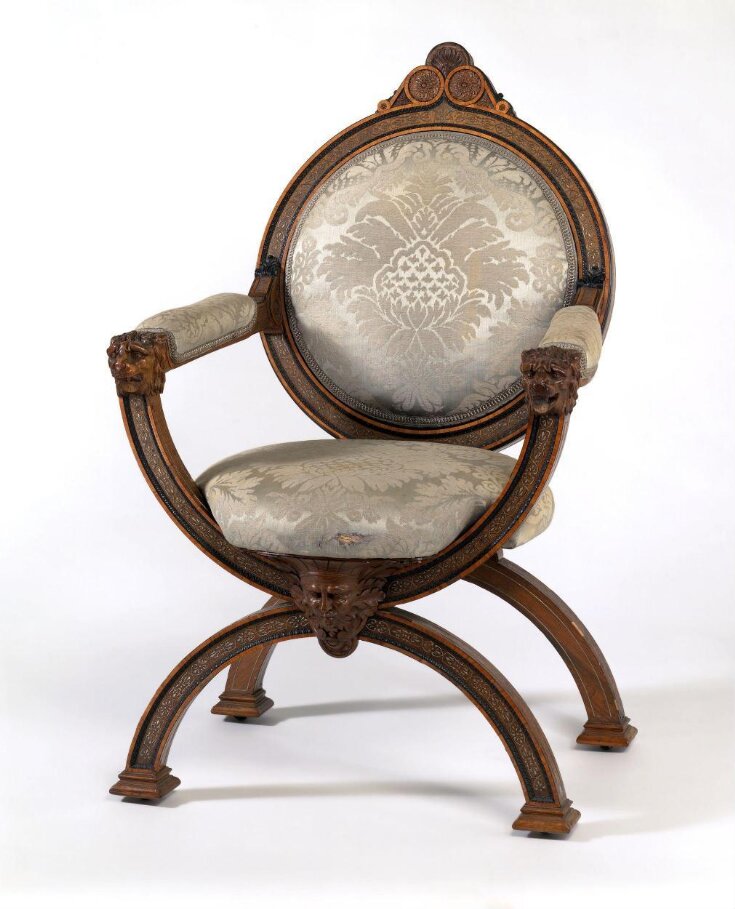

Armchair
1877-1885 (made)
| Artist/Maker | |
| Place of origin |
Chairs with an X-shaped frame have a long history. Illustrations survive of ancient Greek and Roman examples. Medieval manuscripts often show chairs with this kind of frame and they have continued to be made since that time. Such chairs were often formal, even throne-like, and this example is certainly made more for show than use. The way that the back panel attaches to the seat is weak and would not stand up to regular wear, though markings under the seat make it clear that this was one of a set of at least eight chairs. Carl Svensson, who put his mark under the seat, described himself as ‘Upholsterer to the Royal court’. The chair may have been designed and made in his workshops or he may have bought it in for supply to a client. Such a practice was well established by the 19th century. The engraved pewter inlay is an unusual and elegant decorative detail.
Object details
| Categories | |
| Object type | |
| Materials and techniques | Veneered in rosewood, with engraved pewter inlay, the cross-banded fillets veneered in tulipwood, the carving in solid rosewood and walnut; removeable pad seat and back panel with modern upholstery in cotton damask |
| Brief description | An x-framed armchair in carved walnut, veneered tulipwood and veneered rosewood inlaid with engraved pewter, supplied and possibly made by Carl P. Svensson, Stockholm.; Swedish ?, ca. 1880, supplier Svensson, Stockholm |
| Physical description | An x-framed armchair, of solid walnut, and rosewood veneered on oak and beech, with ebonised mouldings and inlay of engraved and punched pewter; the circular back panel, seat and arm pads are upholstered in damask (not original), probably of a rayon/cotton mix. The x-frame is set on the crossing of the front with a carved mask in solid rosewood and the ends of the arms are set with carved lion masks in solid walnut. Originally, the lions held metal ring handles in their mouths but these are now missing and both lions show damage to the jaws. |
| Dimensions |
|
| Style | |
| Marks and inscriptions |
|
| Gallery label |
|
| Object history | One of a suite of 14 chairs commissioned by Lars Olsson Smith (1836-1913) for Bolinder House, Stockholm. The house was named after Jean Bolinder (1813-1899), a founder of the Bolinder Engineering Company (a forerunner of the modern firm Volvo). He had commissioned the architect and Professor of the Royal Swedish Academy, Helgo Zettervall (1831-1907) to build him house. It was designed in a Renaissance Revival Style and built between 1874 and 1877. Much of the ornament was designed so that it could be manufactured in Bolinder's cast-iron manufactory. The house overlooked the royal palace and stood next door to the recently completed, and much celebrated, Grand Hotel, Stockholm. Smith had made his fortune from the production of vodka, creating the brand Absolut, and becoming known as the 'King of Vodka'. The interiors were decorated under the supervision of the Principal of the Academy of Art, George van Rosen (1843-1923) and included rooms with Pompeiian decoration and rooms with rich colours and gilding. It is not clear how he occupied the house or for how long, but by 1889, when it was sold to the Grand Hotel next door, it was in three apartments. Lars Olsson Smith had occupied the first floor rooms of parade before the sale and a photograph of the suite of chairs in a large, coved interior is known. Some photographs of the interior can be seen in Elaine Denby's Grand Hotels: Reality and Illusion. An architectural and social history (London, 1998), pp. 104-5. It is possible that the suite was made to designs by the architect Magnus Isaeus (1841-1890) who designed another suite of ivory- and pietre dure-inlaid furniture for Smith's dining-room at Bolinder House. One of the chairs from this set is illustrated in A Decorative Swedish Arts Legacy 1700-1960, in the collection of the Nationalmuseum, Stockholm (Stockholm: Nationalmuseum/Scala Books, 1998, p. 55). The chair combines Italianate renaissance ornament with inlay that included figures in the traditional dress of the Skåne region of southern Sweden (Smith's birthplace and the site of his vodka distilleries). That chair was given to the museum in 1891, suggesting that 1889 may have been the date on which he left his apartment in Bollinder House. A black and white photograph of L.O. Smith's drawing-room showing 13 of the suite exists. That appears to show a silk damask upholstery with a single large button in the middle of the back and seat of each chair, and a fringe around each seat with large, well articulated tassels, of silk around a wooden core. More recent photographs of surviving chairs (see below) shows them in a variety of upholstery, usually leather. It is not known when the suite was dispersed, although the sale of the house in 1889 is a possible date. The V&A chair was purchased from H. Blairman & Sons in 1989 (RF 89/678). He purchased it from the dealer David Pickup in Burford, Oxfordshire, but no earlier provenance is known. Since that date, further examples from the set have appeared on the art market. Two chairs were offered for sale by Sotheby's, London, 18 November 2008, lot 224, and a further pair offered by Christie's, London, 10 September 2013, lot 59. A single chair was offered for sale by Bonham's, London, 9 July 2015, lot 215. Others have appeared in private collections. Most of these retain the iron rings that originally hung from the mouths of the lion handrests, and it would be possible to re-cast rings for the V&A chair from one of these. |
| Production | |
| Summary | Chairs with an X-shaped frame have a long history. Illustrations survive of ancient Greek and Roman examples. Medieval manuscripts often show chairs with this kind of frame and they have continued to be made since that time. Such chairs were often formal, even throne-like, and this example is certainly made more for show than use. The way that the back panel attaches to the seat is weak and would not stand up to regular wear, though markings under the seat make it clear that this was one of a set of at least eight chairs. Carl Svensson, who put his mark under the seat, described himself as ‘Upholsterer to the Royal court’. The chair may have been designed and made in his workshops or he may have bought it in for supply to a client. Such a practice was well established by the 19th century. The engraved pewter inlay is an unusual and elegant decorative detail. |
| Collection | |
| Accession number | W.13-1989 |
About this object record
Explore the Collections contains over a million catalogue records, and over half a million images. It is a working database that includes information compiled over the life of the museum. Some of our records may contain offensive and discriminatory language, or reflect outdated ideas, practice and analysis. We are committed to addressing these issues, and to review and update our records accordingly.
You can write to us to suggest improvements to the record.
Suggest feedback
You can write to us to suggest improvements to the record.
Suggest feedback
| Record created | April 3, 2001 |
| Record URL |
Download as: JSONIIIF Manifest
