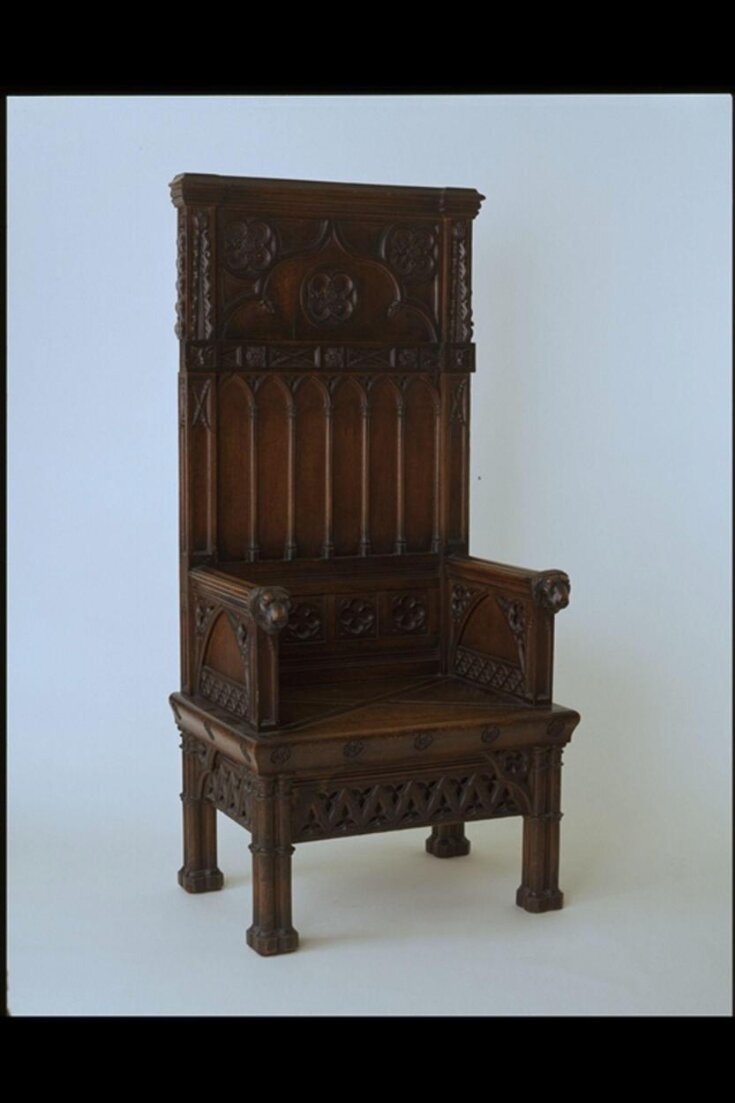

Ceremonial Chair
ca. 1815-1817 (made)
| Artist/Maker | |
| Place of origin |
This imposing chair was designed for the Great Hall of Battle Abbey in Sussex. The site was close to the place where the Battle of Hastings had been fought in 1066, when William, Duke of Normandy, triumphed over the Anglo-Saxon king Harold. The owner of the Abbey, Sir Godfrey Vassall Webster, was keen to commemorate such an historical association. Between 1810 and 1822 he remodelled the entire house in the Gothic style. This included the re-roofing and redecoration of the vast Great Hall, 57 feet (17.4 metres) in length. Webster must have worked with an architect (possibly William Atkinson), but keen amateur architects were often given the credit for the buildings they designed, even when the detail of the plans was undoubtedly drawn up by professionals.
For the interiors, Webster turned to the fashionable cabinetmaker George Bullock and the designer Richard Bridgens, who was working for Bullock at that time. The chair was illustrated in a fashionable magazine, Ackermann's Repository, in 1817. It was designed as a 'state chair'. Originally it stood under a carved Gothic canopy on a dais (a raised floor) at the end of the hall, under an enormous painting of the Battle of Hastings.
For the interiors, Webster turned to the fashionable cabinetmaker George Bullock and the designer Richard Bridgens, who was working for Bullock at that time. The chair was illustrated in a fashionable magazine, Ackermann's Repository, in 1817. It was designed as a 'state chair'. Originally it stood under a carved Gothic canopy on a dais (a raised floor) at the end of the hall, under an enormous painting of the Battle of Hastings.
Object details
| Categories | |
| Object type | |
| Materials and techniques | Carved oak |
| Brief description | Ceremonial chair of oak, carved in Gothic style |
| Physical description | A ceremonial chair of carved oak, in the form of a throne, carved with Gothic motifs. The chair is raised on four cluster-column legs, joined by apron panels carved and pierced with Gothic trefoil motifs. The edge of the seat flares outwards and is carve with quatrefoils. The seat surface shows four panels set in a saltire frame. The uprights supporting the arms are set a little back from the front legs. They are square-sectioned, the front and sides with recessed panels. Moulded top rails to the arms run over these uprights and end in carved lions' heads. The arms are panelled and carved on the inside and outside with a single Gothi arch, with quatrefoils in the spandrels. The back of the chair shows three tiers of motifs. At seat level the back is carved with four square panels enclosing quatrefoils. Above this is a tall panel with rather plain arcading, then a narrow panel with alternate saltire crosses and square paterae, and finally a deeper panel with a single ogee arch with quatrefoils in the spandrels and centre. The chair is finished in a dark brown varnish. |
| Dimensions |
|
| Style | |
| Gallery label |
|
| Credit line | Given by the Associates and Friends of the V&A |
| Subjects depicted | |
| Summary | This imposing chair was designed for the Great Hall of Battle Abbey in Sussex. The site was close to the place where the Battle of Hastings had been fought in 1066, when William, Duke of Normandy, triumphed over the Anglo-Saxon king Harold. The owner of the Abbey, Sir Godfrey Vassall Webster, was keen to commemorate such an historical association. Between 1810 and 1822 he remodelled the entire house in the Gothic style. This included the re-roofing and redecoration of the vast Great Hall, 57 feet (17.4 metres) in length. Webster must have worked with an architect (possibly William Atkinson), but keen amateur architects were often given the credit for the buildings they designed, even when the detail of the plans was undoubtedly drawn up by professionals. For the interiors, Webster turned to the fashionable cabinetmaker George Bullock and the designer Richard Bridgens, who was working for Bullock at that time. The chair was illustrated in a fashionable magazine, Ackermann's Repository, in 1817. It was designed as a 'state chair'. Originally it stood under a carved Gothic canopy on a dais (a raised floor) at the end of the hall, under an enormous painting of the Battle of Hastings. |
| Bibliographic references |
|
| Collection | |
| Accession number | W.56-1980 |
About this object record
Explore the Collections contains over a million catalogue records, and over half a million images. It is a working database that includes information compiled over the life of the museum. Some of our records may contain offensive and discriminatory language, or reflect outdated ideas, practice and analysis. We are committed to addressing these issues, and to review and update our records accordingly.
You can write to us to suggest improvements to the record.
Suggest feedback
You can write to us to suggest improvements to the record.
Suggest feedback
| Record created | April 2, 2001 |
| Record URL |
Download as: JSONIIIF Manifest
