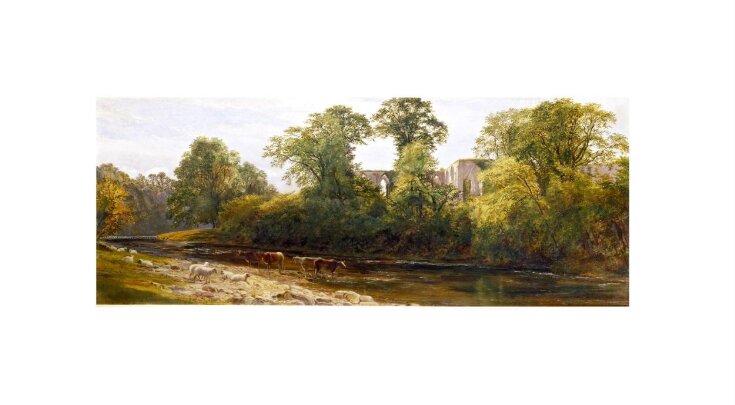

Bolton Abbey: Morning
Oil Painting
1847 (made)
1847 (made)
| Artist/Maker | |
| Place of origin |
Object Type
Oil paintings showing ancient ruins in a romantic setting appealed to an intense nostalgia for the Medieval past. Such works were widely commissioned and collected from the end of the 18th century and remained popular throughout the 19th century.
Subjects Depicted
Bolton Abbey, a ruined Priory by the River Wharfe in the West Riding of Yorkshire, is located in a picturesque setting of wild moorland, much admired by artists. Queen Victoria particularly admired this painting when she visited the National Gallery of British Art, part of the South Kensington Museum in 1858.
People
Henry Cole, the first Director of this Museum, persuaded the successful painter and designer Richard Redgrave (1804-1888) to join him at the newly regenerated Schools of Design (the ancestors of the Royal College of Art). Redgrave was appointed in 1847, becoming Headmaster in 1848. Eventually Redgrave became Inspector-General for Art in 1857. Redgrave continued to exhibit his work at the Royal Academy until 1883, and became Surveyor of the Queen's Pictures from 1857 until 1880. He catalogued most of the paintings in the Royal Collection.
Oil paintings showing ancient ruins in a romantic setting appealed to an intense nostalgia for the Medieval past. Such works were widely commissioned and collected from the end of the 18th century and remained popular throughout the 19th century.
Subjects Depicted
Bolton Abbey, a ruined Priory by the River Wharfe in the West Riding of Yorkshire, is located in a picturesque setting of wild moorland, much admired by artists. Queen Victoria particularly admired this painting when she visited the National Gallery of British Art, part of the South Kensington Museum in 1858.
People
Henry Cole, the first Director of this Museum, persuaded the successful painter and designer Richard Redgrave (1804-1888) to join him at the newly regenerated Schools of Design (the ancestors of the Royal College of Art). Redgrave was appointed in 1847, becoming Headmaster in 1848. Eventually Redgrave became Inspector-General for Art in 1857. Redgrave continued to exhibit his work at the Royal Academy until 1883, and became Surveyor of the Queen's Pictures from 1857 until 1880. He catalogued most of the paintings in the Royal Collection.
Object details
| Categories | |
| Object type | |
| Title | Bolton Abbey: Morning (assigned by artist) |
| Materials and techniques | Oil on canvas |
| Brief description | Oil painting by Richard Redgrave entitled 'Bolton Abbey, Morning'. Great Britain, 1847. |
| Physical description | Oil on canvas depicting Bolton Abbey in Yorkshire |
| Dimensions |
|
| Styles | |
| Marks and inscriptions | 'Richd Redgrave 1847' (Signed and dated by the artist on rock to left of centre foreground) |
| Gallery label | British Galleries:
Queen Victoria admired this painting when she visited the National Gallery of British Art, part of the South Kensington Museum. It belongs to the tradition of picturesque landscape painting, which appealed to the British public of the period. The subject was not intended to make any social comment, as did many other new paintings of the time.(27/03/2003) |
| Credit line | Given by John Sheepshanks, 1857 |
| Object history | Given by John Sheepshanks, 1857. By Richard Redgrave CB, RA (born in London, 1804, died there in 1888) Exhibited at the Royal Academy 1848 |
| Production | dated 1847 |
| Subjects depicted | |
| Place depicted | |
| Summary | Object Type Oil paintings showing ancient ruins in a romantic setting appealed to an intense nostalgia for the Medieval past. Such works were widely commissioned and collected from the end of the 18th century and remained popular throughout the 19th century. Subjects Depicted Bolton Abbey, a ruined Priory by the River Wharfe in the West Riding of Yorkshire, is located in a picturesque setting of wild moorland, much admired by artists. Queen Victoria particularly admired this painting when she visited the National Gallery of British Art, part of the South Kensington Museum in 1858. People Henry Cole, the first Director of this Museum, persuaded the successful painter and designer Richard Redgrave (1804-1888) to join him at the newly regenerated Schools of Design (the ancestors of the Royal College of Art). Redgrave was appointed in 1847, becoming Headmaster in 1848. Eventually Redgrave became Inspector-General for Art in 1857. Redgrave continued to exhibit his work at the Royal Academy until 1883, and became Surveyor of the Queen's Pictures from 1857 until 1880. He catalogued most of the paintings in the Royal Collection. |
| Bibliographic reference | Catalogue of British Oil Paintings 1820-1860, Ronald Parkinson, Victoria and Albert Museum, London: HMSO, 1990, pp. 244-45 |
| Collection | |
| Accession number | FA.172[O] |
About this object record
Explore the Collections contains over a million catalogue records, and over half a million images. It is a working database that includes information compiled over the life of the museum. Some of our records may contain offensive and discriminatory language, or reflect outdated ideas, practice and analysis. We are committed to addressing these issues, and to review and update our records accordingly.
You can write to us to suggest improvements to the record.
Suggest feedback
You can write to us to suggest improvements to the record.
Suggest feedback
| Record created | March 5, 2001 |
| Record URL |
Download as: JSONIIIF Manifest
