
Edward Howard
Oil Painting
1766 (painted)
1766 (painted)
| Artist/Maker | |
| Place of origin |
Object Type
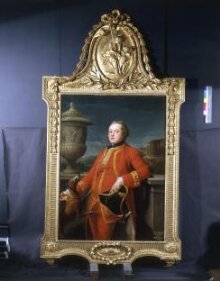
When rich young men went on the Grand Tour of Europe as part of their education, many of them took the opportunity to commission an Italian artist to paint their portrait. The frame made for this portrait is a good example of the British Neo-classical style.
Subjects Depicted
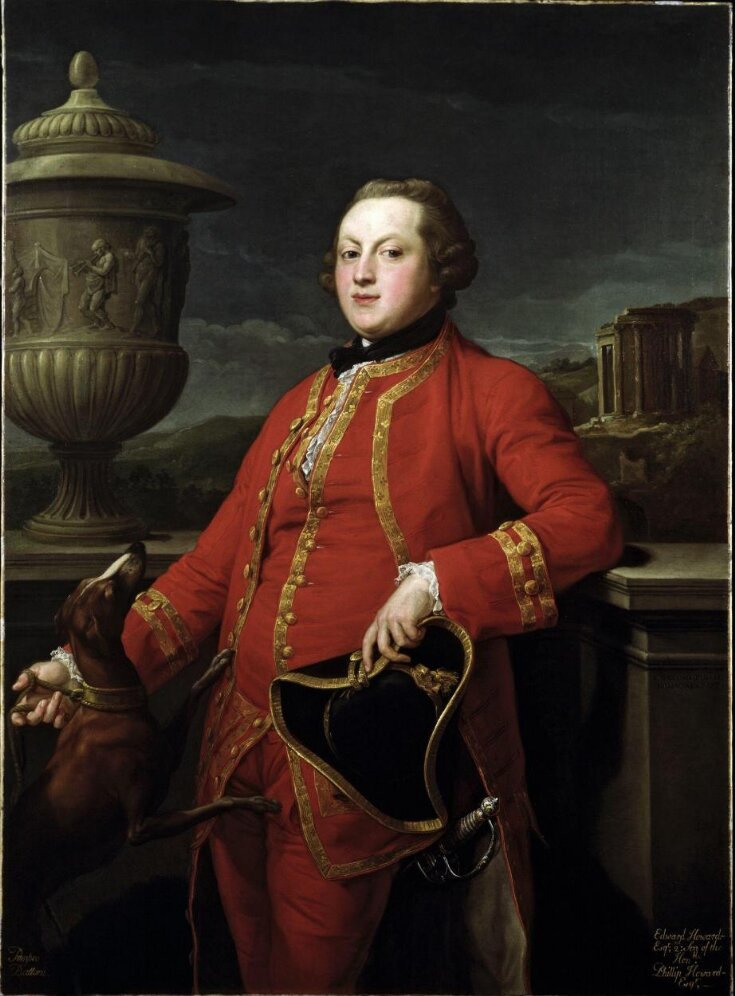
Edward Howard was the son of Lord Philip Howard. In 1764, in the course of his travels in Italy, Edward commissioned Pompeo Batoni (1708-1787) to paint his portrait. Frequently, the backgrounds in portraits of Grand Tourists included identifiable Roman antiquities, and here Batoni has inserted the ruined Temple of Vesta.
People
At that time Batoni was the most celebrated painter in Rome, and one of the most famous in Europe. For nearly 50 years he made portraits of Rome's visitors. He was equally gifted as a history painter, as well as being internationally known for his religious and mythological paintings. On completion of this portrait in 1766, he sent it to Edward Howard in Britain, who had returned home in 1764. It was finally mounted in an elaborately-carved British frame surmounted by an oval with a relief of Minerva and Cupid, very much in the decorative manner of Sir William Chambers (1723-1796), an influential architect and designer in the Neo-classical style.
When rich young men went on the Grand Tour of Europe as part of their education, many of them took the opportunity to commission an Italian artist to paint their portrait. The frame made for this portrait is a good example of the British Neo-classical style.
Subjects Depicted
Edward Howard was the son of Lord Philip Howard. In 1764, in the course of his travels in Italy, Edward commissioned Pompeo Batoni (1708-1787) to paint his portrait. Frequently, the backgrounds in portraits of Grand Tourists included identifiable Roman antiquities, and here Batoni has inserted the ruined Temple of Vesta.
People
At that time Batoni was the most celebrated painter in Rome, and one of the most famous in Europe. For nearly 50 years he made portraits of Rome's visitors. He was equally gifted as a history painter, as well as being internationally known for his religious and mythological paintings. On completion of this portrait in 1766, he sent it to Edward Howard in Britain, who had returned home in 1764. It was finally mounted in an elaborately-carved British frame surmounted by an oval with a relief of Minerva and Cupid, very much in the decorative manner of Sir William Chambers (1723-1796), an influential architect and designer in the Neo-classical style.
Object details
| Categories | |
| Object type | |
| Title | Edward Howard (generic title) |
| Materials and techniques | Oil on canvas |
| Brief description | Portrait of Edward Howard with his dog. Oil painting by Pompeo Batoni, 1766. |
| Physical description | Portrait three-quarter length of Edward Howard, standing; wearing a scarlet costume trimmed with gold lace; holding a tricorne hat in left hand and the leash of a greyhound in right; the greyhound jumps up and paws him; behind at left is a vase with antique dionysiac reliefs; in the right distance is a view of the ancient Temple of Vesta. The portrait is in an elaborately carved contemporary English frame surmounted by an oval with a relief of Minerva and Cupid. |
| Dimensions |
|
| Style | |
| Marks and inscriptions |
|
| Gallery label | British Galleries:
This portrait was painted in Italy, but its frame was made in London. It may have been designed by John Linnell, a leading cabinet-maker of the day who was greatly inflluenced by the architect William Chambers. Such a strongly Neo-classical frame, with its medallion showing the Roman goddess Minerva with Cupid, was considered a suitable choice for a portrait that was painted during the Grand Tour.(27/03/2003) |
| Object history | Purchased, 1949. The frame possibly designed by John Linnell (born in London, 1729, died there in 1796) Painted in Rome; the frame probably made in London Historical significance: Pompeo (Girolamo) Batoni, (b Lucca, 1708; d Rome, 1787) was the most celebrated painter in Rome in the eighteenth century and one of the most famous in Europe. For nearly half a century he recorded the visits to Rome of international travellers on the Grand Tour in portraits that remain among the most memorable artistic accomplishments of the period. He was equally gifted as a history painter, and his religious and mythological paintings were sought after by the greatest princes of Europe. Edward Howard (1744-1767) was the son of the Lord Philip Howard, who was the brother of edward Howard, 9th Duke of Norfolk. He is described by David Garrick in a letter of 1764 as 'a very worthy good natured Young Man.' Behind Edward there is a carefully observed representation of the circular temple of Vesta, known in the 18th century as the Temple of the Sibyl, set within the Roman countryside. The ruined temple appears to have been one of Batoni's favourite motifs as it reappears in several of his portraits. The dionysiac scene represented on the vase appears in various versions and may be a pastiche. |
| Historical context | Grand Tour Portraiture. The ‘Grand Tour’ was a journey, usually through France and Italy, made by classically educated male members of the northern European ruling class to complete their education, to acquire manners and languages and to attain an understanding of the politics of other countries, their economies, geography and history. Especially from the 17th century onwards, it was undertaken to admire (or pretend to admire) the remains of the Classical past and to collect art and antiquities. The conventions of the Grand Tour portrait were brilliantly perfected by Pompeo Batoni who showed the wealthy and aristocratic youth of England and Scotland elegantly posed before the most celebrated statues and monuments of ancient Rome. If Batoni were too expensive or unavailable, other popular portraitists were George Willison (1741–97), and Nathaniel Dance-Holland. |
| Subjects depicted | |
| Place depicted | |
| Summary | Object Type When rich young men went on the Grand Tour of Europe as part of their education, many of them took the opportunity to commission an Italian artist to paint their portrait. The frame made for this portrait is a good example of the British Neo-classical style. Subjects Depicted Edward Howard was the son of Lord Philip Howard. In 1764, in the course of his travels in Italy, Edward commissioned Pompeo Batoni (1708-1787) to paint his portrait. Frequently, the backgrounds in portraits of Grand Tourists included identifiable Roman antiquities, and here Batoni has inserted the ruined Temple of Vesta. People At that time Batoni was the most celebrated painter in Rome, and one of the most famous in Europe. For nearly 50 years he made portraits of Rome's visitors. He was equally gifted as a history painter, as well as being internationally known for his religious and mythological paintings. On completion of this portrait in 1766, he sent it to Edward Howard in Britain, who had returned home in 1764. It was finally mounted in an elaborately-carved British frame surmounted by an oval with a relief of Minerva and Cupid, very much in the decorative manner of Sir William Chambers (1723-1796), an influential architect and designer in the Neo-classical style. |
| Bibliographic references |
|
| Collection | |
| Accession number | W.36:1-1949 |
About this object record
Explore the Collections contains over a million catalogue records, and over half a million images. It is a working database that includes information compiled over the life of the museum. Some of our records may contain offensive and discriminatory language, or reflect outdated ideas, practice and analysis. We are committed to addressing these issues, and to review and update our records accordingly.
You can write to us to suggest improvements to the record.
Suggest feedback
You can write to us to suggest improvements to the record.
Suggest feedback
| Record created | March 5, 2001 |
| Record URL |
Download as: JSONIIIF Manifest
