Champagne Glass
1880-1890 (made)
| Artist/Maker | |
| Place of origin |
Object Type
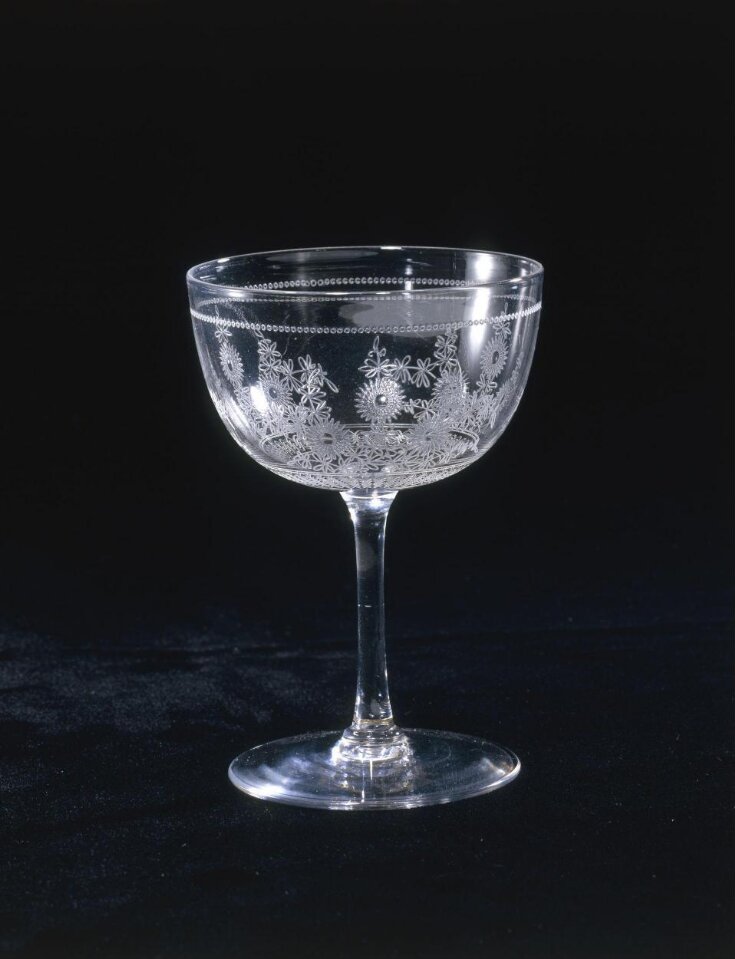
The first table services entirely in glass were devised by the mid-1820s. Extensive services became increasingly popular by the end of the 19th century. Such services might include up to seven or eight goblets, each for a different drink. This example is for champagne. Although flutes were still made for drinking champagne, glasses with cup-shaped bowls were probably introduced around 1830 and were standard by the 1860s. Increasing mechanisation of manufacture and decoration reduced the price of such sets, making even the most elaborate designs affordable to a wider audience.
Materials & Making
Etching glass by drawing a pattern in a layer of wax on the surface of the glass and then plunging it into hydrofluoric acid was first practised in the late 18th century. The process was developed commercially in the 1840s. By 1861 John Northwood (1836-1909) and James Northwood (1839-1915) at Wordsley, West Midlands, were among the first major producers to use it extensively. They had earlier invented the template etching machine for inscribing the pattern through the wax. With the invention in 1864 of a gear-driven, geometric etching machine, interlocking patterns such as loops or the ever-popular 'Greek key' border patterns were applied to virtually all table glass. They were used especially on the new paper-thin glass that appeared in the 1870s.
The first table services entirely in glass were devised by the mid-1820s. Extensive services became increasingly popular by the end of the 19th century. Such services might include up to seven or eight goblets, each for a different drink. This example is for champagne. Although flutes were still made for drinking champagne, glasses with cup-shaped bowls were probably introduced around 1830 and were standard by the 1860s. Increasing mechanisation of manufacture and decoration reduced the price of such sets, making even the most elaborate designs affordable to a wider audience.
Materials & Making
Etching glass by drawing a pattern in a layer of wax on the surface of the glass and then plunging it into hydrofluoric acid was first practised in the late 18th century. The process was developed commercially in the 1840s. By 1861 John Northwood (1836-1909) and James Northwood (1839-1915) at Wordsley, West Midlands, were among the first major producers to use it extensively. They had earlier invented the template etching machine for inscribing the pattern through the wax. With the invention in 1864 of a gear-driven, geometric etching machine, interlocking patterns such as loops or the ever-popular 'Greek key' border patterns were applied to virtually all table glass. They were used especially on the new paper-thin glass that appeared in the 1870s.
Object details
| Categories | |
| Object type | |
| Materials and techniques | Machine-etched glass |
| Brief description | Champagne glass, part of a set, probably English, ca. 1880 |
| Physical description | Etched with floral and scrolled design |
| Dimensions |
|
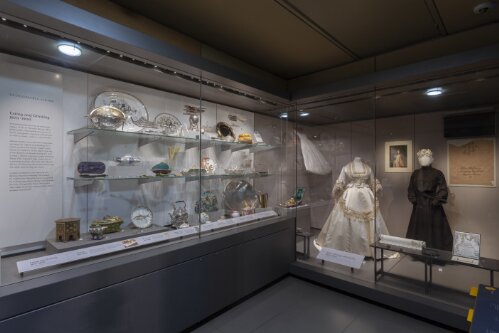
| Gallery label | British Galleries:
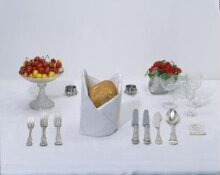
Mrs Beeton advised diners to drink champagne ' with the joints'. Champagne had become very popular with ladies and could be drunk throughout the dinnner but never with dessert.(27/03/2003) |
| Object history | Made in Stourbridge, West Midlands |
| Summary | Object Type The first table services entirely in glass were devised by the mid-1820s. Extensive services became increasingly popular by the end of the 19th century. Such services might include up to seven or eight goblets, each for a different drink. This example is for champagne. Although flutes were still made for drinking champagne, glasses with cup-shaped bowls were probably introduced around 1830 and were standard by the 1860s. Increasing mechanisation of manufacture and decoration reduced the price of such sets, making even the most elaborate designs affordable to a wider audience. Materials & Making Etching glass by drawing a pattern in a layer of wax on the surface of the glass and then plunging it into hydrofluoric acid was first practised in the late 18th century. The process was developed commercially in the 1840s. By 1861 John Northwood (1836-1909) and James Northwood (1839-1915) at Wordsley, West Midlands, were among the first major producers to use it extensively. They had earlier invented the template etching machine for inscribing the pattern through the wax. With the invention in 1864 of a gear-driven, geometric etching machine, interlocking patterns such as loops or the ever-popular 'Greek key' border patterns were applied to virtually all table glass. They were used especially on the new paper-thin glass that appeared in the 1870s. |
| Collection | |
| Accession number | C.37-2000 |
About this object record
Explore the Collections contains over a million catalogue records, and over half a million images. It is a working database that includes information compiled over the life of the museum. Some of our records may contain offensive and discriminatory language, or reflect outdated ideas, practice and analysis. We are committed to addressing these issues, and to review and update our records accordingly.
You can write to us to suggest improvements to the record.
Suggest feedback
You can write to us to suggest improvements to the record.
Suggest feedback
| Record created | March 2, 2001 |
| Record URL |
Download as: JSONIIIF Manifest
