
Stool
1580-1625 (made)
| Artist/Maker | |
| Place of origin |
Object Type
Stools were perhaps the most common form of seating and were found in large numbers in any house. Sometimes they were upholstered en suite with the bed, chairs and curtains of a bedchamber. They were, however, reserved for people lower down the hierarchy than those entitled to a chair. Randle Holme's Academy of Armory (1688) contains a table of everyday objects. They include a 'joynt stoole', made up of a wooden seat set on four legs; an ordinary stool covered with upholstery, so more expensive; and a 'turned stoole', consisting of a triangular wooden seat placed just below the tops of three rounded or turned legs.
Materials & Making
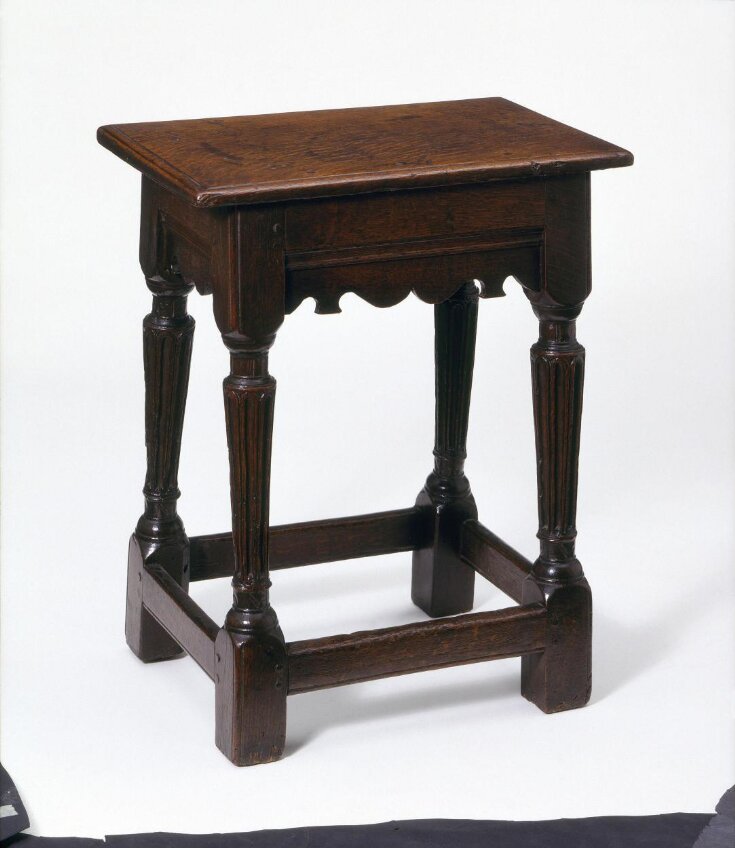
The legs of this stool are turned and decorated with grooves, made by a gouge or scraper. They are linked to each other by stretchers, whose tenons (pared-down protrusions) slot into mortises (squared holes). The rails immediately beneath the seat are slotted into a groove on the inside of the leg and held in position by dowels or wooden pegs. The seat is fixed to the frame by means of dowels.
Time
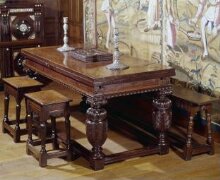
These stools were often used with the 'drawer' table that became popular around 1600. This kind of table had leaves that could be 'drawn' or pulled out so as to expand to the required length. With such a table, a variable number of stools could be used, whereas the bench or form was of a fixed length.
Stools were perhaps the most common form of seating and were found in large numbers in any house. Sometimes they were upholstered en suite with the bed, chairs and curtains of a bedchamber. They were, however, reserved for people lower down the hierarchy than those entitled to a chair. Randle Holme's Academy of Armory (1688) contains a table of everyday objects. They include a 'joynt stoole', made up of a wooden seat set on four legs; an ordinary stool covered with upholstery, so more expensive; and a 'turned stoole', consisting of a triangular wooden seat placed just below the tops of three rounded or turned legs.
Materials & Making
The legs of this stool are turned and decorated with grooves, made by a gouge or scraper. They are linked to each other by stretchers, whose tenons (pared-down protrusions) slot into mortises (squared holes). The rails immediately beneath the seat are slotted into a groove on the inside of the leg and held in position by dowels or wooden pegs. The seat is fixed to the frame by means of dowels.
Time
These stools were often used with the 'drawer' table that became popular around 1600. This kind of table had leaves that could be 'drawn' or pulled out so as to expand to the required length. With such a table, a variable number of stools could be used, whereas the bench or form was of a fixed length.
Object details
| Categories | |
| Object type | |
| Materials and techniques | Oak, turned and joined |
| Brief description | Stool, English, 1580-1625, oak |
| Physical description | Stool. Joined and turned oak. Plain rectangular tops above plain frame with shaped lower edging. Fluted tapering legs connected by plain stretchers. |
| Dimensions |
|
| Gallery label |
|
| Credit line | Given by Brigadier W. E. Clark CMG, DSO through Art Fund |
| Object history | At one time in Horeham Hall and Debden Hall, both in Essex. Stool, gift of Brig. Clark Notes from R.P. 45/233 6/2/32 Minute paper, Ralph Edwards outlines Clark's bequest proposal and reports that "the bulk" of his collection has been bought from Messrs Greenwood of Harrogate, "well known North Country dealers" 4/9/46 letter, Clark to Edwards enclosed a list of objects available to the Museum. Among them "A pair of early 17th century oak stools with shaped underframing and tapering fluted legs. 1'10 1/2" high, the tops 1'7" x 11 1/2"" The Gift form Lists as "English, about 1600" |
| Production | Made in England, possibly in the south-east |
| Summary | Object Type Stools were perhaps the most common form of seating and were found in large numbers in any house. Sometimes they were upholstered en suite with the bed, chairs and curtains of a bedchamber. They were, however, reserved for people lower down the hierarchy than those entitled to a chair. Randle Holme's Academy of Armory (1688) contains a table of everyday objects. They include a 'joynt stoole', made up of a wooden seat set on four legs; an ordinary stool covered with upholstery, so more expensive; and a 'turned stoole', consisting of a triangular wooden seat placed just below the tops of three rounded or turned legs. Materials & Making The legs of this stool are turned and decorated with grooves, made by a gouge or scraper. They are linked to each other by stretchers, whose tenons (pared-down protrusions) slot into mortises (squared holes). The rails immediately beneath the seat are slotted into a groove on the inside of the leg and held in position by dowels or wooden pegs. The seat is fixed to the frame by means of dowels. Time These stools were often used with the 'drawer' table that became popular around 1600. This kind of table had leaves that could be 'drawn' or pulled out so as to expand to the required length. With such a table, a variable number of stools could be used, whereas the bench or form was of a fixed length. |
| Associated object | W.46A-1946 (Ensemble) |
| Collection | |
| Accession number | W.46-1946 |
About this object record
Explore the Collections contains over a million catalogue records, and over half a million images. It is a working database that includes information compiled over the life of the museum. Some of our records may contain offensive and discriminatory language, or reflect outdated ideas, practice and analysis. We are committed to addressing these issues, and to review and update our records accordingly.
You can write to us to suggest improvements to the record.
Suggest feedback
You can write to us to suggest improvements to the record.
Suggest feedback
| Record created | February 15, 2001 |
| Record URL |
Download as: JSONIIIF Manifest
