
The Salting Carpet
Carpet
1560-1580 (made)
1560-1580 (made)
| Artist/Maker | |
| Place of origin |
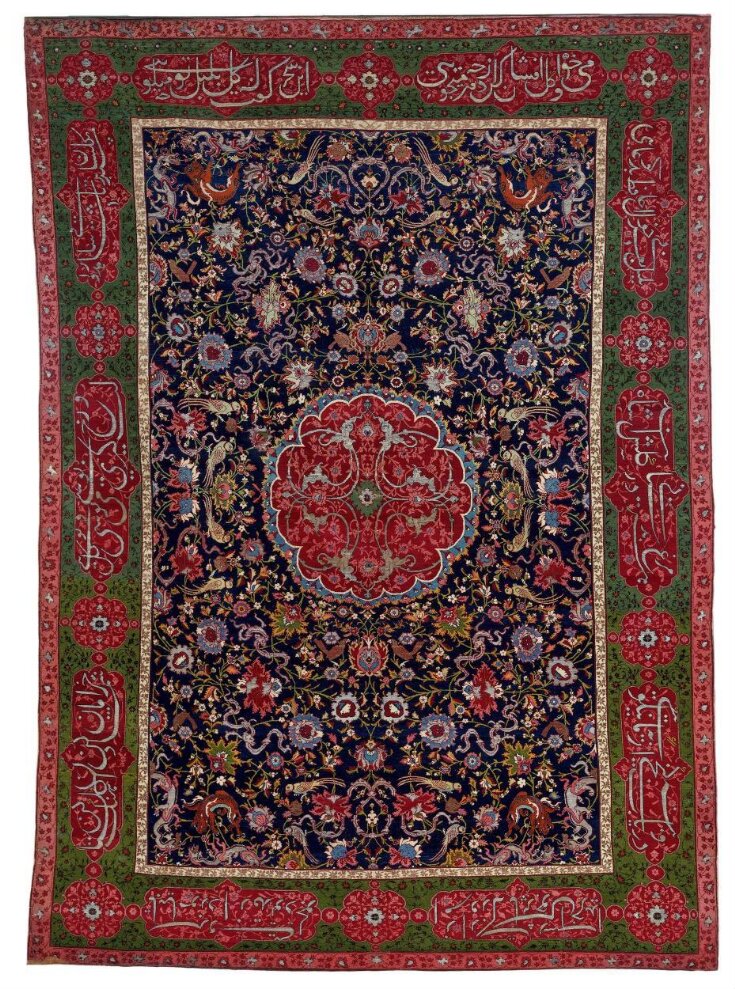
Dating from late sixteenth-century Iran, this is an extremely fine and beautiful carpet, with an intricate floral design filled with wild creatures, and verses of Persian poetry all around the borders, highlighted in metal brocade. The lines quote the great Iranian poet Hafez (d.1389), and they describe a blissful world of gardens, nightingales, roses and wine. This poetry was certainly chosen to suit the design and intended purpose of the carpet itself, to be a beautiful place to sit together with friends, in a private garden, reciting romantic verses: “Call for wine and scatter roses: what do you seek from Time?/ Thus spoke the rose at dawn. O nightingale, what say you?” The verses are emphasised by the scale of the fine calligraphy, by the use of silver brocade lettering against a dark red background, and by the distinctive formatting: each half-verse is placed in a cartouche, laid against a green border. The central medallion repeats the red and pink background, with a leafy design also overlaid with gleaming metal brocade.
The carpet is attributed to the late sixteenth century, and the Safavid court of Iran (which was then based in Qazvin). At this time, carpet weaving had reached an extraordinarily high standard of design and technique, and the Safavid shahs commissioned the finest carpets as pious shrine donations, personal furnishings and suitably impressive diplomatic gifts to other states.
Known in scholarly literature as "the Salting Carpet", this famous carpet belongs to a larger carpet group which has long been debated by art historians. A diverse set was collectively named “Salting Carpets”, named after this example in the V&A, although they are now understood as a more complex cluster with a wider date-range. Today, consensus attributes the central group to late sixteenth-century Iran, on the basis of style and technical structure, and by association with recorded diplomatic gifts from Safavid Iran to the Ottoman empire, including the embassy sent in 1567. Two carpets are known to have been in European collections (in Poland and Spain) by the seventeenth century, but the majority were not published until after the 1878 international exhibition in Paris: then the art-dealer Albert Goupil displayed several at his Galerie Orientale loan exhibition. George Salting bought this carpet from the London-based art-dealers Murray Marks and Durlacher Brothers, between 1880 and 1883. Although not proven, it is suggested that by 1878, these carpets had very recently come from Istanbul, having been sold out of the Ottoman palace stores. One explanation for this was the sudden instability in the city, which was under threat of the Russian-Turkish war of 1877-8: the British press certainly noted a sudden influx of other Turkish textiles on the art market as a direct result of that civilian fear. These carpets are exceptionally significant though, as Safavid court products of late sixteenth-century Iran.
The carpet is attributed to the late sixteenth century, and the Safavid court of Iran (which was then based in Qazvin). At this time, carpet weaving had reached an extraordinarily high standard of design and technique, and the Safavid shahs commissioned the finest carpets as pious shrine donations, personal furnishings and suitably impressive diplomatic gifts to other states.
Known in scholarly literature as "the Salting Carpet", this famous carpet belongs to a larger carpet group which has long been debated by art historians. A diverse set was collectively named “Salting Carpets”, named after this example in the V&A, although they are now understood as a more complex cluster with a wider date-range. Today, consensus attributes the central group to late sixteenth-century Iran, on the basis of style and technical structure, and by association with recorded diplomatic gifts from Safavid Iran to the Ottoman empire, including the embassy sent in 1567. Two carpets are known to have been in European collections (in Poland and Spain) by the seventeenth century, but the majority were not published until after the 1878 international exhibition in Paris: then the art-dealer Albert Goupil displayed several at his Galerie Orientale loan exhibition. George Salting bought this carpet from the London-based art-dealers Murray Marks and Durlacher Brothers, between 1880 and 1883. Although not proven, it is suggested that by 1878, these carpets had very recently come from Istanbul, having been sold out of the Ottoman palace stores. One explanation for this was the sudden instability in the city, which was under threat of the Russian-Turkish war of 1877-8: the British press certainly noted a sudden influx of other Turkish textiles on the art market as a direct result of that civilian fear. These carpets are exceptionally significant though, as Safavid court products of late sixteenth-century Iran.
Object details
| Categories | |
| Object type | |
| Title | The Salting Carpet (popular title) |
| Materials and techniques | Hand-knotted wool pile, on silk warp and weft, with areas brocaded with metal thread; asymmetrical knot, open to the left; 600-756 knots per sq. in (9,024-11,544 per sq. dm).
WARP: yellow silk; Z2S; depressed; 192 - 208 warp threads per dm (48 - 54 per in)
WEFT: Foundation weft: yellow silk; Z2S; 3 shoots after each row of knots; 94 - 111 knots per dm (25 - 28 knots per in). Pattern weft: (1) silver strip, Z-twisted around a yellow silk core; (2) silver strip, Z-twisted around a white silk core; brocaded over 3 warp threads.
PILE: wool; 14 colours: dark red, light red, dark orange, yellow, dark green, green, light green, very light green, dark blue, blue, very light blue, dark brown, brown, white; asymmetrical knot open to the left; 9024 -11544 knots per sq.dm (600 - 756 knots per sq. in).
SIDE FINISH: one cord oversewn with dark red silk.
END FINISH: Lower: part missing but there are the remains of a tapestry-woven band with an inscription in black and silver thread. Upper: cut. |
| Brief description | Carpet, known as the 'Salting Carpet', wool knotted pile and metal brocade on silk foundation, red central medallion on dark blue field filled with leafy floral scrolls, cloudbands, birds, Chinese-style lions and dragons, outer border inscribed with Persian verses from the poet Hafez, Safavid Iran, 1560-1580 |
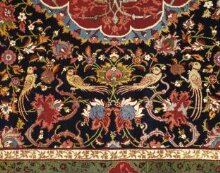
| Physical description | Field: central lobed medallion with half-palmette scrollwork in metal thread and pink floral scrollwork on red ground, set against main field of dark blue ground. The main field is filled with cloudbands, floral stems and lotus flowers containing animal heads, as well as brown birds (perhaps the nightingales referred to in the surrounding poetry), green parrots, Chinese-style lions and dragons. Main border: red cartouches of Persian poetry in metal brocade, on green ground Inner border: white ground with light brown flowers and stems. Outer border: light red with red floral scroll. |
| Dimensions |
|
| Style | |
| Marks and inscriptions |
|
| Gallery label | |
| Credit line | Bequeathed by George Salting |
| Object history | This carpet was initially on long term loan to the South Kensington Museum (today called the V&A), from 1883, and it would be over twenty years before the museum officially acquired it, in 1910. At that time, the owner was the art-collector George Salting, who loaned so much (particularly Chinese porcelain) to the museum, that a dedicated gallery was organised just to display his collection. After Salting’s death in 1909, the collection was bequeathed to the V&A on a permanent basis. The carpet was discussed as “the Salting Carpet” in later scholarship (see below), but it was not the only carpet in the Salting Bequest. |
| Subjects depicted | |
| Summary | Dating from late sixteenth-century Iran, this is an extremely fine and beautiful carpet, with an intricate floral design filled with wild creatures, and verses of Persian poetry all around the borders, highlighted in metal brocade. The lines quote the great Iranian poet Hafez (d.1389), and they describe a blissful world of gardens, nightingales, roses and wine. This poetry was certainly chosen to suit the design and intended purpose of the carpet itself, to be a beautiful place to sit together with friends, in a private garden, reciting romantic verses: “Call for wine and scatter roses: what do you seek from Time?/ Thus spoke the rose at dawn. O nightingale, what say you?” The verses are emphasised by the scale of the fine calligraphy, by the use of silver brocade lettering against a dark red background, and by the distinctive formatting: each half-verse is placed in a cartouche, laid against a green border. The central medallion repeats the red and pink background, with a leafy design also overlaid with gleaming metal brocade. The carpet is attributed to the late sixteenth century, and the Safavid court of Iran (which was then based in Qazvin). At this time, carpet weaving had reached an extraordinarily high standard of design and technique, and the Safavid shahs commissioned the finest carpets as pious shrine donations, personal furnishings and suitably impressive diplomatic gifts to other states. Known in scholarly literature as "the Salting Carpet", this famous carpet belongs to a larger carpet group which has long been debated by art historians. A diverse set was collectively named “Salting Carpets”, named after this example in the V&A, although they are now understood as a more complex cluster with a wider date-range. Today, consensus attributes the central group to late sixteenth-century Iran, on the basis of style and technical structure, and by association with recorded diplomatic gifts from Safavid Iran to the Ottoman empire, including the embassy sent in 1567. Two carpets are known to have been in European collections (in Poland and Spain) by the seventeenth century, but the majority were not published until after the 1878 international exhibition in Paris: then the art-dealer Albert Goupil displayed several at his Galerie Orientale loan exhibition. George Salting bought this carpet from the London-based art-dealers Murray Marks and Durlacher Brothers, between 1880 and 1883. Although not proven, it is suggested that by 1878, these carpets had very recently come from Istanbul, having been sold out of the Ottoman palace stores. One explanation for this was the sudden instability in the city, which was under threat of the Russian-Turkish war of 1877-8: the British press certainly noted a sudden influx of other Turkish textiles on the art market as a direct result of that civilian fear. These carpets are exceptionally significant though, as Safavid court products of late sixteenth-century Iran. |
| Bibliographic references |
|
| Collection | |
| Accession number | T.402-1910 |
About this object record
Explore the Collections contains over a million catalogue records, and over half a million images. It is a working database that includes information compiled over the life of the museum. Some of our records may contain offensive and discriminatory language, or reflect outdated ideas, practice and analysis. We are committed to addressing these issues, and to review and update our records accordingly.
You can write to us to suggest improvements to the record.
Suggest feedback
You can write to us to suggest improvements to the record.
Suggest feedback
| Record created | February 7, 2001 |
| Record URL |
Download as: JSONIIIF Manifest
