
Autoperipatetikos
Walking Doll
1862 (manufactured)
1862 (manufactured)
| Artist/Maker | |
| Place of origin |
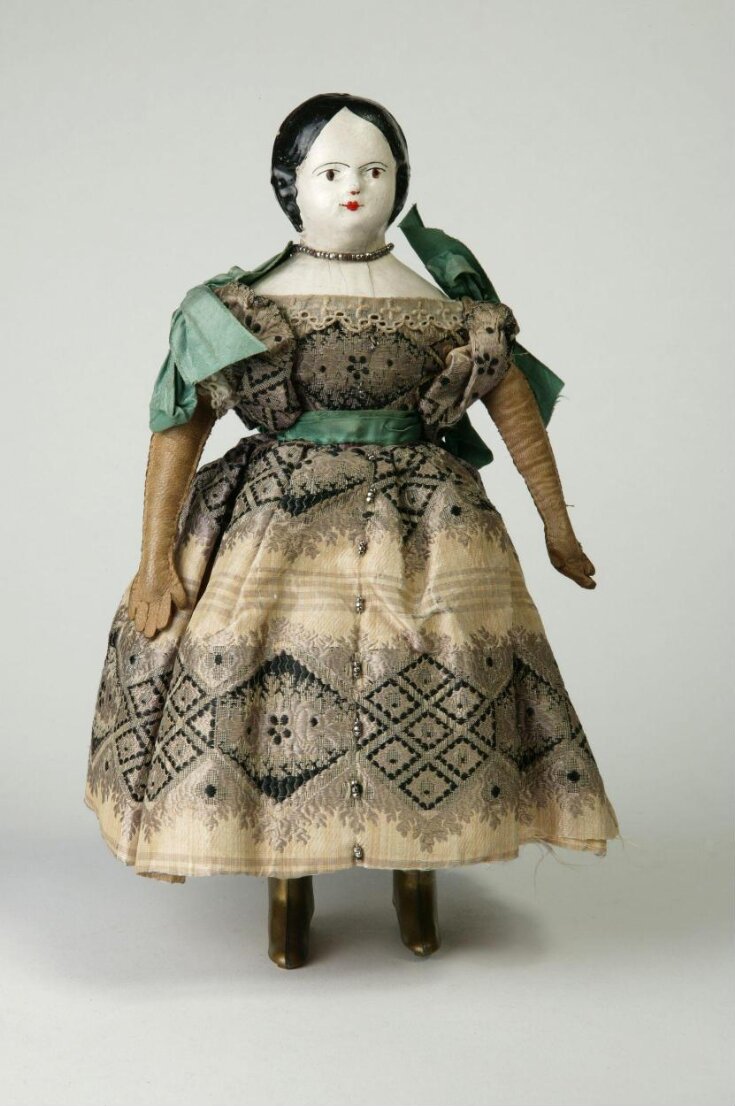
Mechanical or wind up dolls are also known as "Autoperipatetikos" which means 'the automatic walking one'. This one was designed by Enoch Morrison in 1862 and made by Martin and Runyon in the United States. Moving dolls are quite common now but in the 19th century it would have been a magical experience to receive a doll that actually walked. The clockwork mechanism is very strong as this doll is still in perfect working order.
Object details
| Categories | |
| Object type | |
| Parts | This object consists of 2 parts.
|
| Title | Autoperipatetikos (manufacturer's title) |
| Materials and techniques | Composition, brass, wood and leather |
| Brief description | Brass and composition Autoperipatetikos walking doll made in the USA by Martin & Runyon about 1865 |
| Physical description | Composition shoulder head with moulded hair and painted facial features; body containing clockwork mechanism covered with oilcloth and supported by a wooden base; brass lower legs with a caterpillar movement inside; leather arms |
| Dimensions |
|
| Production type | mass produced |
| Marks and inscriptions | Patented July 15th 1862; also in Europe 20 Dec. 1862 (wood base; stamping) |
| Object history | Martin & Runyon, 299 Broadway New York City, had London offices from 1865 to 1867 |
| Historical context | Autoperipatetikos was patented in the USA and England by Enoch Rice Morrison in 1862. Made and distributed by a variety of people including Daniel S Cohen and Joseph Lyon & Co of New York. |
| Summary | Mechanical or wind up dolls are also known as "Autoperipatetikos" which means 'the automatic walking one'. This one was designed by Enoch Morrison in 1862 and made by Martin and Runyon in the United States. Moving dolls are quite common now but in the 19th century it would have been a magical experience to receive a doll that actually walked. The clockwork mechanism is very strong as this doll is still in perfect working order. |
| Bibliographic reference | The Ultimate Doll Book, C G Goodfellow, Dorling Kindersley, 1993 |
| Collection | |
| Accession number | T.64&A-1938 |
About this object record
Explore the Collections contains over a million catalogue records, and over half a million images. It is a working database that includes information compiled over the life of the museum. Some of our records may contain offensive and discriminatory language, or reflect outdated ideas, practice and analysis. We are committed to addressing these issues, and to review and update our records accordingly.
You can write to us to suggest improvements to the record.
Suggest feedback
You can write to us to suggest improvements to the record.
Suggest feedback
| Record created | February 5, 2001 |
| Record URL |
Download as: JSONIIIF Manifest
