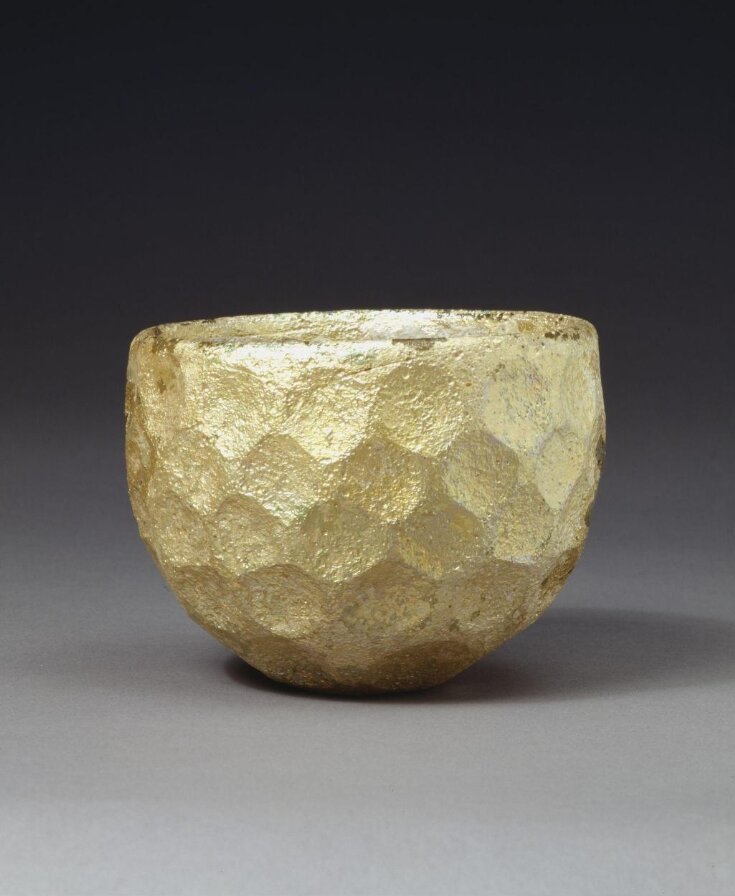
Bowl
6th century-8th century (made)
| Artist/Maker | |
| Place of origin |
This type of thick-walled glass cup is relatively common. The glass was originally clear with a green tinge. The iridescent patina here is the result of a long period of burial. The surface is cut with circular facets in a honeycomb pattern. When Iran was ruled by the Sasanian dynasty (about AD 224 to631), the techniques used to cut precious and semi-precious stones were also used on glass.
When the Middle East passed under Islamic rule in the 7th century, there was no sudden break in artistic production. One of the main influences on early Islamic art was the art of the Sasanian empire. This empire had ruled Iraq, Iran and the western part of Central Asia for four centuries before the Islamic conquest. Sasanian traditions continued for many years after that and so it is often difficult to tell whether an object is late Sasanian or early Islamic.
When the Middle East passed under Islamic rule in the 7th century, there was no sudden break in artistic production. One of the main influences on early Islamic art was the art of the Sasanian empire. This empire had ruled Iraq, Iran and the western part of Central Asia for four centuries before the Islamic conquest. Sasanian traditions continued for many years after that and so it is often difficult to tell whether an object is late Sasanian or early Islamic.
Object details
| Categories | |
| Object type | |
| Materials and techniques | Glass, cut |
| Brief description | Cup, glass, hemispherical with honeycomb facet-cut irridescent surface; northern Iraq or north-west Iran, 6th-8th century. |
| Physical description | Cup, clear, green-tinged glass, of hemispherical shape with large circular facets all over the surface, now much degraded from burial to an opaque, irridescent finish. |
| Dimensions |
|
| Style | |
| Gallery label | Jameel Gallery
Cut-Glass Cup
Northern Iraq or north-west Iran
500-800
Under the Sasanians, the same glass-cutting techniques were applied to precious and semi-precious stones and to glass. This thick-walled cup represents a relatively common type cut with circular facets in a honeycomb pattern. The clear, green-tinged glass is now covered with an iridescent patina due to a long period of burial.
Glass, blown and wheel-cut
Museum no. C.58-1963(Jameel Gallery) |
| Object history | Bold facet cutting is characteristic of the glass of pre-Islamic Persia. Such pieces were highly prized and exported, and examples have been recorded as far afield as China and Japan. Weathering during burial has given the once clear glass a metallic finish. |
| Subject depicted | |
| Summary | This type of thick-walled glass cup is relatively common. The glass was originally clear with a green tinge. The iridescent patina here is the result of a long period of burial. The surface is cut with circular facets in a honeycomb pattern. When Iran was ruled by the Sasanian dynasty (about AD 224 to631), the techniques used to cut precious and semi-precious stones were also used on glass. When the Middle East passed under Islamic rule in the 7th century, there was no sudden break in artistic production. One of the main influences on early Islamic art was the art of the Sasanian empire. This empire had ruled Iraq, Iran and the western part of Central Asia for four centuries before the Islamic conquest. Sasanian traditions continued for many years after that and so it is often difficult to tell whether an object is late Sasanian or early Islamic. |
| Bibliographic references |
|
| Other number | 8225 - Glass gallery number |
| Collection | |
| Accession number | C.58-1963 |
About this object record
Explore the Collections contains over a million catalogue records, and over half a million images. It is a working database that includes information compiled over the life of the museum. Some of our records may contain offensive and discriminatory language, or reflect outdated ideas, practice and analysis. We are committed to addressing these issues, and to review and update our records accordingly.
You can write to us to suggest improvements to the record.
Suggest feedback
You can write to us to suggest improvements to the record.
Suggest feedback
| Record created | December 13, 1997 |
| Record URL |
Download as: JSONIIIF Manifest
