Trafalgar
Chair
ca. 1810 (made)
ca. 1810 (made)
| Artist/Maker | |
| Place of origin |
Object type
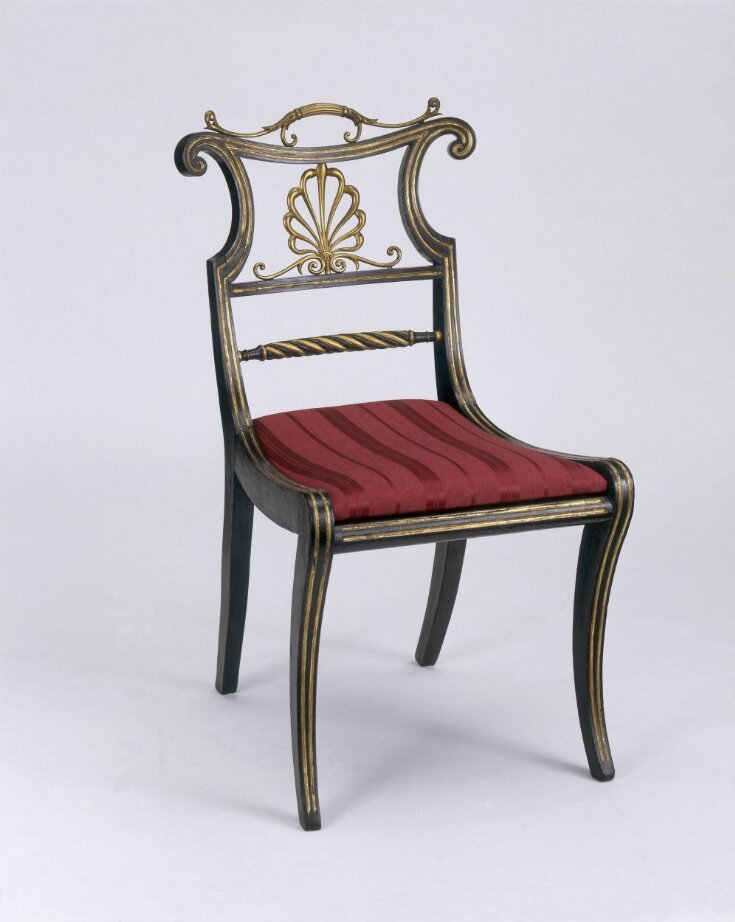
This particular style of chair was fashionable after 1808, when the design was first published in the trade catalogue, 'The London Chair-Makers and Carvers Book of Prices Supplement'. It was described there as the 'Trafalgar'. The essential feature of a 'Trafalgar' chair is the continuous, curving line formed by the sides of the back, the seat rail and the chair legs. It incorporates the fashionable outward curving front leg, used on chairs since 1801 and known as 'Grecian'. This feature was derived from an ancient Greek chair style.
Historical Associations
The firm Morgan and Saunders, who had provided furniture for Lord Nelson, renamed their premises 'Trafalgar House'. They may have given the name to this type of chair, as they made many of the type. Naval references on furniture, such as the rope-twist back rail on this chair, had been popular since Nelson's victory in the Battle of the Nile in 1798.
Design & Designing
The wood is painted black to simulate ebony. The shallow grooves are painted gold to emphasise the sinuous lines of the chair. In the back is a classical 'anthemion' in gilt brass. The 'anthemion', Greek for 'flower', was a motif fashionable in the Greek Revival style of the time.
This particular style of chair was fashionable after 1808, when the design was first published in the trade catalogue, 'The London Chair-Makers and Carvers Book of Prices Supplement'. It was described there as the 'Trafalgar'. The essential feature of a 'Trafalgar' chair is the continuous, curving line formed by the sides of the back, the seat rail and the chair legs. It incorporates the fashionable outward curving front leg, used on chairs since 1801 and known as 'Grecian'. This feature was derived from an ancient Greek chair style.
Historical Associations
The firm Morgan and Saunders, who had provided furniture for Lord Nelson, renamed their premises 'Trafalgar House'. They may have given the name to this type of chair, as they made many of the type. Naval references on furniture, such as the rope-twist back rail on this chair, had been popular since Nelson's victory in the Battle of the Nile in 1798.
Design & Designing
The wood is painted black to simulate ebony. The shallow grooves are painted gold to emphasise the sinuous lines of the chair. In the back is a classical 'anthemion' in gilt brass. The 'anthemion', Greek for 'flower', was a motif fashionable in the Greek Revival style of the time.
Object details
| Categories | |
| Object type | |
| Parts | This object consists of 2 parts.
|
| Title | Trafalgar (popular title) |
| Materials and techniques | |
| Brief description | 'Trafalgar' chair, beech, Regency design, England, ca. 1810 |
| Physical description | 'Trafalgar' style chair, beech, with central anthemion motif in the back and square seat upholstered with red fabric |
| Dimensions |
|
| Gallery label | CHAIR
ENGLISH; about 1810
Japanned and gilded beechwood
One of a set of twelve.
Bequeathed by Lady Glyn.(pre October 2000) |
| Credit line | Bequeathed by Lady Glyn |
| Object history | This lightweight and portable chair was a popular Regency design. Many manufacturers made versions of it. They called it a 'Trafalgar' chair after Nelson's famous victory in 1805. However, the curving shape of the legs and the central anthemion motif in the back were entirely based on those of ancient Greek chairs. |
| Summary | Object type This particular style of chair was fashionable after 1808, when the design was first published in the trade catalogue, 'The London Chair-Makers and Carvers Book of Prices Supplement'. It was described there as the 'Trafalgar'. The essential feature of a 'Trafalgar' chair is the continuous, curving line formed by the sides of the back, the seat rail and the chair legs. It incorporates the fashionable outward curving front leg, used on chairs since 1801 and known as 'Grecian'. This feature was derived from an ancient Greek chair style. Historical Associations The firm Morgan and Saunders, who had provided furniture for Lord Nelson, renamed their premises 'Trafalgar House'. They may have given the name to this type of chair, as they made many of the type. Naval references on furniture, such as the rope-twist back rail on this chair, had been popular since Nelson's victory in the Battle of the Nile in 1798. Design & Designing The wood is painted black to simulate ebony. The shallow grooves are painted gold to emphasise the sinuous lines of the chair. In the back is a classical 'anthemion' in gilt brass. The 'anthemion', Greek for 'flower', was a motif fashionable in the Greek Revival style of the time. |
| Collection | |
| Accession number | W.27:1, 2-1958 |
About this object record
Explore the Collections contains over a million catalogue records, and over half a million images. It is a working database that includes information compiled over the life of the museum. Some of our records may contain offensive and discriminatory language, or reflect outdated ideas, practice and analysis. We are committed to addressing these issues, and to review and update our records accordingly.
You can write to us to suggest improvements to the record.
Suggest feedback
You can write to us to suggest improvements to the record.
Suggest feedback
| Record created | January 24, 2001 |
| Record URL |
Download as: JSONIIIF Manifest
