Armchair
ca. 1760 (made), ca. 1740-ca. 1750 (embroidered)
| Artist/Maker | |
| Place of origin |
Object Type
Many versions of the upholstered drawing-room armchair were made in the mid-18th century. Few chairs were entirely based on contemporary published designs. Mid-18th-century carvers were often skilled designers and very inventive.
Design & Designing
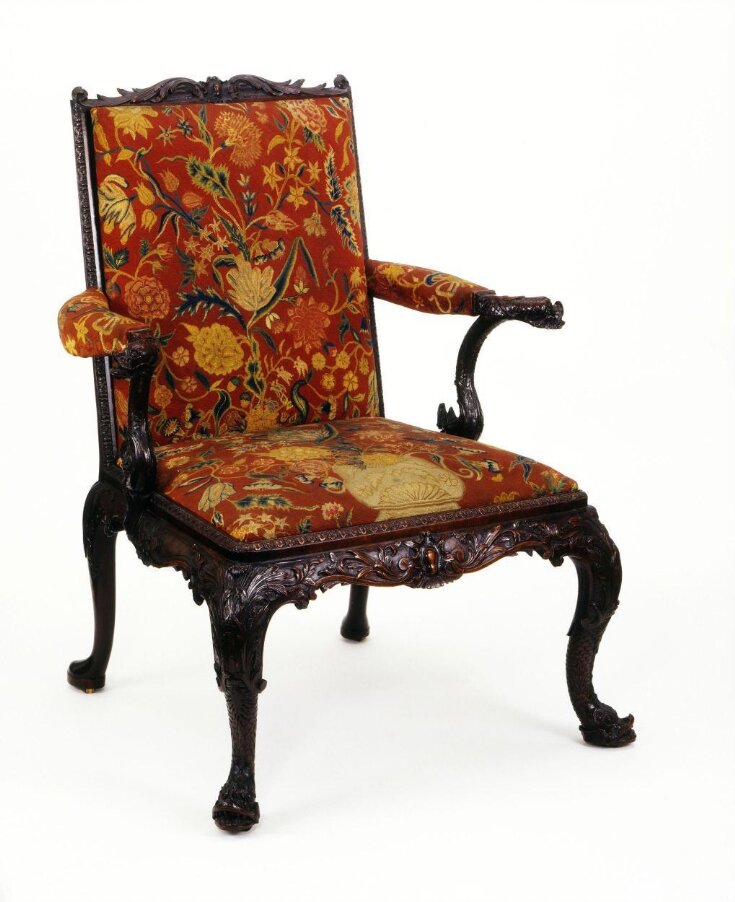
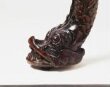
The carver has used dolphin heads as terminals for the feet and the arms. Chippendale's design, which may have inspired the carver, used the whole dolphin - its tail visible at the top of the leg. The scale of the chair and quality of the carving indicate that this chair was part of a special commission for a set of seating furniture for a large drawing room. At least four other chairs and a footstool of the same carved design are known today.
Materials & Making
Thomas Chippendale (1718-1779) recommended tapestry or needlework for drawing-room chairs. The embroidery on this chair probably dates from the 1740s. It may have been cut down from a set of larger wall hangings and has been associated with the chair since the 1920s, when it was advertised by the London furniture dealers Moss Harris in an advertisement in Country Life magazine. The use of crossbanded mahogany on the front seat rail above the carved apron is an additional sign of quality.
Many versions of the upholstered drawing-room armchair were made in the mid-18th century. Few chairs were entirely based on contemporary published designs. Mid-18th-century carvers were often skilled designers and very inventive.
Design & Designing
The carver has used dolphin heads as terminals for the feet and the arms. Chippendale's design, which may have inspired the carver, used the whole dolphin - its tail visible at the top of the leg. The scale of the chair and quality of the carving indicate that this chair was part of a special commission for a set of seating furniture for a large drawing room. At least four other chairs and a footstool of the same carved design are known today.
Materials & Making
Thomas Chippendale (1718-1779) recommended tapestry or needlework for drawing-room chairs. The embroidery on this chair probably dates from the 1740s. It may have been cut down from a set of larger wall hangings and has been associated with the chair since the 1920s, when it was advertised by the London furniture dealers Moss Harris in an advertisement in Country Life magazine. The use of crossbanded mahogany on the front seat rail above the carved apron is an additional sign of quality.
Object details
| Categories | |
| Object type | |
| Parts | This object consists of 2 parts.
|
| Materials and techniques | Carved mahogany; the embroidery re-used on this chair |
| Brief description | Carved mahogany armchair, covered with contemporary tent-stich embroidery. |
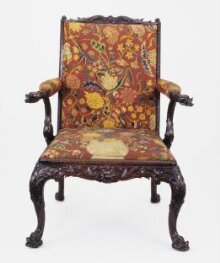
| Physical description | Carved mahogany, the seat covered with contemporary tent-stitch embroidery. The side rails are carved with a moulding of flutes alternating with flowers. The top rail with carved cresting of leaves centering on a Rococo cartouche. Drop-in seat, the seat rails with deep aprons carved in front with foliage and a cartouche en suite with the top rail. The aprons to the side seat rails carved with flat scrolls centering on a formal flower. S shaped arms terminating in dolphin's heads, the supports carved as dolphin's bodies. The front legs carved on the knee with acanthus foliage; the lower part carved as dolphins, the foot forming the dolphin's head. The cabriole rear legs are plainer, ending in club terminals. Both seat and back drop in and are covered with embroidery of silk and wool with natrualistic flowers in colours against a russet ground. |
| Dimensions |
|
| Marks and inscriptions | Marked 'VI' |
| Gallery label | ARMCHAIR
ENGLISH; about 1760
Carved mahogany with contemporary tent-stitch embroidery.
Given by Brigadier W.E. Clark, C.M.G., D.S.O., through the National Art-Collections Fund.(1976) |
| Credit line | Given by Brigadier W. E. Clark CMG, DSO through Art Fund |
| Subjects depicted | |
| Summary | Object Type Many versions of the upholstered drawing-room armchair were made in the mid-18th century. Few chairs were entirely based on contemporary published designs. Mid-18th-century carvers were often skilled designers and very inventive. Design & Designing The carver has used dolphin heads as terminals for the feet and the arms. Chippendale's design, which may have inspired the carver, used the whole dolphin - its tail visible at the top of the leg. The scale of the chair and quality of the carving indicate that this chair was part of a special commission for a set of seating furniture for a large drawing room. At least four other chairs and a footstool of the same carved design are known today. Materials & Making Thomas Chippendale (1718-1779) recommended tapestry or needlework for drawing-room chairs. The embroidery on this chair probably dates from the 1740s. It may have been cut down from a set of larger wall hangings and has been associated with the chair since the 1920s, when it was advertised by the London furniture dealers Moss Harris in an advertisement in Country Life magazine. The use of crossbanded mahogany on the front seat rail above the carved apron is an additional sign of quality. |
| Associated object | W.39-1946 (Ensemble) |
| Bibliographic reference | Illustrated in Apollo, VoL XLI FEBRUARY, 1945, P 39
Macquoid, P and Edwards, R The Dictionary of English Furniture, revised by Edwards, R Volume One, Country Life, 1954, Figures 161 and 162 p 278 (Lady Leverhulme example).
Wood, Lucy The Upholstered Furniture in the Lady Lever Art Gallery, Vol 1 pp 532-541, published Yale, 2008. |
| Collection | |
| Accession number | W.16-1956 |
About this object record
Explore the Collections contains over a million catalogue records, and over half a million images. It is a working database that includes information compiled over the life of the museum. Some of our records may contain offensive and discriminatory language, or reflect outdated ideas, practice and analysis. We are committed to addressing these issues, and to review and update our records accordingly.
You can write to us to suggest improvements to the record.
Suggest feedback
You can write to us to suggest improvements to the record.
Suggest feedback
| Record created | January 24, 2001 |
| Record URL |
Download as: JSONIIIF Manifest
