Drinking Glass
ca. 1677 (made)
| Artist/Maker | |
| Place of origin |
Object Type
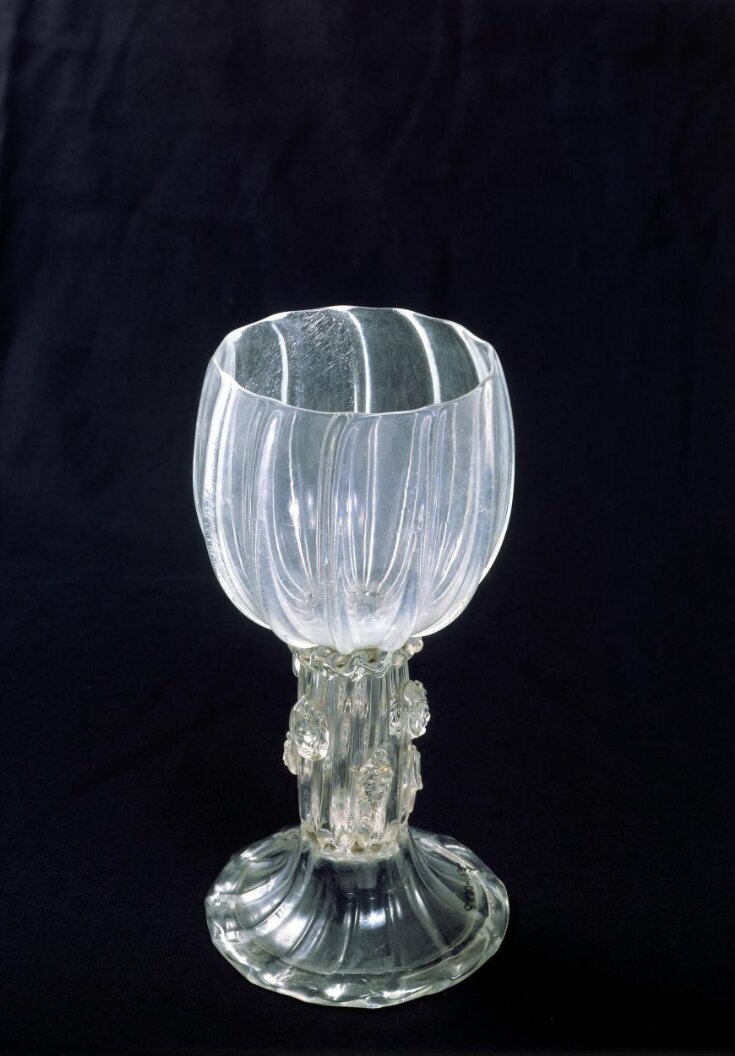
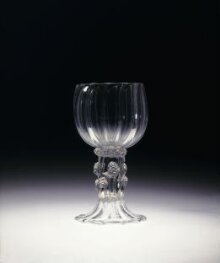
The 'Roemer' was simply an English copy of the traditional German green drinking glass that is still in use today. Perhaps because so little German wine was consumed in England, the special type of glass was always associated with it.
Collecting
Because of their infrequent use, several early lead-glass Roemers have survived. Very similar examples with seals of either a raven's head or a letter 'S' are now both considered Ravenscroft products. Documentary evidence shows that this maker used seals in 1676-7, but more precise dating poses a puzzle for glass historians. We know that in 1676 the Roemers could have been made at either of his two glasshouses: at Henley-on-Thames in Oxfordshire, or at the Savoy glasshouse in London. By 1677 the former was closed, however, so they could only have been made in London.
Trade
Before George Ravenscroft began producing these in the mid-1670s, the small but steady demand for German-type Roemers led to at least one London glass dealer ordering crystal glass versions from a Venetian glasshouse. Even though the clarity of crystal glass was much admired, it is rather surprising that the cheaper German Roemers were not imported. By the end of the 18th century, however, it became customary for English 'Old Hock' glasses (named after a German wine) to be made of green glass like the originals.
The 'Roemer' was simply an English copy of the traditional German green drinking glass that is still in use today. Perhaps because so little German wine was consumed in England, the special type of glass was always associated with it.
Collecting
Because of their infrequent use, several early lead-glass Roemers have survived. Very similar examples with seals of either a raven's head or a letter 'S' are now both considered Ravenscroft products. Documentary evidence shows that this maker used seals in 1676-7, but more precise dating poses a puzzle for glass historians. We know that in 1676 the Roemers could have been made at either of his two glasshouses: at Henley-on-Thames in Oxfordshire, or at the Savoy glasshouse in London. By 1677 the former was closed, however, so they could only have been made in London.
Trade
Before George Ravenscroft began producing these in the mid-1670s, the small but steady demand for German-type Roemers led to at least one London glass dealer ordering crystal glass versions from a Venetian glasshouse. Even though the clarity of crystal glass was much admired, it is rather surprising that the cheaper German Roemers were not imported. By the end of the 18th century, however, it became customary for English 'Old Hock' glasses (named after a German wine) to be made of green glass like the originals.
Object details
| Categories | |
| Object type | |
| Materials and techniques | Lead glass, mould-blown, with ribbing and applied raspberry prunts and raven's head seal |
| Brief description | Roemer, England (London), George Ravenscroft, probably at the Savoy glasshouse, 1677-1677 |
| Physical description | Foot: rib-moulded; Bowl: cup |
| Dimensions |
|
| Style | |
| Marks and inscriptions | raven's head (applied seal) |
| Gallery label |
|
| Credit line | Wilfred Buckley Collection |
| Object history | Made by George Ravenscroft (born in 1632, died in 1683) either at the Savoy glasshouse, London or at Henley-on-Thames, Oxfordshire |
| Summary | Object Type The 'Roemer' was simply an English copy of the traditional German green drinking glass that is still in use today. Perhaps because so little German wine was consumed in England, the special type of glass was always associated with it. Collecting Because of their infrequent use, several early lead-glass Roemers have survived. Very similar examples with seals of either a raven's head or a letter 'S' are now both considered Ravenscroft products. Documentary evidence shows that this maker used seals in 1676-7, but more precise dating poses a puzzle for glass historians. We know that in 1676 the Roemers could have been made at either of his two glasshouses: at Henley-on-Thames in Oxfordshire, or at the Savoy glasshouse in London. By 1677 the former was closed, however, so they could only have been made in London. Trade Before George Ravenscroft began producing these in the mid-1670s, the small but steady demand for German-type Roemers led to at least one London glass dealer ordering crystal glass versions from a Venetian glasshouse. Even though the clarity of crystal glass was much admired, it is rather surprising that the cheaper German Roemers were not imported. By the end of the 18th century, however, it became customary for English 'Old Hock' glasses (named after a German wine) to be made of green glass like the originals. |
| Bibliographic reference | W A Thorpe, English & Irish Glass (1929) pl.XVI; R J Charleston, English Glass (1968) pl.14; John A Brooks, Glass (1973) p.39; Charles Truman, English Glassware to 1900 (1984) pl.7; R J Charleston, English Glass (1984) pl.23d; J M Bickerton, Eighteenth Century English Drinking Glasses (1986) pl.23 Exhibited at BFAC Exh.1930, Age of Walnut 1932. |
| Collection | |
| Accession number | C.530-1936 |
About this object record
Explore the Collections contains over a million catalogue records, and over half a million images. It is a working database that includes information compiled over the life of the museum. Some of our records may contain offensive and discriminatory language, or reflect outdated ideas, practice and analysis. We are committed to addressing these issues, and to review and update our records accordingly.
You can write to us to suggest improvements to the record.
Suggest feedback
You can write to us to suggest improvements to the record.
Suggest feedback
| Record created | December 13, 1997 |
| Record URL |
Download as: JSONIIIF Manifest
