
Tazza
1550-1600 (made)
| Artist/Maker | |
| Place of origin |
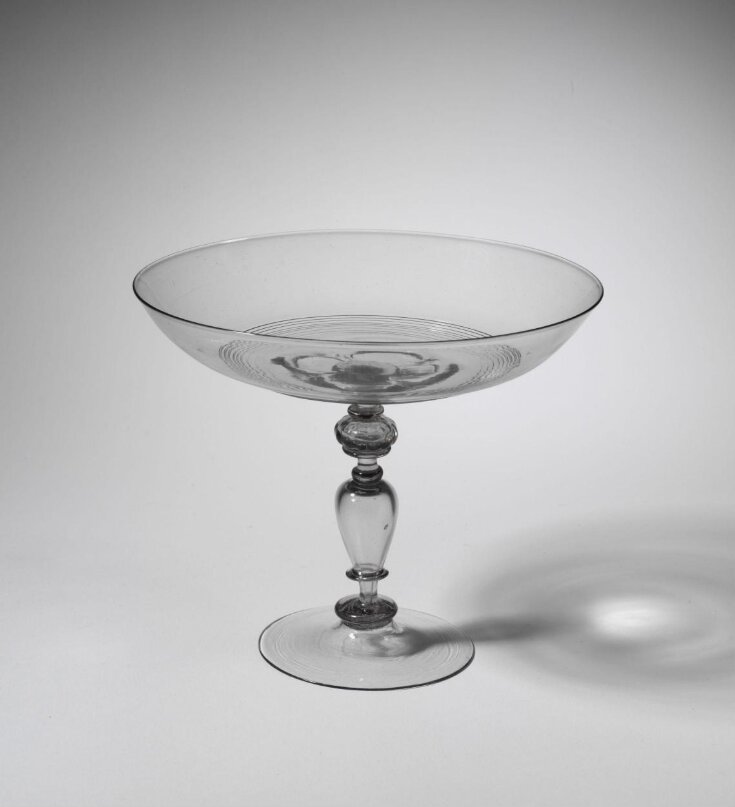
This type of shallow glass on a tall stem is called a tazza. It was primarily intended as a drinking glass for red wine. However, it required practice and the utmost care to drink from such a glass without spilling, and being able to do so was probably a sign of great sophistication. Tazze (plural of tazza) were most likely used for special occasions only, which explains why, despite their obvious fragility, a disproportional high number has survived the perils of time.
Tazze could also be used for serving 'sweetmeats'. These were the different sorts of sugared and spiced fruits, conserves, biscuits and other confectionery that made up the final 'sweet' course of a banquet.
Tazze could also be used for serving 'sweetmeats'. These were the different sorts of sugared and spiced fruits, conserves, biscuits and other confectionery that made up the final 'sweet' course of a banquet.
Object details
| Categories | |
| Object type | |
| Materials and techniques | Blown glass, with applied and tooled decoration |
| Brief description | Glass tazza, Italy (Venice) or possibly Netherlands, 1550-1600 |
| Physical description | Drinking glass with wide, shallow bowl on a high stem. The base of the bowl is decorated with trailed decoration. |
| Dimensions |
|
| Styles | |
| Object history | Formerly Robinson Collection |
| Historical context | This type of shallow glass on a tall stem is called a tazza. It was primarily intended as a drinking glass for red wine. However, it required practice and the utmost care to drink from such a glass without spilling, and being able to do so was probably a sign of great sophistication. Tazze (plural of tazza) were most likely used for special occasions only, which explains why, despite their obvious fragility, a disproportional high number has survived the perils of time. Tazze could also be used for serving 'sweetmeats'. These were the different sorts of sugared and spiced fruits, conserves, biscuits and other confectionery that made up the final 'sweet' course of a banquet. |
| Summary | This type of shallow glass on a tall stem is called a tazza. It was primarily intended as a drinking glass for red wine. However, it required practice and the utmost care to drink from such a glass without spilling, and being able to do so was probably a sign of great sophistication. Tazze (plural of tazza) were most likely used for special occasions only, which explains why, despite their obvious fragility, a disproportional high number has survived the perils of time. Tazze could also be used for serving 'sweetmeats'. These were the different sorts of sugared and spiced fruits, conserves, biscuits and other confectionery that made up the final 'sweet' course of a banquet. |
| Bibliographic references |
|
| Other number | 7836 - Glass gallery number |
| Collection | |
| Accession number | 188-1879 |
About this object record
Explore the Collections contains over a million catalogue records, and over half a million images. It is a working database that includes information compiled over the life of the museum. Some of our records may contain offensive and discriminatory language, or reflect outdated ideas, practice and analysis. We are committed to addressing these issues, and to review and update our records accordingly.
You can write to us to suggest improvements to the record.
Suggest feedback
You can write to us to suggest improvements to the record.
Suggest feedback
| Record created | December 13, 1997 |
| Record URL |
Download as: JSONIIIF Manifest
