
The Dacre Ram
Figure
| Artist/Maker | |
| Place of origin |
Object Type
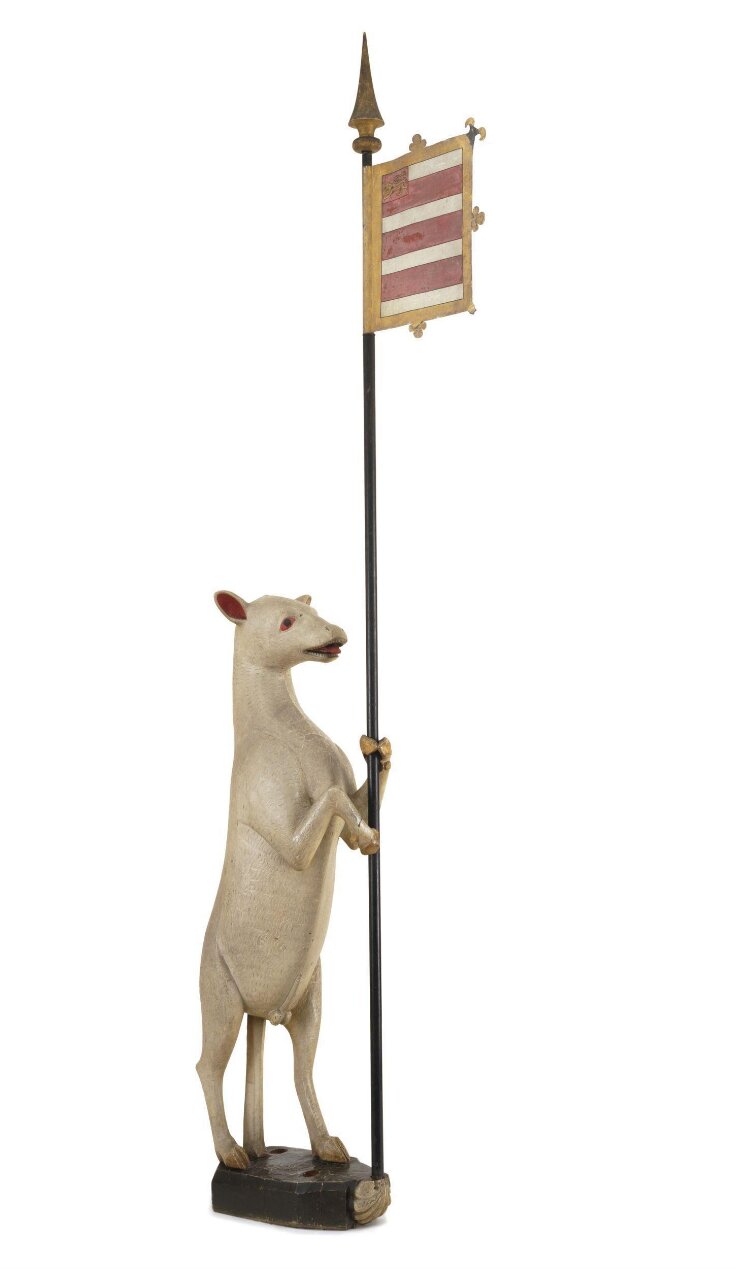
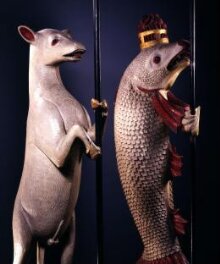
This figure of a white ram, holding a banner, forms part of a group which, together with bull, griffin and dolphin, are known as the Dacre Beasts. The white ram is the supporter of the de Multon (or 'Mouton', French for sheep and hence the ram) coat of arms, which can be seen here on the banner. The Dacre Beasts are rare survivors of a tradition of heraldic ornament. They represent one of the most powerful families in Northern England and are a unique survivors of free standing, large-scale wooden heraldic sculpture from the English Renaissance.
People
A member of the de Multon family married into the Dacre family in 1317, bringing with them considerable land. This strengthened the Dacre's position as one of the most powerful families in northern England during the Middle Ages.
Places
Naworth Castle, Brampton, Cumbria, was a family seat of the Dacre family from 1317 until 1577, when the Castle became the property of Lord William Howard through marriage to Elizabeth Dacre. Dacre Beasts have stood in the Hall at Naworth Castle since the early 16th century.
Materials & Making
The Dacre Beasts were probably made by unnamed local craftsmen from a single, large oak grown on the estate.
This figure of a white ram, holding a banner, forms part of a group which, together with bull, griffin and dolphin, are known as the Dacre Beasts. The white ram is the supporter of the de Multon (or 'Mouton', French for sheep and hence the ram) coat of arms, which can be seen here on the banner. The Dacre Beasts are rare survivors of a tradition of heraldic ornament. They represent one of the most powerful families in Northern England and are a unique survivors of free standing, large-scale wooden heraldic sculpture from the English Renaissance.
People
A member of the de Multon family married into the Dacre family in 1317, bringing with them considerable land. This strengthened the Dacre's position as one of the most powerful families in northern England during the Middle Ages.
Places
Naworth Castle, Brampton, Cumbria, was a family seat of the Dacre family from 1317 until 1577, when the Castle became the property of Lord William Howard through marriage to Elizabeth Dacre. Dacre Beasts have stood in the Hall at Naworth Castle since the early 16th century.
Materials & Making
The Dacre Beasts were probably made by unnamed local craftsmen from a single, large oak grown on the estate.
Object details
| Categories | |
| Object type | |
| Parts | This object consists of 4 parts.
|
| Title | The Dacre Ram (popular title) |
| Materials and techniques | Carved, painted and gilded oak, with tinned copper banner |
| Brief description | Dacre beast -The White Ram |
| Physical description | Carved, painted and gilded figure of a ram, bearing the medieval arms of the De Moulton family. |
| Dimensions |
|
| Production type | Unique |
| Marks and inscriptions | The Ram, supporter of the De Multon family with the arms of De Multon 'argent, three bars gu in chief a lion passant gardant' |
| Gallery label |
|
| Credit line | Accepted in lieu of inheritance tax by H M Government and allocated to the Victoria and Albert Museum; with additional funding from the Friends of the V&A, the National Heritage Memorial Fund, Art Fund, Mr Ralph Brocklebank, and the Old Possum's Practical Trust |
| Object history | Accepted in lieu of inheritance tax by H M Government and allocated to the Victoria and Albert Museum; with additional funding from the Friends of the V&A, the National Heritage Memorial Fund, The Art Fund, Mr Ralph Brocklebank, and the Old Possum's Practical Trust The four Dacre beasts were loaned for display at Tullie House Museum and Art Gallery, Carlisle Nov. 2000 - Jan 2001. The Dacre Beasts were commissioned by Lord Thomas Dacre (1467-1525) in about 1520 and were displayed in the rebuilt hall at Naworth Castle, Cumbria. He was a formidable soldier who fought on the side of Henry Tudor against Richard III at the Battle of Bosworth and with the Earl of Surrey against the French and the Scots at the Battle of Flodden in 1513. Lord Dacre's prowess was epitomized by the battle cry "a read bull, a read bull, a Dacre, a Dacre". In 1488 Lord Dacre eloped with Elizabeth Greystoke (1471-1516), the heiress to the baronies of Greystoke and Fitzwilliam. Through his marriage Lord Dacre acquired Morpeth Castle and the manor of Henderskelfe, later rebuilt as Castle Howard. In 1577 Lord William Howard, son of the Duke of Norfolk, married Elizabeth Dacre and the Dacre properties have descended in the Howard family. The barony of Gilsland was acquired through Ranulph de Dacre's marriage to Margaret de Multon in 1317. The white ram is the supporter of the de Multon family (or Mouton-French for sheep-hence the ram) coat of arms. Ranulph de Dacre received a licence to crenellate Naworth in 1335. The beasts thus demonstrate the antiquity of the Dacres-one of the most powerful Northern families-and the importance of two dynastic marriages. They were probably made by local craftsmen from oak grown on the estate, although the names of the carvers and painters have not been recorded. Their design is derived from contemporary grants of arms to the Dacre, de Multon and Greystoke families. Dendrochronological analysis recently demonstrated that the single trunk of oak from which all four beasts were carved was felled between 1499 and 1549. Testing of the polychrome decoration has revealed at least three successive paintings on the Bull, the Ram and the Dolphin. Samples from the earliest decoration contain pigments available in the first quarter of the 16th century and are likely to form part of the original decoration. The Dacre Beasts have remained in the hall at Naworth since the early 16th century. The present decoration dates from the 1840s and was executed after the fire at Naworth of 1844. The staves and coats of arms held by the beasts also date from the mid-19th century. The present appearance of the Dacre Beasts reflects mid-19th century interest in antiquarian interest. They were rescued from a major fire at Naworth in 1844, and restored in 1849 under the careful supervision of the Victorian architect Anthony Salvin (1799-1881) who wanted the new work to marry as closely as possible with the old. Repainting of the Dacre Beasts was done by a Mr Wilkinson. Historical significance: The Dacre heraldic beasts are unique national survivors of free standing large-scale wooden heraldic sculpture from the English Renaissance. Although there is both written and pictorial evidence for contemporary Royal Beasts, the Dacre Beasts are apparently the only recorded surviving heraldic beasts representing a noble family. They are also of considerable regional interest as they represent one of the most powerful families in Northern England. These heraldic sculptures demonstrate the primitive nature of British art in the early 16th century before the impact of the Italian Renaissance later in the reign of Henry VIII. |
| Production | Probably made 1507-1525; the banners added about 1844. There is a suggestion the beasts might have come from Kirkoswald, Cumbria. Reason For Production: Commission |
| Summary | Object Type This figure of a white ram, holding a banner, forms part of a group which, together with bull, griffin and dolphin, are known as the Dacre Beasts. The white ram is the supporter of the de Multon (or 'Mouton', French for sheep and hence the ram) coat of arms, which can be seen here on the banner. The Dacre Beasts are rare survivors of a tradition of heraldic ornament. They represent one of the most powerful families in Northern England and are a unique survivors of free standing, large-scale wooden heraldic sculpture from the English Renaissance. People A member of the de Multon family married into the Dacre family in 1317, bringing with them considerable land. This strengthened the Dacre's position as one of the most powerful families in northern England during the Middle Ages. Places Naworth Castle, Brampton, Cumbria, was a family seat of the Dacre family from 1317 until 1577, when the Castle became the property of Lord William Howard through marriage to Elizabeth Dacre. Dacre Beasts have stood in the Hall at Naworth Castle since the early 16th century. Materials & Making The Dacre Beasts were probably made by unnamed local craftsmen from a single, large oak grown on the estate. |
| Associated objects |
|
| Bibliographic references |
|
| Collection | |
| Accession number | W.8:1 to 4-2000 |
About this object record
Explore the Collections contains over a million catalogue records, and over half a million images. It is a working database that includes information compiled over the life of the museum. Some of our records may contain offensive and discriminatory language, or reflect outdated ideas, practice and analysis. We are committed to addressing these issues, and to review and update our records accordingly.
You can write to us to suggest improvements to the record.
Suggest feedback
You can write to us to suggest improvements to the record.
Suggest feedback
| Record created | November 7, 2000 |
| Record URL |
Download as: JSONIIIF Manifest
