Standing Buddha
Statue
late 18th century - early 19th century (made)
late 18th century - early 19th century (made)
| Place of origin |
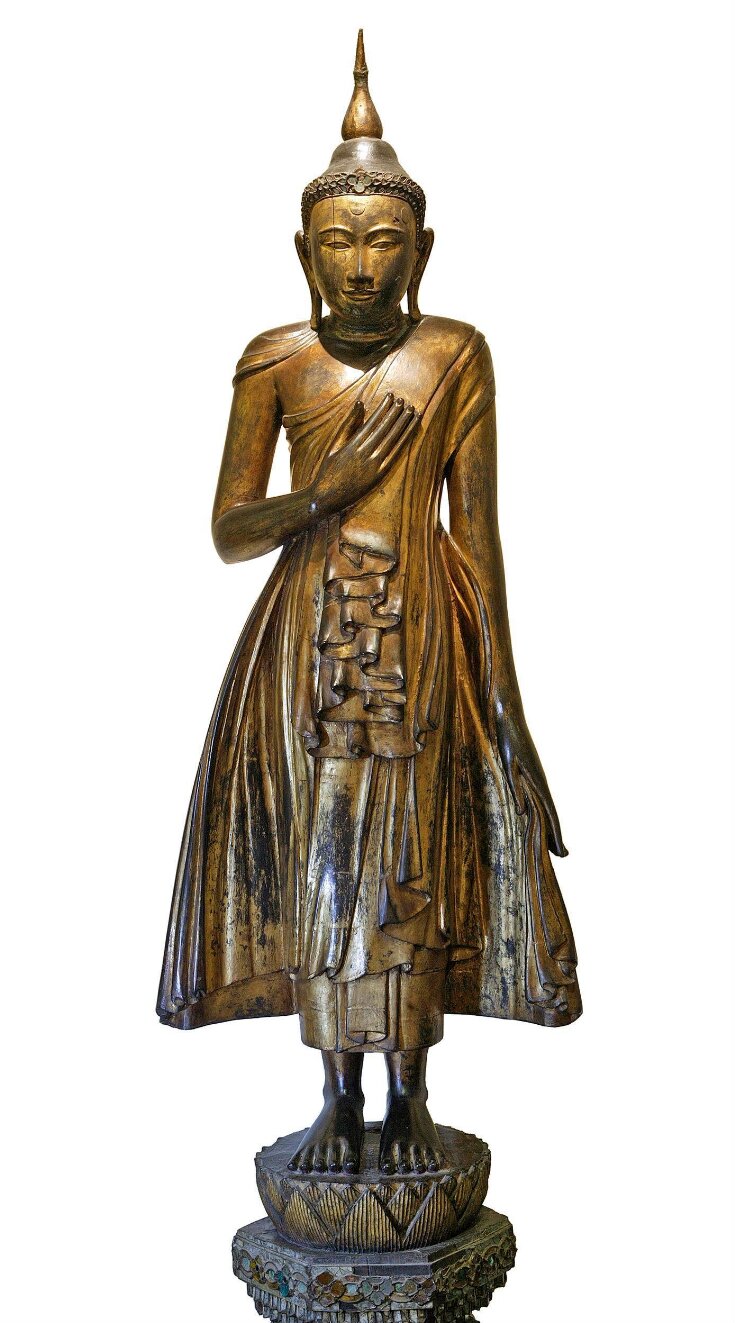
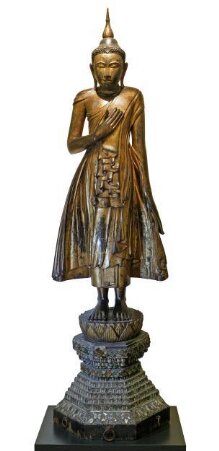
This image depicts the standing Buddha dressed in the robes of a Burmese monk - open mode of bare right shoulder with a partial covering by the third garment falling in cascades down the front and ending in voluminous folds which his hand holds open on his left side. His right hand is placed across his chest. His hair, the sparkling fillet and ushnisha resemble a close fitting cap finishing in a bulbous finial. He stands on an open lotus bud which is in turn supported by an elaborate sparkling waisted octagonal base.
Object details
| Categories | |
| Object type | |
| Title | Standing Buddha (generic title) |
| Materials and techniques | Carved in teak, overlaid with black thitsi-lacquer (Melanorrhoea usitat) and gilt. Partly decorated in the relief moulded thayo and glass inlay <i>hman-zi shwei-cha</i> technique. |
| Brief description | Standing figure of the buddha. Burmese teak lacquered and gilded Buddha. Konbaung Dynasty (1752-1885). Depicted standing in monk's robes on an elaborate base partly decorated with mirror work, late 18th/early 19th century. |
| Physical description | This image depicts the standing Buddha dressed in the robes of a Burmese monk - open mode of bare right shoulder with a partial covering by the third garment falling in cascades down the front and ending in voluminous folds which his hand holds open on his left side. His right hand is placed across his chest. His hair, the sparkling fillet and ushnisha resemble a close fitting cap finishing in a bulbous finial. He stands on an open lotus bud which is in turn supported by an elaborate sparkling waisted octagonal base. |
| Dimensions |
|
| Style | |
| Gallery label |
|
| Credit line | Given by Mrs Charles H. Murray |
| Object history | Made at Moulmein (Maulmain), Lower Burma, during the eighteenth century. Given by Mrs Charles H. Murray, Partney Rectory, Spilsby, Lincolnshire. This acquisition information reflects that found in the Museum records (Asia Department registers and/or Central Inventory) as part of a 2023 provenance research project. RP 1912- 707M |
| Production | This sculpture was reportedly obtained from the Moulmein Pagoda in Amherst, between 1840-1845 by a captain in the sevice of the East India Company. This may have in fact been the Kyaikthanlan Pagoda at Moulmein which R. Kipling famously described as the Moulmein Pagoda. |
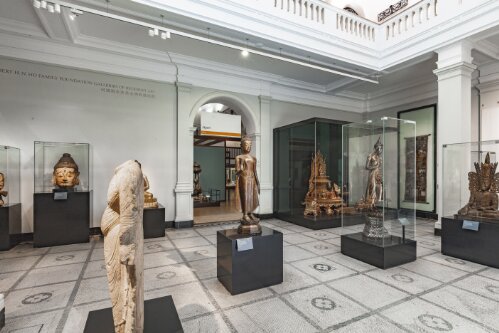
| Bibliographic reference | Clarke, John: Arts of Asia, vol. 45, no. 5, September - October 2015, "The Buddha image in Asia: Phase One of the Robert H. N. Ho Family Foundation Galleries of Buddhist Art", p.119, pl. 11. |
| Collection | |
| Accession number | IM.19-1912 |
About this object record
Explore the Collections contains over a million catalogue records, and over half a million images. It is a working database that includes information compiled over the life of the museum. Some of our records may contain offensive and discriminatory language, or reflect outdated ideas, practice and analysis. We are committed to addressing these issues, and to review and update our records accordingly.
You can write to us to suggest improvements to the record.
Suggest feedback
You can write to us to suggest improvements to the record.
Suggest feedback
| Record created | November 6, 2000 |
| Record URL |
Download as: JSONIIIF Manifest
